Skip to content / Đến nội dung
ThichHocToan.com

IKMC 2024 - Grades 9-10 - Set 2 - Self-study

Question 1

Calculate $\frac{2\times0.24}{20\times2.4}$.
  1. 0.01
  2. 0.1
  3. 1
  4. 10
  5. 100

Question 2

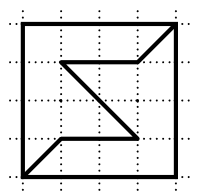
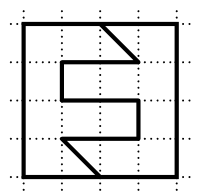
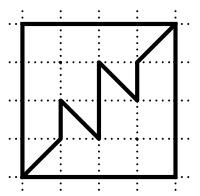
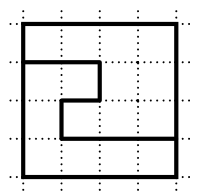
Which square is split into two parts that do not have the same shape?
  1. Question illustration
  2. Question illustration
  3. Question illustration
  4. Question illustration
  5. Question illustration

Question 3

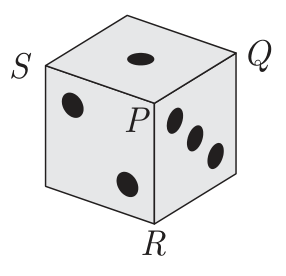
Opposite faces of a die sum to 7. A vertex sum is the sum of the three faces meeting there; P has sum 1+2+3=6. What is the largest vertex sum at Q, R and S?

Question illustration
  1. 7
  2. 9
  3. 10
  4. 11
  5. 15

Question 4

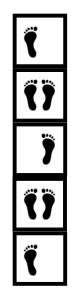
Maya jumps into 48 squares, starting with her left foot, then both feet, right foot, both feet, and repeating. How many times does her left foot touch the floor?

Question illustration
  1. 12
  2. 24
  3. 36
  4. 40
  5. 48

Question 5

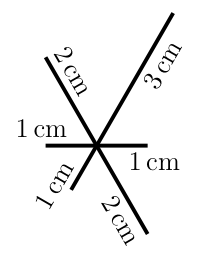
Tim draws every segment of the figure without lifting his pencil, possibly retracing segments. Segment lengths are shown. He may start anywhere. What is the minimum total drawn length?

Question illustration
  1. 14 cm
  2. 15 cm
  3. 16 cm
  4. 17 cm
  5. 18 cm

Question 6

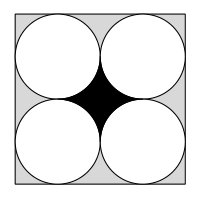
Four equal touching circles lie in a square as shown. What is the ratio of the black area to the grey area?

Question illustration
  1. 1:4
  2. 1:3
  3. 2:3
  4. 3:4
  5. $\pi:1$

Question 7

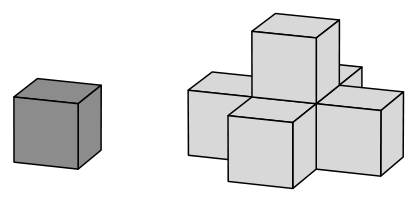
John places a dark cube on a table, then covers its five exposed faces with five light cubes. What is the fewest additional dark cubes needed to cover every exposed light face?

Question illustration
  1. 8
  2. 9
  3. 10
  4. 13
  5. 19

Question 8

A palindrome reads the same forwards and backwards, for example 121 or 444. What is the digit sum of the largest three-digit palindrome divisible by 6?
  1. 16
  2. 18
  3. 20
  4. 21
  5. 24

Question 9

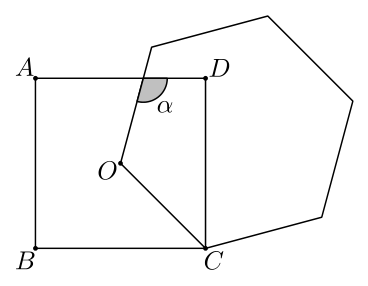
ABCD is a square with centre O. A regular hexagon has OC as one side, as shown. Find angle α.

Question illustration
  1. 105°
  2. 110°
  3. 115°
  4. 120°
  5. 125°

Question 10

A rectangle has perimeter 40 m and prime-number side lengths in metres. What is its largest possible area?
  1. 99 m²
  2. 96 m²
  3. 91 m²
  4. 84 m²
  5. 51 m²

Question 11

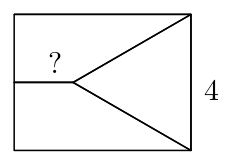
A rectangle is split into three equal-area pieces: an equilateral triangle of side 4 cm and two trapezoids, as shown. Find the shorter parallel side of a trapezoid.

Question illustration
  1. $\sqrt2$ cm
  2. $\sqrt3$ cm
  3. $2\sqrt2$ cm
  4. 3 cm
  5. $2\sqrt3$ cm

Question 12

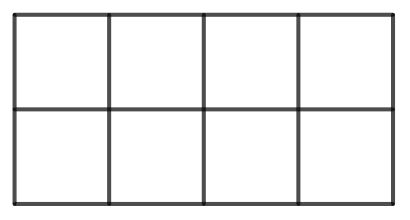
Fill the 2 × 4 table with A, B, C, D so that each letter occurs exactly once in each row and in each of the three 2 × 2 squares. How many fillings are possible?

Question illustration
  1. 12
  2. 24
  3. 48
  4. 96
  5. 198

Question 13

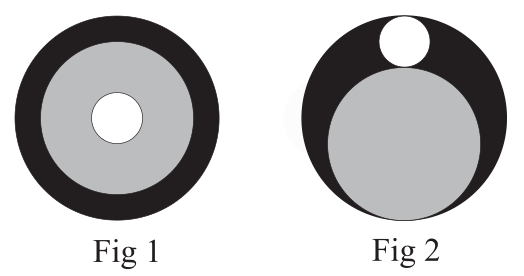
Three coloured disks overlap as in Figure 1, then touch pairwise as in Figure 2. In Figure 1 the visible black area is seven times the white disk’s area. What is the ratio of visible black areas in Figures 1 and 2?

Question illustration
  1. 3:1
  2. 4:3
  3. 6:5
  4. 7:6
  5. 9:7

Question 14

Mary’s granddaughter is born today. In two years the ages of Mary, her daughter and her granddaughter will all be even and their product will be 2024. How old is Mary today?
  1. 42
  2. 44
  3. 46
  4. 48
  5. 50

Question 15

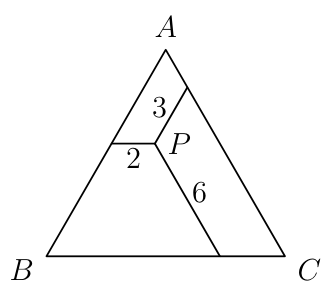
P is inside equilateral triangle ABC. The three indicated segments through P, parallel to its sides, have lengths 2 m, 3 m and 6 m. What is the perimeter of ABC?

Question illustration
  1. 22 m
  2. 26 m
  3. 33 m
  4. 39 m
  5. 44 m

Question 16

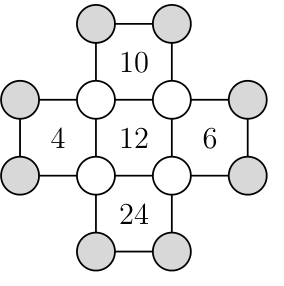
Each circle contains a number. Each square shows the product at its four vertices. Find the product in the eight grey circles.

Question illustration
  1. 20
  2. 40
  3. 80
  4. 120
  5. 480

Question 17

Four bowls contain sweets. Their counts, in order, equal the number of bowls containing respectively 1, 2, 3 and 0 sweets. How many sweets are there in total?
  1. 2
  2. 3
  3. 4
  4. 5
  5. 6

Question 18

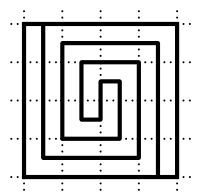
An n×n×n cube with n>2 is built from unit cubes and painted on its surface. The number of small cubes with exactly one painted face equals the number with no painted faces. Find n.
  1. 4
  2. 6
  3. 7
  4. 8
  5. 10

Question 19

Cristina places eight of the cards numbered 1 to 12 in a circle so every adjacent pair has sum divisible by 3. Which four cards does she leave out?
  1. 1, 5, 9, 12
  2. 3, 5, 7, 9
  3. 1, 2, 11, 12
  4. 5, 6, 7, 8
  5. 3, 6, 9, 12

Question 20

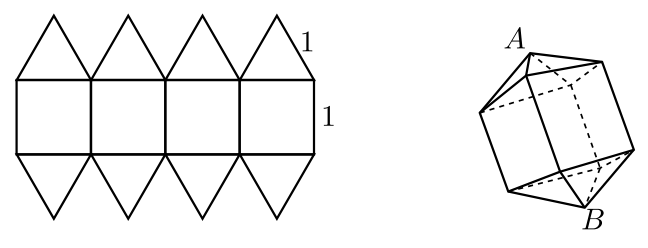
The illustrated net consists of unit squares and equilateral triangles of side 1. After folding into the shown solid, what is the distance AB?

Question illustration
  1. $\sqrt{5}$ cm
  2. $(1+\sqrt{2})$ cm
  3. $5/2$ cm
  4. $(1+\sqrt{3})$ cm
  5. $2\sqrt{2}$ cm