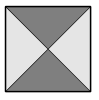
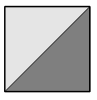
Arno spelled the word KANGAROO with cards showing one letter at a time. Unfortunately some cards were tipped. Tipping back twice he can correct the letter K and tipping once he can correct the A—see the figures. How many times does he need to tilt for all of the letters to be correct?
Source note: the compilation’s physical page 48 is blank; this question and its original artwork are recovered from page 1 of the matching official 2014 Benjamin paper, also supplied again by the user.
A cake weights 900 g. Paul cuts it in 4 pieces. The biggest piece is as heavy as the 3 others weight altogether. What’s the weight of the biggest piece?
Source note: the compilation’s physical page 48 is blank; this question and its original artwork are recovered from page 1 of the matching official 2014 Benjamin paper, also supplied again by the user.
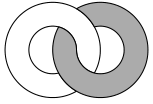
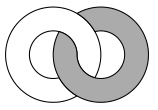
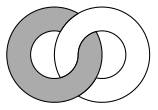
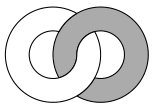
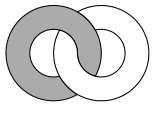
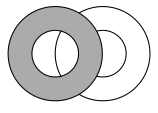
Two great rings, one grey, one white, are linked in each other. Peter, in front of the rings, sees the rings as in the picture. Paul is behind the rings. What does he see?
Source note: the compilation’s physical page 48 is blank; this question and its original artwork are recovered from page 1 of the matching official 2014 Benjamin paper, also supplied again by the user.
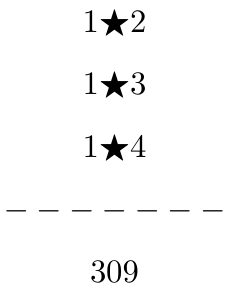
In the following addition, some of the digits have been replaced by stars. What is the sum of the missing digits?
Source note: the compilation’s physical page 48 is blank; this question and its original artwork are recovered from page 1 of the matching official 2014 Benjamin paper, also supplied again by the user.
What is the difference between the smallest 5-digit number and the largest 4-digit number?
Source note: the compilation’s physical page 48 is blank; this question and its original artwork are recovered from page 1 of the matching official 2014 Benjamin paper, also supplied again by the user.
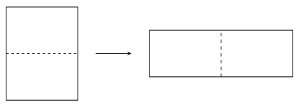
A square of perimeter 48 cm is cut into 2 pieces to make a rectangle (see picture). What is the perimeter of the rectangle?
Source note: the compilation’s physical page 48 is blank; this question and its original artwork are recovered from page 1 of the matching official 2014 Benjamin paper, also supplied again by the user.
Katrin has 38 matches. She builds a triangle and a square, using all the matches. Each side of the triangle consists of 6 matches. How many matches are in each side of the square?
The pearl necklace in the picture contains dark grey pearls and shiny white pearls. Arno wants to have 5 of the dark grey pearls. He can only take pearls from either end of the necklace, and so he has to take some of the white pearls also. What is the smallest number of white pearls Arno has to take?
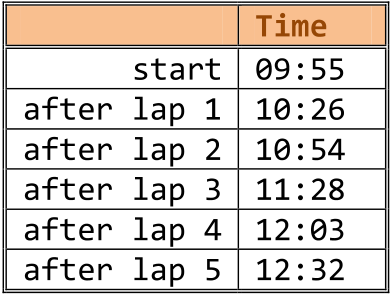
Harry participated in a broom flight contest which consisted of 5 laps. The times when Harry passed the starting point are shown in the picture. Which lap took the shortest time?
Ben’s digital watch is not working properly. The three horizontal lines in the rightmost digit on the watch are not displayed. Ben is looking at his watch and the time has just changed from the one shown on the left to the one shown on the right. What time is it now?
Henry and John started walking from the same point. Henry went 1 km north, 2 km west, 4 km south and finally 1 km west. John went 1 km east, 4 km south and 4 km west. Which of the following must be the final part of his walk in order to reach the same point as Henry?
At the summer camp, 7 pupils eat ice cream every day, 9 pupils eat ice cream every second day and the rest of the pupils don’t eat ice cream at all. Yesterday, 13 pupils had ice cream. How many pupils will eat ice cream today?
Kangaroos A, B, C, D and E are sitting in that order, clockwise, around a circular table. Exactly when the bell rings, each kangaroo but one exchanges its position with a neighbour. The resulting positions, clockwise and starting with A, are A, E, B, D, C. Which kangaroo did not move?
In a restaurant there are 16 tables, each having either 3, 4 or 6 chairs. Together, the tables having 3 or 4 chairs can accommodate 36 people. Knowing that the restaurant can accommodate 72 people, how many tables are there with 3 chairs?
Parisa set her stones in groups on the desk. After she arranged the stones in groups of 3, she found that there were 2 stones left. Then she arranged the stones in groups of 5, and again there were 2 stones left. At least how many more stones does she need so that there won’t be any left when she arranges them in groups of 3 and in groups of 5?
The faces of a cube are numbered 1, 2, 3, 4, 5, and 6. The faces 1 and 6 have a common edge. The same is true for faces 1 and 5, faces 1 and 2, faces 6 and 5, faces 6 and 4, and faces 6 and 2. Which number is on the face opposite the one with number 4?