Skip to content / Đến nội dung
ThichHocToan.com

PIMSO 2025 - Science - Primary 3 - National Round

Question 1

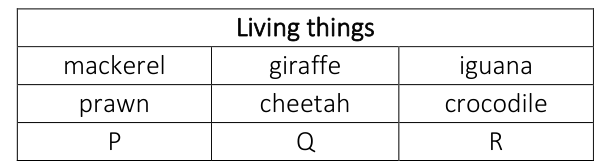
Study the classification table of animals below. Living things: P contains mackerel and prawn; Q contains giraffe and cheetah; R contains iguana and crocodile. What could P, Q, and R be?

Question illustration
  1. P: shark; Q: greyhound; R: ostrich
  2. P: lion; Q: crayfish; R: snake
  3. P: eel; Q: tiger; R: alligator
  4. P: elephant; Q: salmon; R: python

Question 2

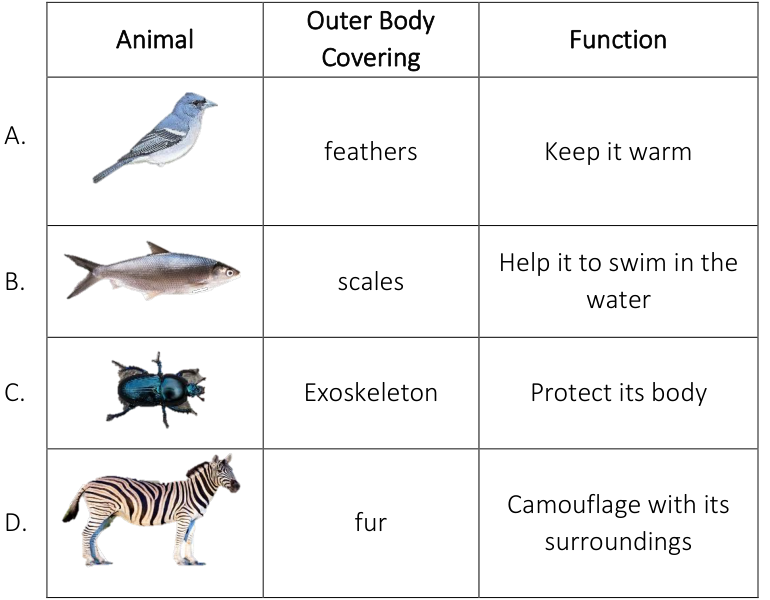
Which of the functions of the outer coverings is not correctly stated?

Question illustration
Editorial scope: compare the principal protective or movement functions taught at elementary level.
  1. Bird: feathers — keep it warm
  2. Fish: scales — help it to swim in the water
  3. Beetle: exoskeleton — protect its body
  4. Zebra: fur — camouflage with its surroundings

Question 3

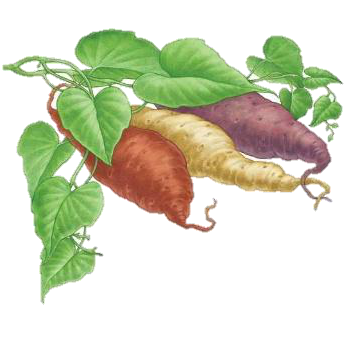
How are the roots of a yam useful to the plant? I. The roots give color to the plant. II. The roots help to store food. III. The roots transport water and minerals to the leaves. IV. The roots absorb water and minerals.

Question illustration

Original choices:
A. I and II only
B. II and IV only
C. I and III only
D. I, II, III and IV
Explain the scientific ambiguity; this item is manually reviewed.

Question 4

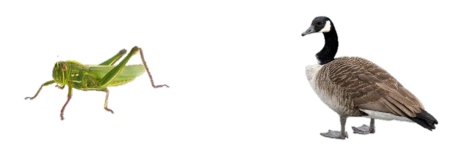
What does a grasshopper and a goose have in common?

Question illustration
  1. Both of them have two legs.
  2. Both of them are covered with feathers.
  3. Both of them feed only on plants.
  4. Both of them lay eggs.

Question 5

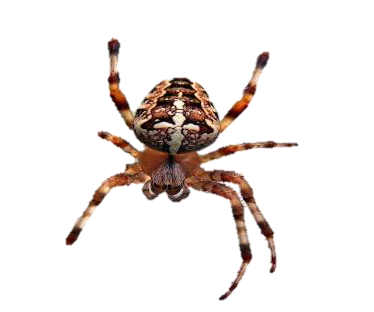
Why is the spider not classified as an insect? I. It is poisonous. II. It has two body parts. III. It feeds on insects. IV. It does not have six legs.

Question illustration
  1. I and III only
  2. II and IV only
  3. I, II, IV only
  4. II, III, IV only

Question 6

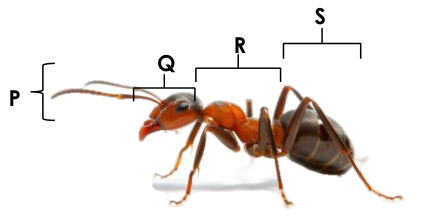
The figure shows the different parts of an insect. Which of the following properly name the labeled parts?

Question illustration
  1. P abdomen; Q head; R thorax; S antennae
  2. P head; Q antennae; R abdomen; S thorax
  3. P antennae; Q head; R thorax; S abdomen
  4. P antennae; Q thorax; R abdomen; S head

Question 7

Which of the following groups includes microorganisms?

Original choices:
A. Lichen and algae
B. Bacteria and algae
C. Yeast and mushroom
D. Bacteria and yeast
Explain the scientific ambiguity; this item is manually reviewed.

Question 8

In what way are liquids different from gasses?
  1. Liquids have no definite shape unlike gases.
  2. Liquids have definite volume unlike gases.
  3. Liquids have no definite volume unlike gases
  4. Liquids have no definite shape and volume unlike gases.

Question 9

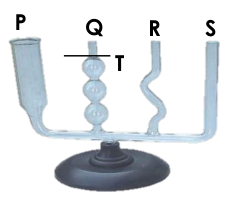
Noel poured some liquid into a communicating vessel through the mouth at P as shown below. If Noel had poured the liquid until it reached the level marked T, what would he observe about the liquid levels in the other mouths P, Q, R and S?

Question illustration
  1. The liquid levels in P and Q are higher than in R and S.
  2. The liquid levels in Q, R, and S are higher than in P.
  3. The liquid levels in P, Q, R, and S are all the same.
  4. The liquid level in S is the highest.

Question 10

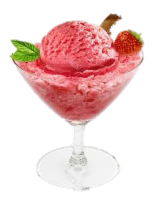
The ice cream below is left on top of a desk for few minutes. Which of the following statements is correct?

Question illustration
  1. The ice cream gains heat from the glass and eventually melt.
  2. The glass gains heat from the ice cream causing the ice cream to melt.
  3. The ice cream loses heat to the surrounding air and eventually melt.
  4. The glass loses heat to the surrounding air and causes the ice cream to melt.

Question 11

Refer to the table below. Melting points: P 12 °C; Q −10 °C; R 37 °C; S 6 °C. At 8 °C, which of the substances listed in the table would have changed from its solid state into a liquid?
  1. P and Q only
  2. Q and R only
  3. Q and S only
  4. P, R and S only

Question 12

When a material made of iron is left exposed in open air, it becomes rusted. Which of the following is/are responsible for rusting of the material? I. Oxygen gas present in air. II. Carbon dioxide gas present in air. III. Moisture present in air.
  1. I and II only
  2. I and III only
  3. II and III only
  4. I, II, and III

Question 13

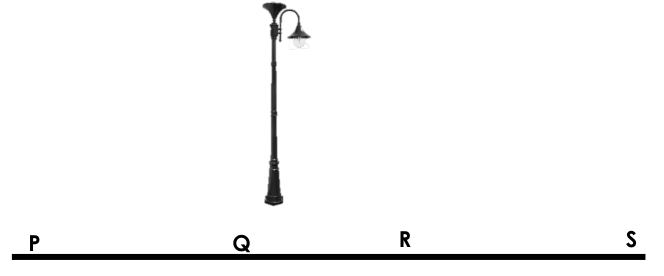
Miguel walks from points S to P. Which one of the following shows the correct order of the length of Miguel’s shadow from shortest to longest as he walks from point S to point P?

Question illustration
  1. P-Q-R-S
  2. R-Q-P-S
  3. Q-R-P-S
  4. Q-R-S-P

Question 14

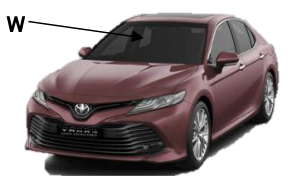
The windshield of the car labeled W as shown below is made up of glass. Why do you think is/are the reasons? I. It blocks out sunlight. II. It easily breaks. III. It is waterproof. IV. It is transparent.

Question illustration
  1. I and II only
  2. II and III only
  3. III and IV only
  4. I, II, III, IV

Question 15

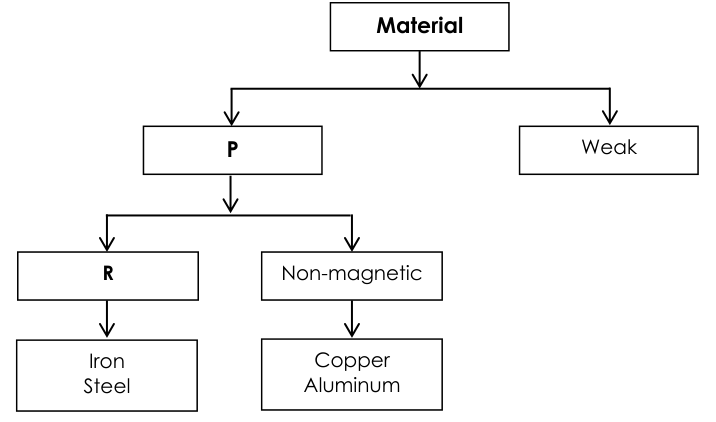
The chart below shows some materials classified according to certain characteristics. Which of the following descriptions clearly represents P and R?

Question illustration
  1. P Flexible; R Strong
  2. P Not flexible; R Magnetic
  3. P Strong; R Flexible
  4. P Strong; R Magnetic

Question 16

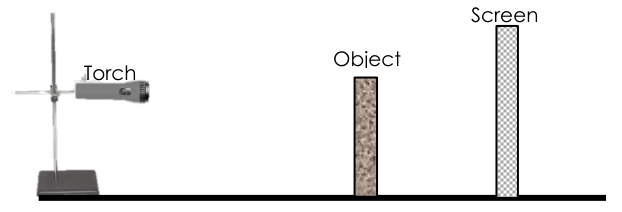
Darwin conducted an experiment to find out how the size of the shadow is affected by the distance between the object and the screen. The diagram below shows the set-up of the experiment. How should the experiment be carried out in order to collect data?

Question illustration
  1. To use glass for the screen.
  2. To move the screen away from the object
  3. To move the light source nearer to the object
  4. To exchange the positions of the screen and the object

Question 17

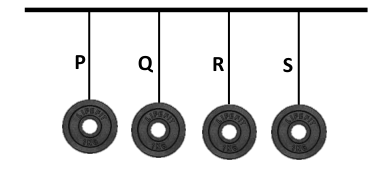
Celso carried out an experiment to test the strength of four materials for making fishing lines. He added weights of 2kg to the strings made of four different materials until it broke. Number of weights added until the string breaks: P 4; Q 5; R 7; S 6. To catch a fish of more than 12 kg, which string should Celso use?

Question illustration
Editorial scope: select the strongest tested line, not a guarantee for every possible fish mass.
  1. String P
  2. String Q
  3. String R
  4. String S

Question 18

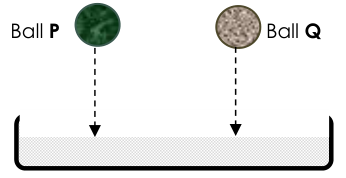
Ariel dropped two balls, P and Q, of the same size but of different mass into a tray of dough from the same height as shown below. He recorded the depth of the dent made by each ball in the tray of flour in the table below. P: 2, 2.1, 2.2 cm; average 2.1 cm. Q: 3.4, 3.6, 3.2 cm; average 3.4 cm. Based on the results in the table above, which one of the following statements correctly explains her observations?

Question illustration
  1. More frictional force was acting on P than on Q.
  2. More frictional force was action on Q than on P.
  3. More amount of gravitational force was acting on P than on Q.
  4. More amount of gravitational force was acting on Q than on P.

Question 19

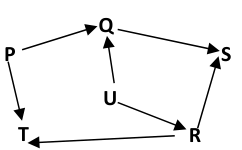
The diagram below shows a food web. Which of the following is correctly represented by P, Q, R, S, T and U in the food web?

Question illustration
  1. Plant P; plant eater only Q; animal eater only S; plant and animal eater T, R
  2. Plant P; plant eater only Q, R; animal eater only S; plant and animal eater T
  3. Plant U; plant eater only T; animal eater only B; plant and animal eater R, S, T
  4. Plant U; plant eater only S; animal eater only T; plant and animal eater S

Question 20

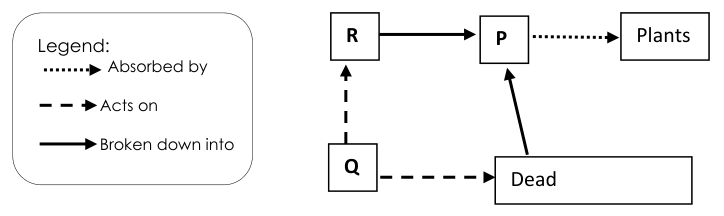
The diagram below shows how decomposers act on dead matter and change them into simple substances. Which one of the following best represents P, Q and R respectively?
Question illustration
  1. carbon dioxide; predators; nutrients
  2. water; fungi; nutrients
  3. mineral salts; bacteria; animal waste
  4. mineral salts; water; animal waste