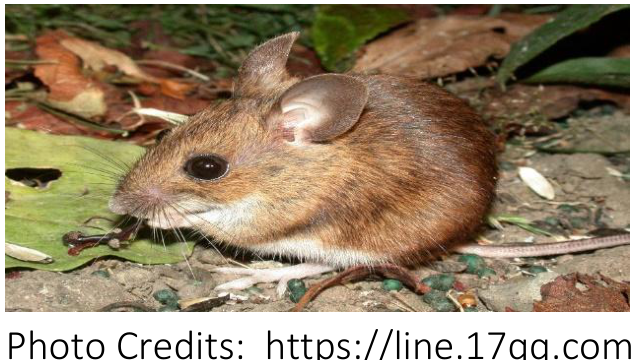
PIMSO 2025 - Science - Secondary 1 - National Round Next → A mouse’s habitat is a grassland containing rocks, soil, and grass. The mouse lives in a burrow underground. Based on this information, which statement best describes how the mouse interacts with its environment?
The mouse uses soil for food and shelter.
The mouse gets energy from its predators.
The mouse changes its environment to create food.
The mouse gets energy and shelter from its environment.
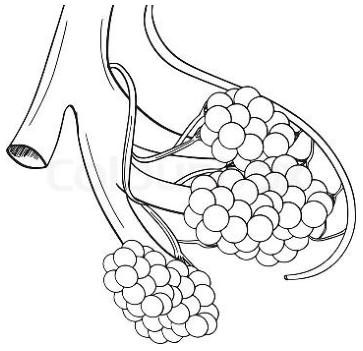
What is the role of alveoli in the transport of gases in the body?
They serve as the linkage from the respiratory system and the circulatory system.
They serve as the carrier of the deoxygenated blood.
They serve as the carrier of the oxygenated blood.
They serve as the linkage from the respiratory system and the digestive system.
When a plant cell is placed in a hypotonic solution, __________.
the cell membrane shrinks.
the cytoplasm shrinks.
the vacuole expands.
the cell wall breaks.
How do biodiversity and stability work together?
Biodiversity has nothing to do with ecosystem stability.
The higher the biodiversity, the greater the stability of the ecosystem.
The higher the biodiversity, the less stable the ecosystem
The lower the biodiversity the greater the stability of an ecosystem.
Organisms that reproduce sexually exhibit zygotic, gametic, or sporic meiosis. One way to determine the type of life cycle an organism has is by_____
observing embryonic development.
comparing the diploid and haploid forms of the organism.
determining when in the life cycle fertilization occurs.
determining if gametes are multicellular or unicellular.
Which of the following accurately describes the relationship between a dominant and a recessive allele?
The dominant allele physically alters the recessive allele so that it cannot be expressed.
The dominant allele blends with the recessive allele to produce an in between trait.
The dominant allele is expressed however, the recessive allele is unaltered.
The dominant allele is more common in the species population than the recessive.
What do you call an atom that has more protons than electrons?
A cation
A molecule
An anion
An isotope
A drop of food coloring spreading out in a cup of water is an example of which transport process?
Diffusion
Effusion
Osmosis
Vapor Pressure
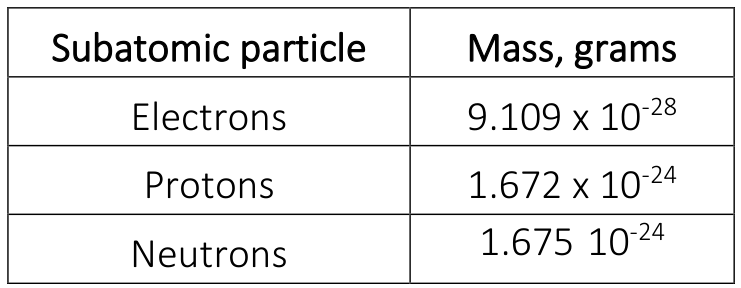
Which subatomic particle is the lightest?
Source table (mass in grams): electron $9.109\times10^{-28}$; proton $1.672\times10^{-24}$; neutron $1.675\times10^{-24}$.
Electron
Neutron
Nucleus
Proton
Which subatomic particle/s make/s up most of the mass of the atom?
Source table (mass in grams): electron $9.109\times10^{-28}$; proton $1.672\times10^{-24}$; neutron $1.675\times10^{-24}$.
Electrons
Protons
Neutrons and Electrons
Neutrons and Protons
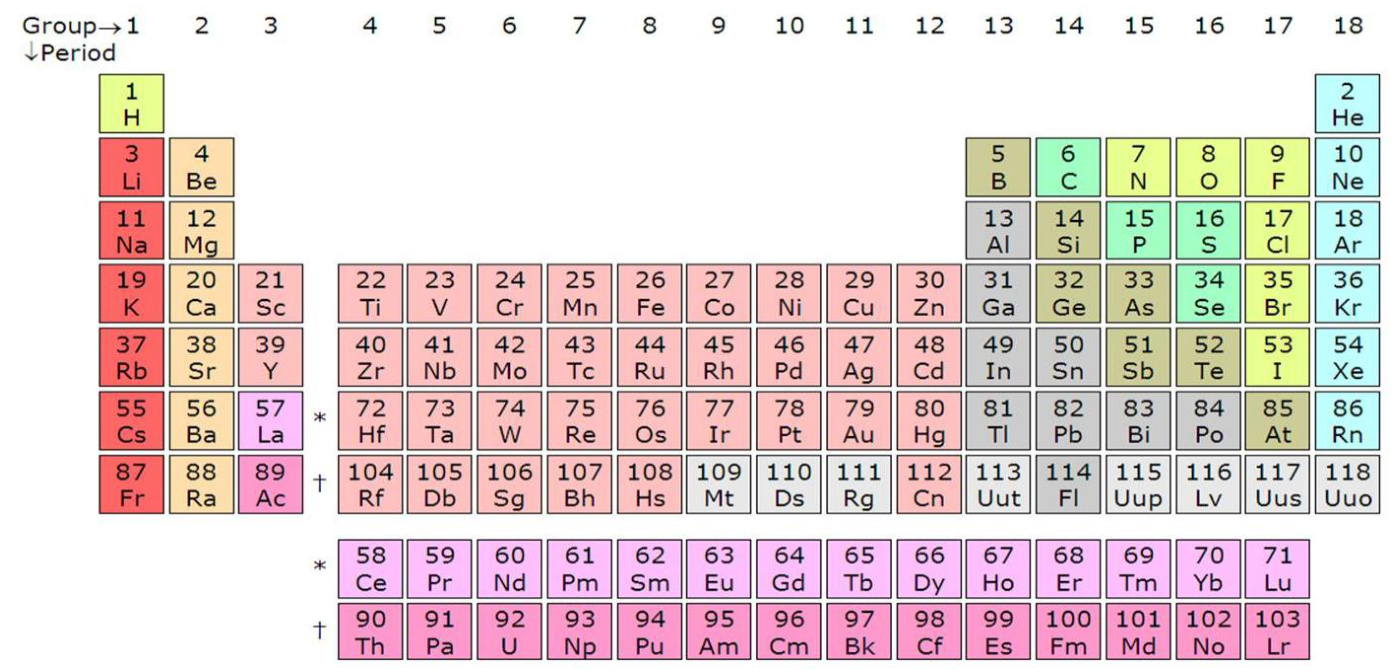
The following species have the same electronic configuration. Which of them has the biggest radius? (Shown below is the Periodic Table for reference.)
$\mathrm{O}^{2-}$
$\mathrm{F}^{-}$
$\mathrm{Ne}$
$\mathrm{Na}^{+}$
Given the electronic configuration of Sc ($1s^2\,2s^2\,2p^6\,3s^2\,3p^6\,4s^2\,3d^1\,4s^2$), what are the possible charges of the Sc cation?
The year 1905 was said to be Einstein´s Annus Mirabilis or ¨miracle year¨, when he published several papers that brought him to international fame. (One of the papers actually won him the Nobel Prize.) Which of the following is NOT a subject of one of his papers that year?
Photoelectric effect
Brownian motion
Special relativity
General relativity
On July 26, 2021, the weightlifter Hidilyn Diaz won the first Olympic gold medal for the Philippines. This was after a 127 kg lift. In this category, she lifted the weight overhead, with her arms stretched, i.e. almost 2.0 m above ground. If she were to let this weight fall freely after the lift, by what speed would the weight hit the ground (in m/s)?
20
10
4.5
6.3
Which of the following would increase the electrical resistance through a wire?
Decreasing the length of the wire
Decreasing the resistivity
Decreasing the diameter of the wire
All of the above
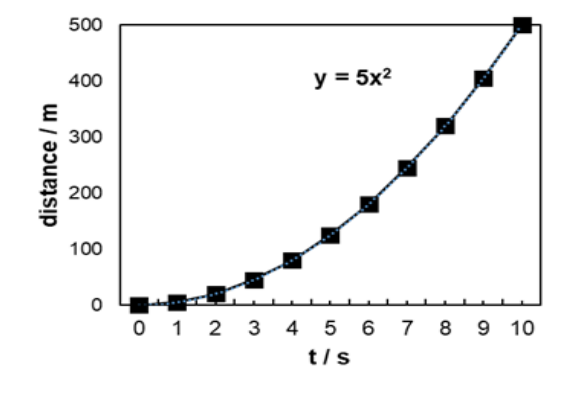
Shown below is the graph of distance (y-axis) travelled by a particle over time (x- axis). The graph traced is a parabola, showing that the acceleration is constant. What is the acceleration of the particle?
1.25 $\mathrm{m/s^2}$
2.5 $\mathrm{m/s^2}$
5 $\mathrm{m/s^2}$
10 $\mathrm{m/s^2}$
Which of the following properties of a wave is directly related to its energy?
Wavelength
Frequency
Speed
Amplitude
Which of the following would NOT cause an electron to accelerate?
Placing it in a constant electric field
Placing it in a gap with potential energy difference
Placing a point charge of opposite charge near it
Placing it in a magnetic field parallel to the direction of motion
This zone where the temperature is almost at freezing point and no sunlight can penetrate covers the majority of the ocean floor.
Hadalpelagic Zone
Abyssopelagic Zone
Bathypelagic Zone
Mesopelagic Zone
Flowering plants first appeared on earth 130 million years ago during which period?
Triassic
Jurassic
Cretaceous
Paleocene
Next →