Which of the following statements is INCORRECT about genetic engineering?
Editorial interpretation: assess whether each statement describes the general aim of genetic engineering.
It creates crops of bigger yield and with greater disease-resistance.
It involves manipulating or changing the genetic makeup of plant or animal.
The aim is to target the worst trait or characteristics of the source organism.
The resulting organism is Genetically Modified Organism (GMO).
The hypothalamus releases antidiuretic hormone that reduces urine formation in the kidney. Which condition can prevent the release of antidiuretic hormone?
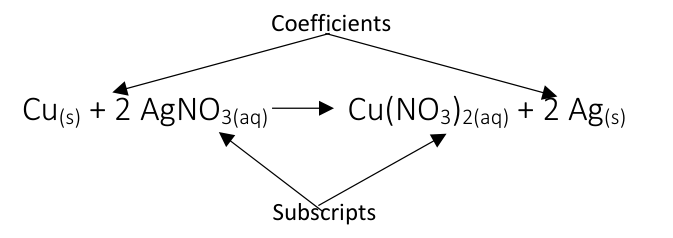
Chemical equations must be balanced to accurately reflect the law of conservation of matter. Balanced chemical equations have the same number and type of each atom on both sides of the equation. How is chemical equation balanced?
Different metals react differently with oxygen, water and dilute acid, allowing a reactivity series to be deduced. In a reaction with oxygen, why does iron fillings rust faster than iron nail?
Editorial comparison: equal amounts of iron, similar temperature and exposure.
The iron fillings contain more atoms than an iron nail.
The iron fillings are hotter than iron nail.
The iron fillings weighs heavier than an iron nail.
The iron fillings have bigger surface area than the iron nail.
A metal object corrodes when it is exposed to the open air and bad weather. In iron, this change is called rusting in which weaker and flaky brown compound is formed. Which condition can cause severe rusting fast?
Gasoline is made up of hydrocarbons such as heptane ($\mathrm{C_7H_{18}}$) and hexane ($\mathrm{C_6H_{14}}$). When they burn, they produce water ($\mathrm{H_2O}$) and carbon dioxide ($\mathrm{CO_2}$). If you burn equimolar quantities of heptane and hexane, the former requires more oxygen gas ($\mathrm{O_2}$) than the latter. Calculate by how many % more $\mathrm{O_2}$ gas heptane requires relative to the same molar quantity of hexane.
A. 21 %
B. 31 %
C. 42 %
D. 52%
Editorial response: Explain the scientific reasoning and the limitation or contradiction in the source choices.
Formally, chalk or calcium carbonate is insoluble in water but a small amount of it is actually in equilibrium between a dissolved state in water and an insoluble phase: $\mathrm{CaCO_3(s)\rightleftharpoons Ca^{2+}(aq)\quad CO_3^{2-}(aq)}$ Which of the following will cause the dissolution of more $\mathrm{CaCO_3}$ in water?
How much energy, in Joules, is contained in a single photon of green light with wavelength 505 nm? For reference, following are some useful constants: Planck’s constant $h=6.62607004\times10^{-34}\,\mathrm{m^2\,kg/s}$; speed of light $c=299\,792\,458\,\mathrm{m/s}$; Boltzmann’s constant $k=1.38064852\times10^{-23}\,\mathrm{m^2\,kg\,s^{-2}\,K^{-1}}$; acceleration due to gravity $g=9.81\,\mathrm{m/s^2}$.
On July 26, 2021, the weightlifter Hidilyn Diaz won the first Olympic gold medal for the Philippines. This was after a 127 kg lift. In this category, she lifted the weight overhead, with her arms stretched, i.e. almost 2.0 m above ground. If 1 cup of cooked rice is approximately 200 kcal, how many cups of rice is equivalent to the energy of such a lift by Diaz? (Note: 1 cal = 4.184 J)
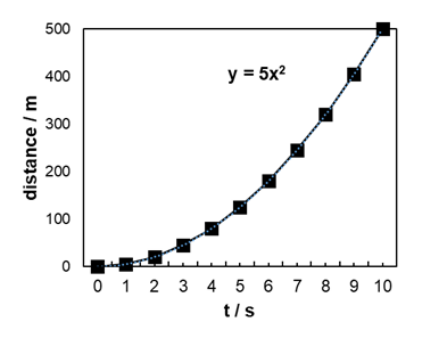
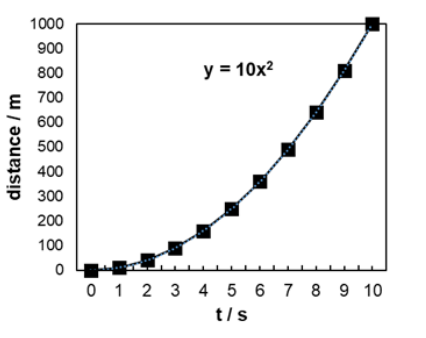
In the first film of the trilogy of the Lord of the Rings: The Fellowship of the Ring, the Balrog fell into a chasm for approximately 13 s before sending a whip to pull Gandalf down. Assuming a constant acceleration due to gravity in Middle Earth similar to Earth (9.8 $\mathrm{m/s^2}$) during the fall, estimate how far the Balrog has fallen during this time.
Editorial model: start from rest and neglect air resistance.
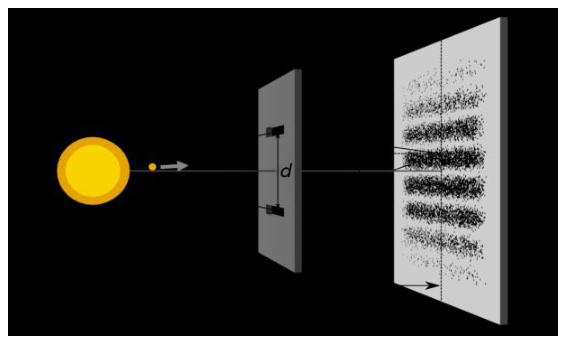
According to quantum mechanics, particles like electrons are also waves. This has been shown by the double slit experiment (diagram shown below). In this experiment, a source of electron is placed a certain distance from two slits, which is itself placed in front of a detector plate. If the electron were to behave as a particle, there would be only two points where the electron would be detected, corresponding to the two slits of entry. To the researcher’s surprise, a pattern shown on the detector, characteristic of interacting waves, was detected. What behavior of of waves is the electron showing?
Dating rock samples has been one of the methods scientists use in determining the age of our planet. Which of the following is home to the oldest rock ever discovered yet?
Editorial convention: choose the specific country; distinguish rocks from isolated mineral grains.