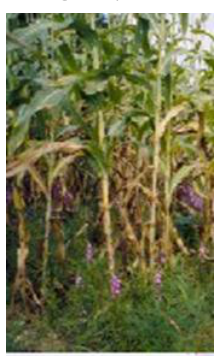
Gloria planted corn on a plot of land. She noticed that the plants were not growing well. Her friend, Korina, commented that the presence of weeds has affected the growth of the corn plants. Which of the following explains why the corn plant is not growing well?
I There is not enough air for the corn plants.
II There is not enough food for the corn plants
III There is not enough space for the corn plants
Editorial convention: interpret food as manufactured sugars and consider direct competition in an ordinary open field.
Rudy studied and made some observation on two animals P and H. He recorded his observation in the table below.
Can the adult fly? P: Yes; H: Yes.
Does it lay its eggs in water? P: Yes; H: No.
Does the young look like its adult? P: No; H: No.
Does it have a larval stage in its cycle? P: Yes; H: Yes.
Which of the following pair of animals can be Animal P and Animal H?
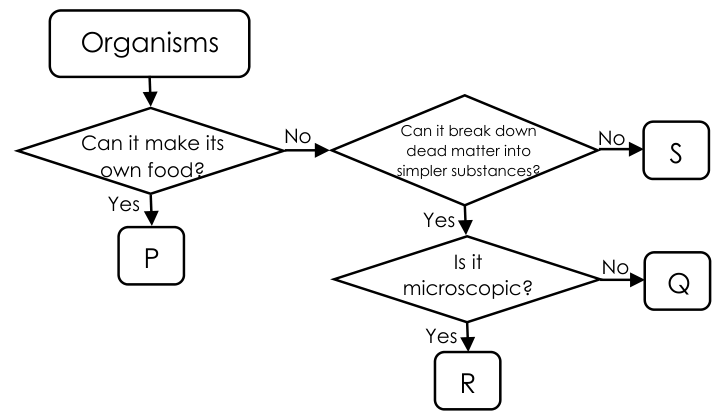
Which of the following statements are true about mushrooms and mold?
I. They only grow in soil.
II. They only reproduce from spores.
III. They are able to make their own food.
IV. They break down dead matter into simpler substances.
A. I and III only
B. I and IV only
C. II and III only
D. II and IV only
Editorial review: explain the scientific problem in the original choices and justify a qualified conclusion.
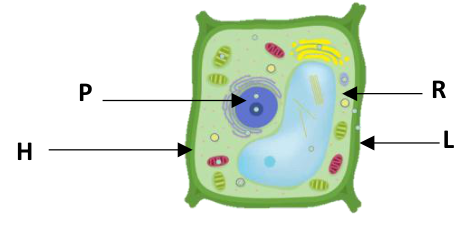
The table below shows some information on three cells, P, Q and R.
Nucleus — P: No; Q: Yes; R: Yes.
Chloroplast — P: Yes; Q: No; R: No.
Cell Wall — P: Yes; Q: Yes; R: No.
Where are cells P, Q, and R likely to be found?
Editorial correction: the nucleus entry for P is a printing error; read Yes for a typical living photosynthetic cell. Other entries are unchanged.
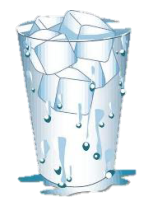
A glass of iced water was left on the table in a classroom. Which of the following observations after 1 hour are correct
I. The water level in the glass will increase.
II. Water droplets will be formed on the inner side of the glass.
III. The temperature of the ice remains at zero degree until all the ice has melted.
IV. Formation of the water droplets is due to the condensation of water vapor on the cold outer surface of the glass.
A. I and IV only
B. II and III only
C. I, III and IV only
D. I, II, III and IV
Editorial review: explain the scientific problem in the original choices and justify a qualified conclusion.
Emily was given a beaker containing three powdery substances P, Q and R, mixed together. The properties of the three substances are given in the table below.
Property I: dissolves in water? P No, Q No, R No.
Property II: floats on water? P Yes, Q No, R No.
Property III: magnetic material? P No, Q Yes, R No.
Property IV: good conductor of electricity? P No, Q Yes, R Yes.
Which properties I, II, III and IV, should Emily make use of in order to separate the three substances?
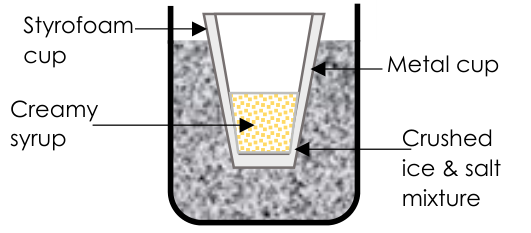
Adding salt to water can increase the boiling point and decrease the freezing point of water. James used the set-up below to make his own ice cream. What would James observe after three minutes?
I The creamy syrup would be frozen.
II The creamy syrup would not freeze.
III A thin layer of ice would form on the outer surface of the metal cup.
A. I only
B. II only
C. I and III only
D. II and III only
Editorial review: explain the scientific problem in the original choices and justify a qualified conclusion.
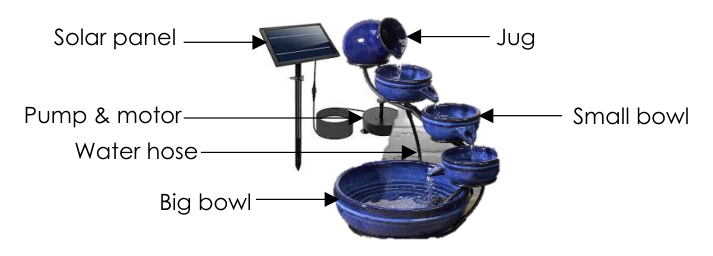
The garden waterfalls below is solar-powered. The solar panel, which absorbs energy from the sun, is connected to a motor in the bowl. The motor pumps water up into the jug through the water hose. Then the water flows down to the bowls. Which one of the following is true of the garden waterfalls?
The water in the big bowl has more potential energy than the water in the jug.
The water flowing out of the jug has both potential energy and kinetic energy.
Heat energy is converted to potential energy and kinetic energy for the garden waterfalls work.
The garden waterfalls cannot operate when there is no heat.
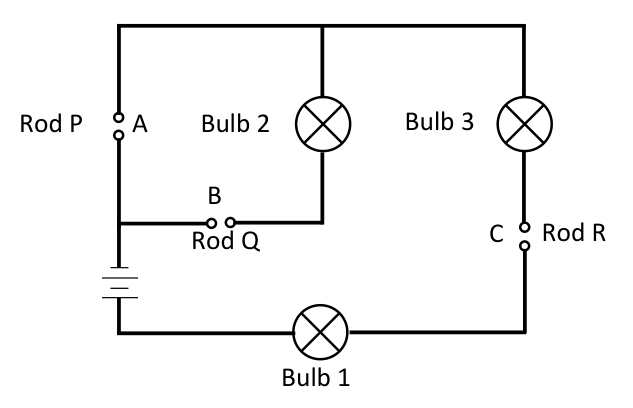
Samson wanted to find out the electrical conductivity of 3 rods, P, Q and R, made of different materials. He inserted the rods into the circuit at positions A, B, and C as shown below. The table below shows the results collected at the end of the experiment.
At A, B, C: P, Q, R → bulbs 1, 2, 3: yes, yes, yes.
At A, B, C: Q, R, P → bulbs 1, 2, 3: no, no, no.
At A, B, C: R, P, Q → bulbs 1, 2, 3: yes, no, yes.
Based on the data above, which one of the following conclusions is correct?
Only rod R is a non-conductor of electricity.
Only rods Q and R are non-conductors electricity.
Only rod P is a non-conductor of electricity.
Rods P and Q are better conductors of electricity than rod R.
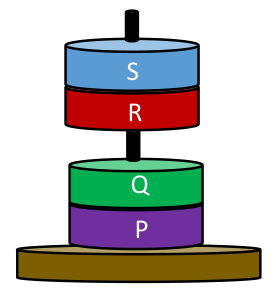
The set-up below is made up of four rings, P, Q, R and S. Based on the information above, which of the following are possible materials for P, Q, R and S.
I: magnet; steel; magnet; Steel
II: magnet; iron; magnet; magnet
III: iron; magnet; magnet; Plastic
IV: steel; plastic; iron; magnet
Assume the iron and steel pieces are initially unmagnetized and the support rod only guides the rings.
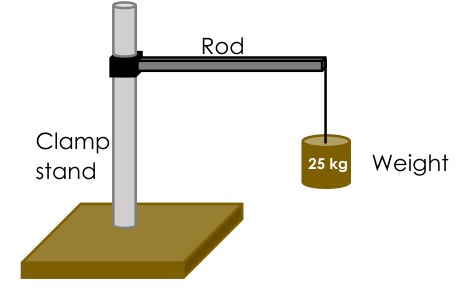
Jack wanted to find out which rod P or Q be more suitable to hang heavy weight. He clamped rod P on a clamp stand and hang a 15-kg weight on it as shown below. He repeated the experiment by replacing rod P with rod Q. He observed that rod Q broke but not rod P. Based on the information above, which one of the following statements is correct?
Editorial correction: read the stem’s 15 kg as 25 kg, matching the figure and choices. Compare equal-sized rods under identical clamping and loading.
P is stronger as it could withstand weight of up to 25kg.
Rod Q is stronger as it could withstand weight of more than 25kg.
Rod P is more flexible as it withstands weights of up to 25kg.
Rod Q is more flexible as it could withstand weighs of more than 25kg.
Which of the following are examples of interactions between living and nonliving things in an environment?
I A cow feeding on grass
II A plant making food using sunlight
III An Earthworm making a tunnel in muddy soil
IV A fish in dissolve oxygen from the water
Editorial reading: the incomplete statement IV means a fish taking in dissolved oxygen from water.
The table below shows the relationship among five organisms in a community.
Q feeds on S
S feeds on R and T
P provides food for T and R
Which one of the following classified as the roles of the organisms in the community correctly? Order: Producers; Prey only; Prey and predator; Predator only.
Use the usual school food-web convention: P is a producer, and plant-eaters are distinguished from predators.