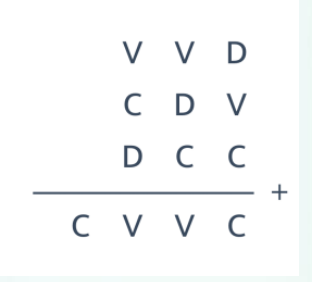
Consider the expression $\frac{2^{k_1}-2^{k_2}}{2^{k_3}-2^{k_4}}$ where $k_1,k_2,k_3,k_4$ are all non-negative integers. What is the smallest value of n where n represents the positive integers that cannot be equal to the expression?
The passcode to Henry’s computer is described in a hint: In a collection of 9809 distinct objects, there are N ways to arrange their order. The number of zeros at the end of N is the passcode. What is the passcode?
Jason partially forgot his 6-digit passcode. He correctly remembers that four of the digits are 1,2,3, and 4, in that specific order, but forgets their respective places in the passcode. He also remembers that the missing 2 digits are the same. Given this information, how many possible combinations of Jason’s passcode are there?
Count distinct digit strings; a passcode may begin with zero.
N is a positive integer that has a remainder of 1 when divided by 3, a remainder of 1 when divided by 4, and a remainder of 2 when divided by 5. What is the difference between the minimum and maximum possible values of N between 1 to 1000?
Vladimir’s wallet contains 20, 50, and 100-peso bills. If the total value of the bills is Php1,650 and there are 30 bills, how many combinations of bills are possible?
Interpretation: at least one bill of each named denomination is present.
The radius of circle A is 1/3 the radius of circle B. Circle A rolls around circle B one trip back to its starting point. How many times will circle A rotate in total?
Assume external rolling without slipping about the fixed circle B.
Families living in New Clark City love biking. There are a total of 2,022 families in the city each with two or four bicycles. Given that there are as many families owning either four bicycles as many as families owning two bicycles, how many bicycles are there in New Clark City?
Let R and F ($R,F\ne0$) be the roots of the equation $x^2-3x-m=0$. If RF and R+F are the roots of the equation $(c+1)x^2-sx+m=0$ and $c+1+s+m=0$, then find the value of $c+s-m$.
If $S=\frac{10}{100}+\frac{200}{100^2}+\frac{3000}{100^3}+\frac{40000}{100^4}+\cdots+\frac{9000000000}{100^9}+\frac{100000000000}{100^{10}}$, what is $S+\frac1{10^9}$?
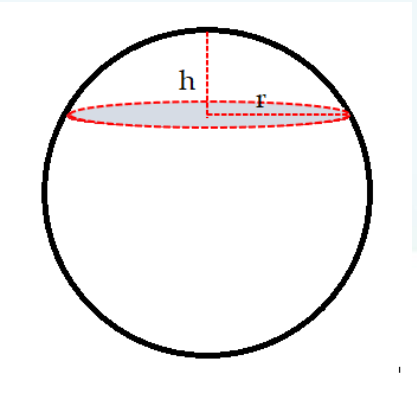
Rose fills a spherical fishbowl with water up to the level indicated in the figure below. The radius of the entire sphere is 10 inches. If the height of the unfilled portion is h=2 inches while radius r=6 inches, what is the volume of the water in the fishbowl? (Leave π as it is or express your answer using π.)
Input format: use * for multiplication, pi for π, ^ for powers and sqrt(...) for square roots.
In the given problem in #19, the unfilled portion of the bowl is called the spherical cap. Find its surface area. (Leave π as it is or express your answer using π.)
Context from Question 19: sphere radius 10 inches, cap height 2 inches, base radius 6 inches. Find curved surface area only. Input format: use * for multiplication, pi for π, ^ for powers and sqrt(...) for square roots.