Printed positive marks are preserved per question. The source uses different blank-answer and incorrect-answer rules by section, including an optional bonus penalty; the import does not reproduce that complete official scoring scheme.
For real $x$, $[x]$ denotes the greatest integer not exceeding $x$ (the integer part). The decimal or fractional part is $\{x\}=x-[x]$, so $x=[x]+\{x\}$. Examples: $[3]=3$, $[6.25]=6$, $[-6.25]=-7$, $[22/7]=3$. The source lists: (1) $0\lt \{x\}\lt 1$ for every real $x$; (2) $\{x\}=0$ exactly when $x$ is an integer; (3) $x-1\lt [x]\le x\lt [x]+1$; (4) $[n+x]=n+[x]$ for positive integers $n$; (5) $[-x]=-[x]-1$ if $x$ is not an integer, and $[-x]=-[x]$ if $x$ is an integer. Editorial correction: property (1) must read $0\le\{x\}\lt 1$; its printed strict lower bound contradicts (2). The definition of $[x]$ is used below.
For real $x$, $[x]$ denotes the greatest integer not exceeding $x$ (the integer part). The decimal or fractional part is $\{x\}=x-[x]$, so $x=[x]+\{x\}$. Examples: $[3]=3$, $[6.25]=6$, $[-6.25]=-7$, $[22/7]=3$. The source lists: (1) $0\lt \{x\}\lt 1$ for every real $x$; (2) $\{x\}=0$ exactly when $x$ is an integer; (3) $x-1\lt [x]\le x\lt [x]+1$; (4) $[n+x]=n+[x]$ for positive integers $n$; (5) $[-x]=-[x]-1$ if $x$ is not an integer, and $[-x]=-[x]$ if $x$ is an integer. Editorial correction: property (1) must read $0\le\{x\}\lt 1$; its printed strict lower bound contradicts (2). The definition of $[x]$ is used below.
For positive integers $n$ satisfying $[\sqrt n]=5$, find the sum of all possible $n$.
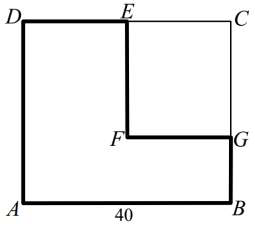
Rectangle $ABCD$ has area 2560 and $AB=40$. Points $E,G$ lie on $CD,BC$ respectively, and interior point $F$ makes $CEFG$ a rectangle as shown. Find the perimeter of hexagon $ABGFED$.
A dealer’s profit, based on cost, is $x\%$. If cost decreased by 8% but selling price stayed fixed, profit based on the new cost would be $(x+10)\%$. Find $x$.