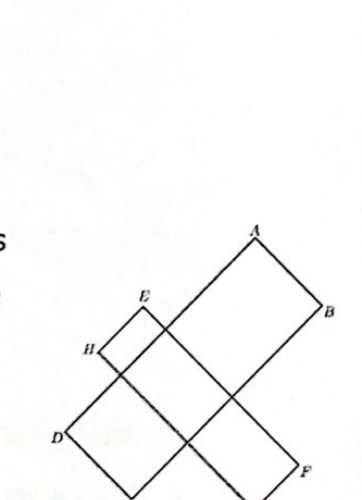
As shown, the overlap of rectangles ABCD and EFGH is also a rectangle. The area of ABCD is 174 cm² and the area of EFGH is 52 cm². EF = 13 cm and BC = 29 cm. What is the area, in cm², of the entire figure?
Larry’s 3-digit number satisfies the following conditions:
- The number is not a multiple of 3.
- Exactly one of the digits is a prime number.
- Another digit is a square number.
- The other digit is neither prime nor square.
What is the largest possible value of Larry’s number?
The length of each edge of a cube is increased by 10%. By what percent is the volume increased? (If your answer is 13.2%, then write 132; if your answer is 35.6%, then write 356; if your answer is 4%, then write 004)
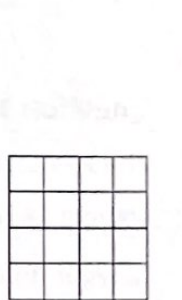
Sixteen 1cm by 1cm tiles are arranged in 4 rows and 4 columns to form a single square as shown. The perimeter of the square is 16cm. If the shape is cut into exactly two pieces along edges of the tiles, what is the greatest total perimeter of the two pieces, in centimeters, that can be made?
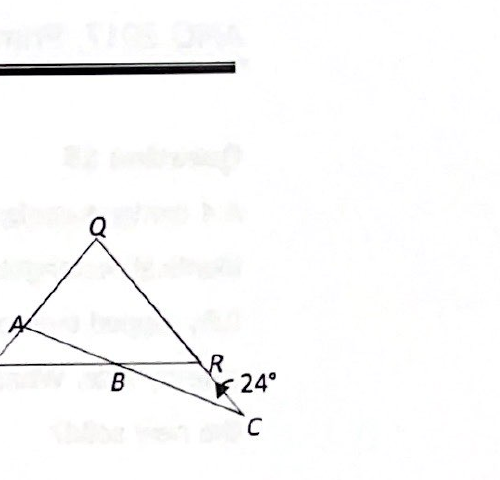
△PQR is an isosceles triangle with PQ = QR. Point B is on side PR and point A is on side PQ, so that when AB is extended it meets extended side QR at point C as shown. If triangle △BRC is also isosceles with BR = RC and the measure of ∠C = 24°, find the number of degrees in the measure of ∠QAC.
Phineas forms an ordered list consisting of seven consecutive whole numbers. The sum of the first, third, and sixth of these numbers is 175. Find the sum of the remaining four whole numbers.
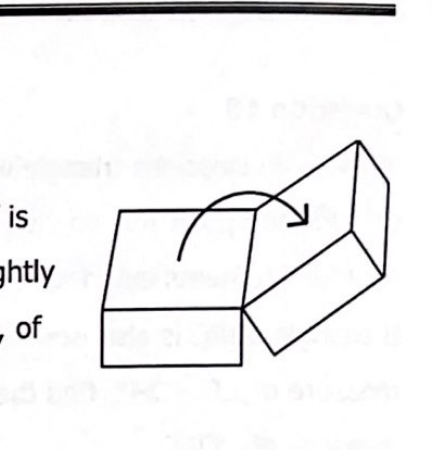
A 4 cm by 4 cm by 4 cm solid cube is cut in two identical rectangular solids, as shown. The top half is fully flipped over one edge so that they are now tightly side-by-side. What is the total surface area, in cm², of the new solid?
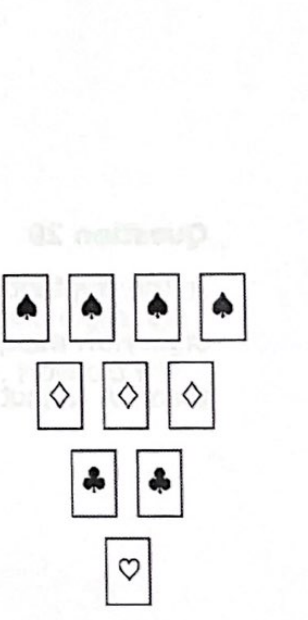
Each of 10 cards displays two different symbols, one on the front and the other on the back. The symbols are ♣, ◇, ♠, ♡, ●. The front of each card is shown. No two cards have the same pair of symbols. What is the least number of cards you can turn over to ensure that ● will appear?