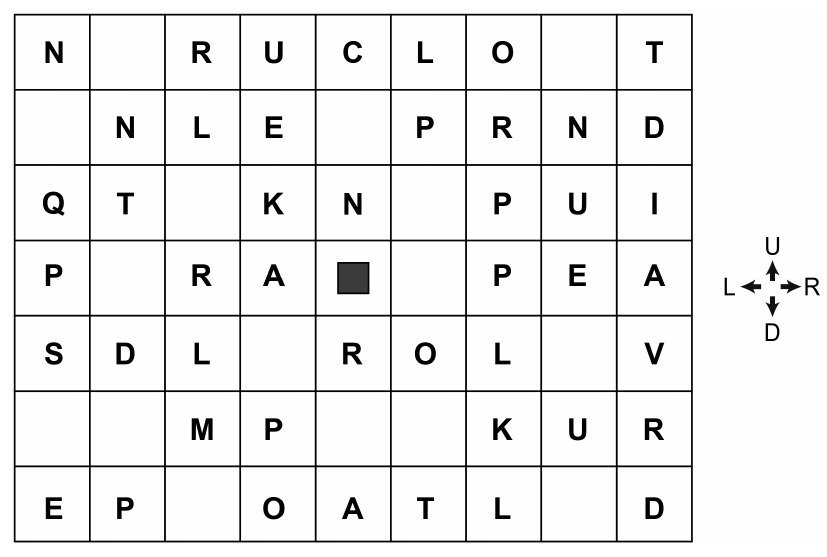
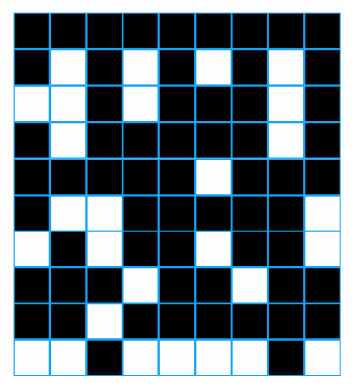
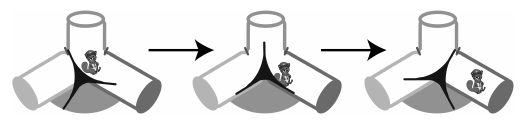
Alice sends Bob this board and the instructions “2 L 1 U 6 R 2 D 1 L 2 D 7 L 1 U 1 R 2 U 1 R”.
Start at the central black square. Follow each instruction in order, recording the letter at its destination if there is one. L,R,U,D mean left,right,up,down; the number is the distance in cells. For example 2 L first gives R; the next 1 U ends at a blank cell. What message does Alice send?
George encodes a word in two steps. First read left to right and concatenate the letters in odd-numbered positions: bread gives bed. Then read right to left and append the remaining letters: bread becomes bedar. Repeating the procedure eventually restores the original word. For example milk→mlki→mkil→milk takes three encodings. How many encodings first restore society?
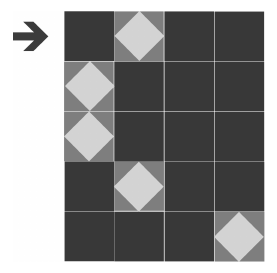
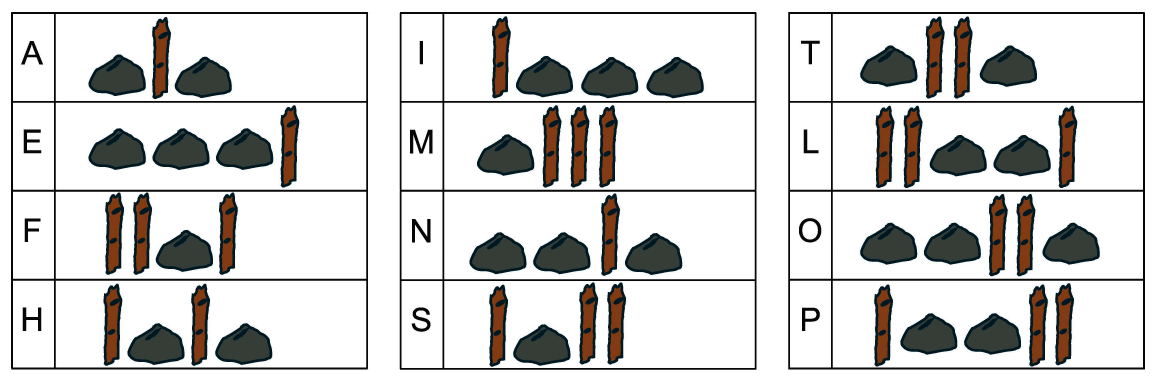
Maria has 19 plain tiles and 5 flower tiles, shown in the original key.
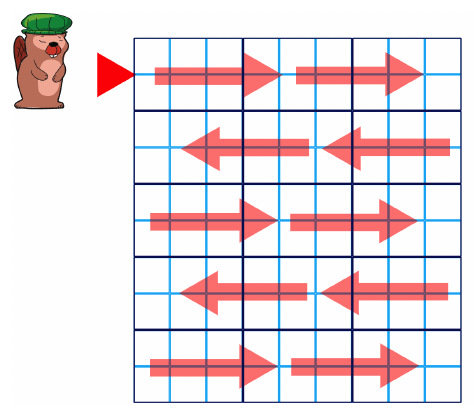
She tiles a floor of 5 rows and 4 columns, starting at the arrow. She works left to right along each row, then continues left to right on the next row. The result is below.
Which strategy did she use?
Place flower tiles so that no two flower tiles are adjacent.
Separate plain-tile groups with one flower tile, making each plain group twice as large as the previous group.
Ensure that every column has at least one flower tile.
Separate plain-tile groups with one flower tile, making each plain group one tile larger than the previous group.
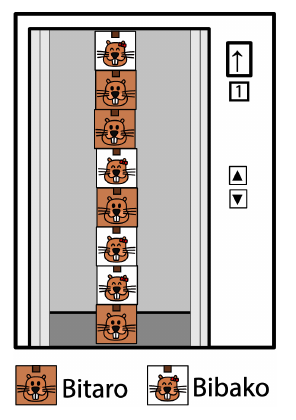
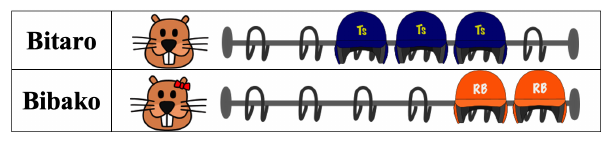
Bitaro lives on floor 2 and Bibako on floor 3. A porter stacks their eight boxes in the elevator as shown. The elevator starts on floor 1 and goes to the floor belonging to the top box. At that stop the porter removes every consecutive top box for that beaver before going to the other beaver’s floor.
How many stops are needed to deliver all the boxes?
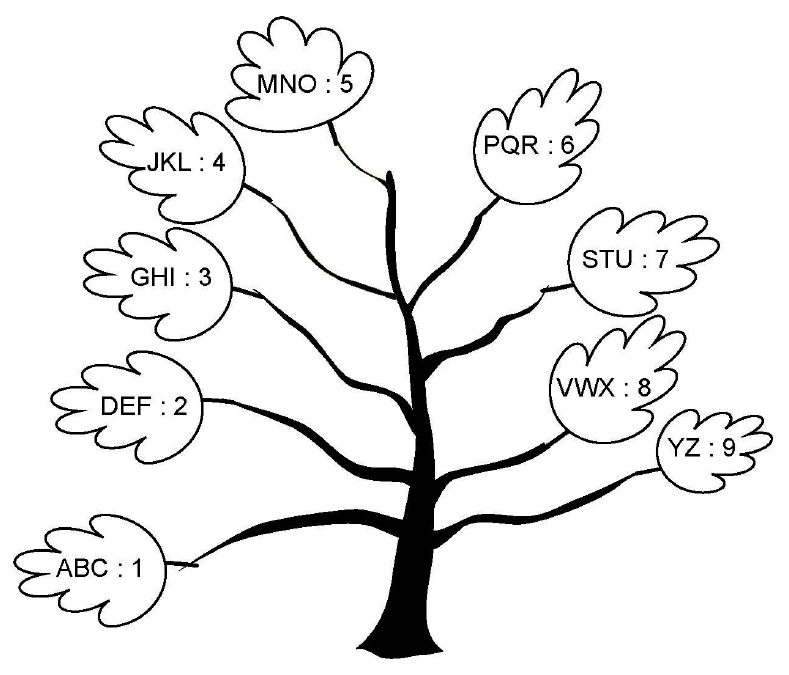
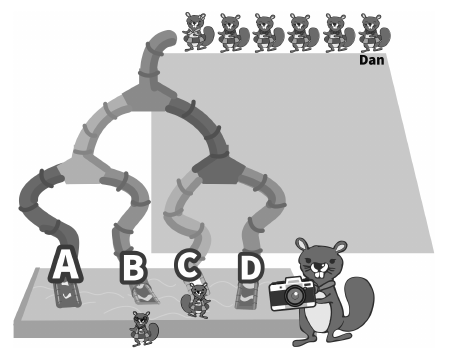
The tree has numbered leaves carrying groups of two or three letters.
Encode a letter with two digits: first its leaf number, then its position in that leaf’s letter group. For example CAR is 13–11–63. How is VIETNAM encoded?
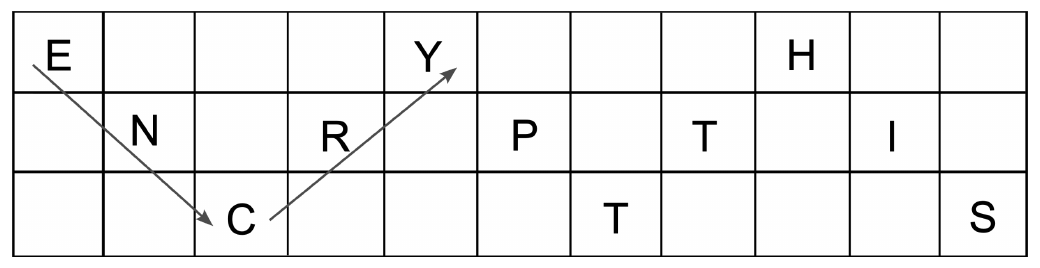
A rail-fence cipher writes a message in a rectangular grid of a chosen height. Starting at the top-left cell, write successive letters in a down-and-up zigzag. Then read each row left to right, from the top row downward. With height 3, ENCRYPTTHIS becomes EYHNRPTICTS as shown.
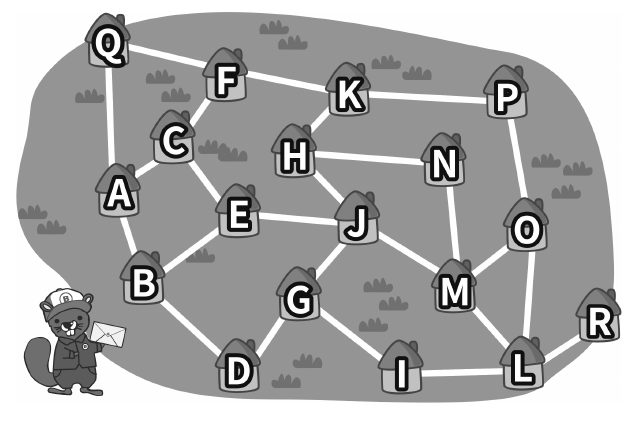
Eighteen villages on an island are connected as shown. Whenever a village originates or newly receives information, its messengers send it to every neighboring village the following day. For example information from A reaches B,C,Q in one day, then D,E,F in two days.
If new information starts at J, how many days are needed for every village to receive it?
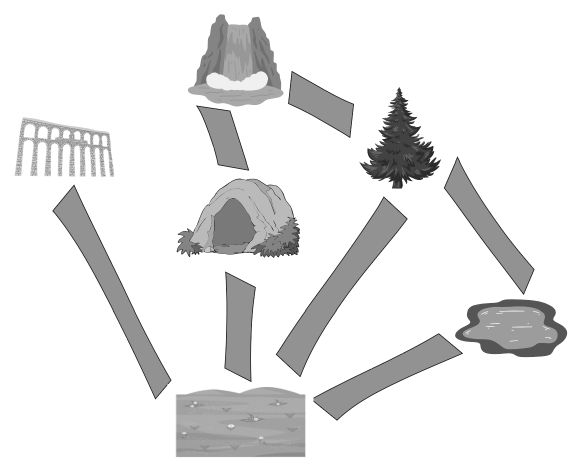
MAX visits six forest places: an aqueduct, pine hill, lake, cave, waterfall and meadow. Roads connect them as pictured. MAX may start anywhere, but must visit every place exactly once.
How many different complete itineraries are possible?
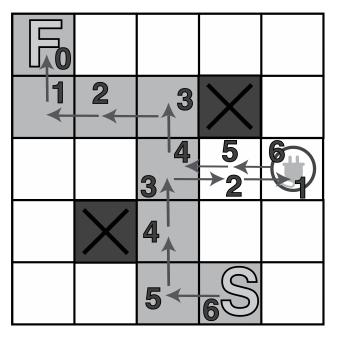
A small electric car can travel six steps on a full battery. For longer trips it may detour to a charging station, then must return to exactly the cell where it left the prescribed route before continuing. The example shows the gray route, movement arrows and remaining battery values from S to F.
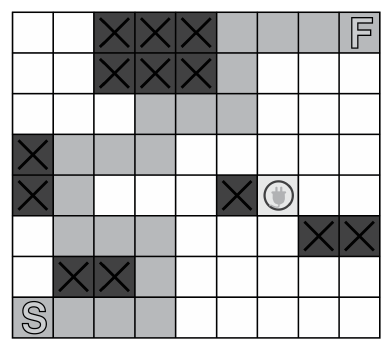
A larger car can travel fifteen steps on a full battery. It follows the gray route below from S to F. If it visits the charger, it must return to the same gray exit cell before continuing; crossed cells are blocked.
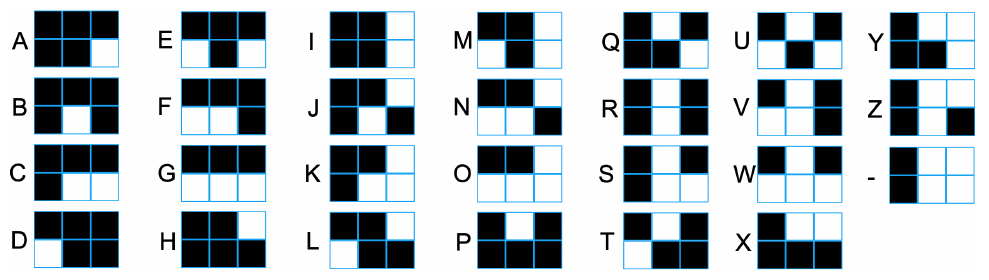
The beaver uses 3 × 2 black-and-white cards to encode letters according to this table.
It decodes by moving in the arrow directions and reading each card from the direction it is facing. The direction diagram and encoded message are below.
Which listed letter occurs most often in the message?
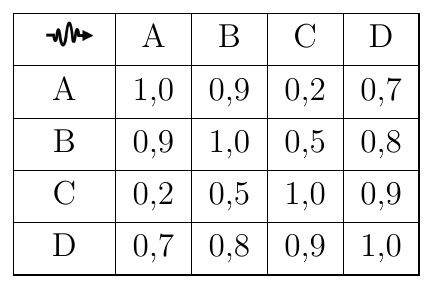
The beaver translates between languages A,B,C,D with the accuracy values in this table, each between 0 and 1. Larger means better.
The accuracy of an indirect translation is the product of its step accuracies. For example C→A directly has accuracy 0.2, while C→B→A gives 0.5 × 0.9=0.45, which is better. What is the greatest possible accuracy from B to C, directly or indirectly?
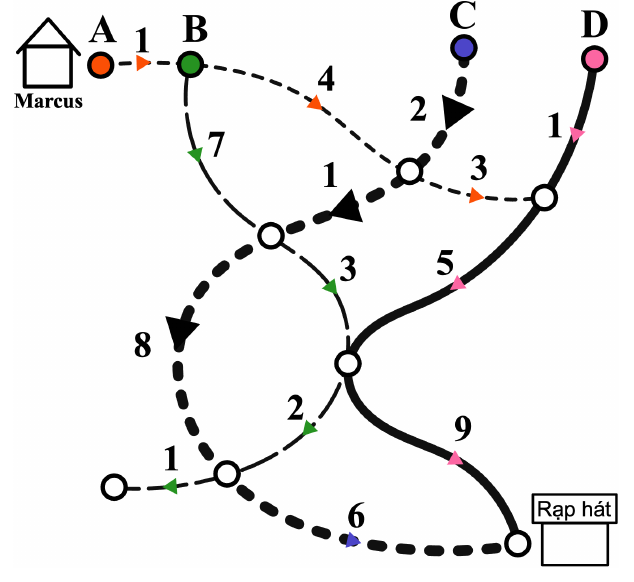
Four one-way tram lines serve the city as shown. Marcus’s home is at A and the theater (Rạp hát) is the lower-right stop. Numbers on segments are travel times in minutes; circles are stops.
- Line A departs A every 3 minutes.
- Line B departs B every 2 minutes.
- Line C departs C every 4 minutes.
- Line D departs D every 5 minutes.
The first departures of all four lines are simultaneous. Stop time is negligible; passengers may change lines at shared stops but may have to wait. What is the shortest time for Marcus to reach the theater?
Editorial start convention: Marcus is ready at A when the first simultaneous departures occur, at time 0; all waiting from that time is counted.