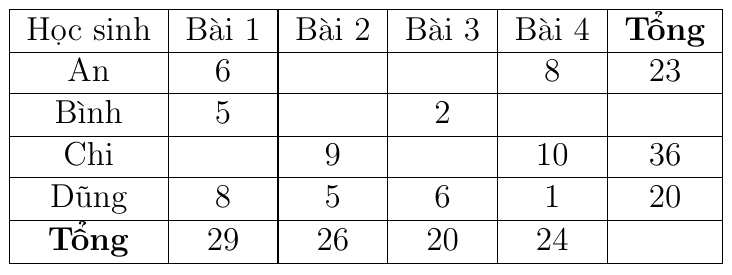
Four students take four tests, each worth at most 10 points. Some entries in their score table have been erased.
Table labels: Học sinh = Student; Bài 1–4 = Tests 1–4; Tổng = Total. The rows are An: (6, blank, blank, 8), total 23; Bình: (5, blank, 2, blank), total unknown; Chi: (blank, 9, blank, 10), total 36; Dũng: (8,5,6,1), total 20. Column totals are 29,26,20,24. What is Bình’s total score?
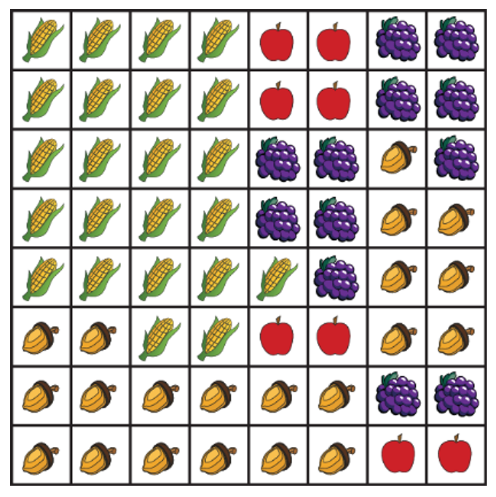
Alex’s farm has different crops arranged as shown.
Each installed pump waters a fixed square region of size 4×4, 2×2 or 1×1. A pump may water only one crop type. When all pumps are on, every plant must receive water from exactly one pump. What is the minimum number of pumps needed?
A beaver tries to enter a thieves’ hideout. The guard uses Vietnamese number words. The beaver hears these accepted exchanges: “Mười” (ten) → “Bốn” (four), “Hai” (two) → “Ba” (three), and “Ba” (three) → “Hai” (two). When the guard says “Bốn” (four), the beaver replies “Mười” (ten) and is refused. What should it say to be admitted? Keep the Vietnamese words when applying the rule.
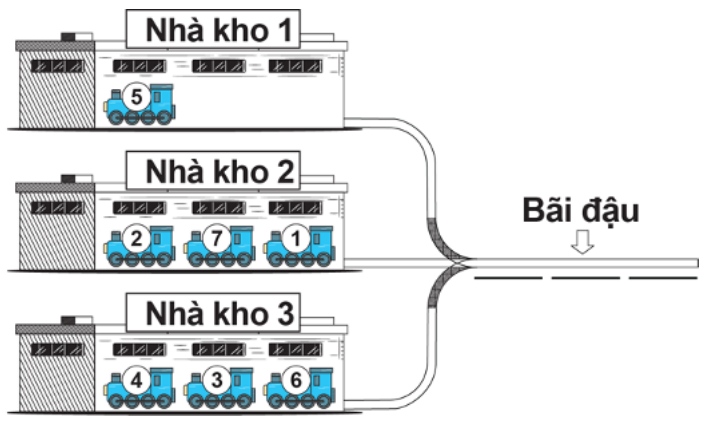
Seven locomotives numbered 1–7 are in three sheds as shown. “Nhà kho” means shed and “Bãi đậu” means parking. Left to right, shed 1 contains [5], shed 2 [2,7,1], and shed 3 [4,3,6]; parking is empty.
John may perform O(X): move the rightmost locomotive of shed X to parking; or I(X): move the leftmost locomotive of parking into shed X. Neither a shed nor parking may hold more than three locomotives. Which action sequence puts locomotives 1,2,3 into shed 1 in that order?
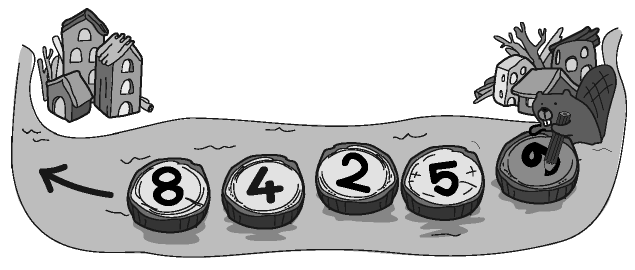
Beavers send digits on floating logs. A differently colored final log carries a check digit. To compute it, add digits in odd positions, multiply that sum by 3, then add the digits in even positions. The check digit is the units digit of the result. For example 8,4,2,5 gives (8+2)×3+(4+5)=39, so its check digit is 9.
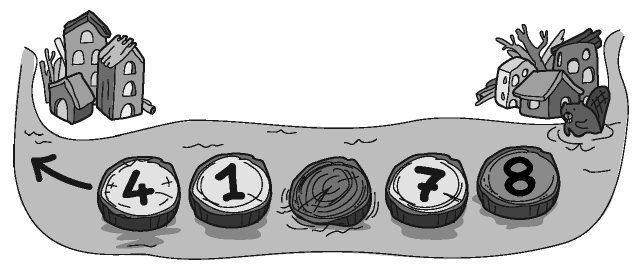
In the next message the data are 4,1,an erased digit,7 and the final check digit is 8. Their order has not changed.
What remainder does the erased digit leave when divided by 4?
The beaver city uses the letters shown. Gray cells are consonants; the other cells are vowels.
The vowels are A,E,I,O,U; the consonants are G,K,P,R,S,T,V. An identification code has four characters. The first is any digit 0–9, and each remaining character is a letter from this alphabet. The second character must be a vowel and the last a consonant. If S is the number of different codes, what is the sum of all digits of S?
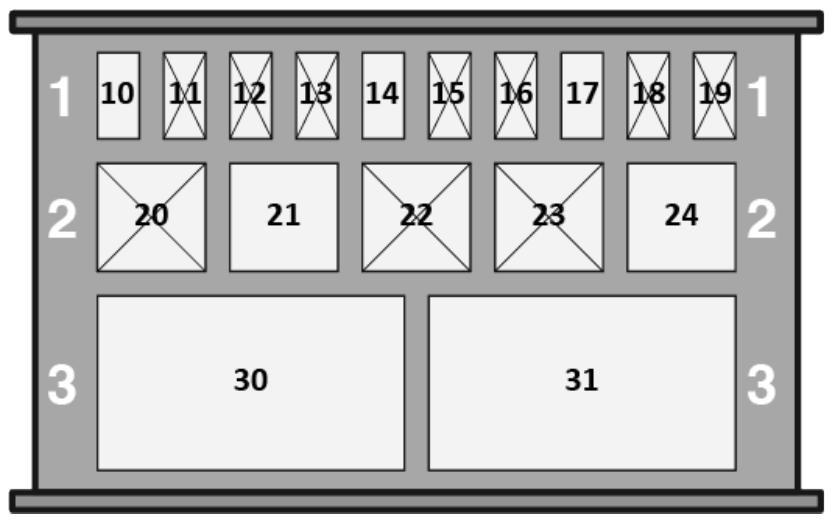
Parcels come in small, medium and large sizes. The cabinet has compartments of types 1,2,3 as shown. Initially, X marks an occupied compartment; all others are empty.
Each compartment holds at most one parcel. Small parcels fit every type, medium parcels fit types 2 and 3, and large parcels fit only type 3. Each new parcel goes into the lowest-numbered empty compartment that can hold it. The events are:
1. Add two small parcels.
2. Remove the parcel in compartment 22.
3. Add one large parcel.
4. Add three small parcels.
5. Remove the parcel in compartment 15.
6. Add one medium parcel.
7. Remove the parcel in compartment 18.
8. Add one small parcel.
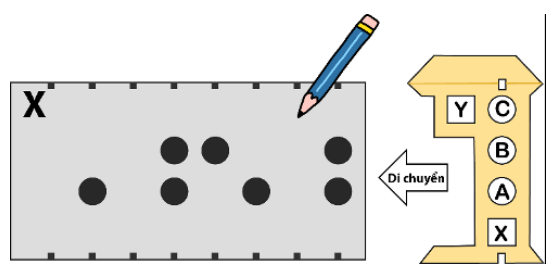
A beaver has a ruler with five holes A,B,C,X,Y and a pencil that draws black marks.
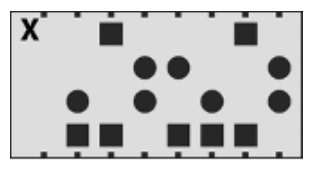
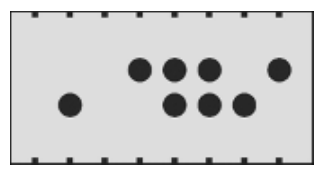
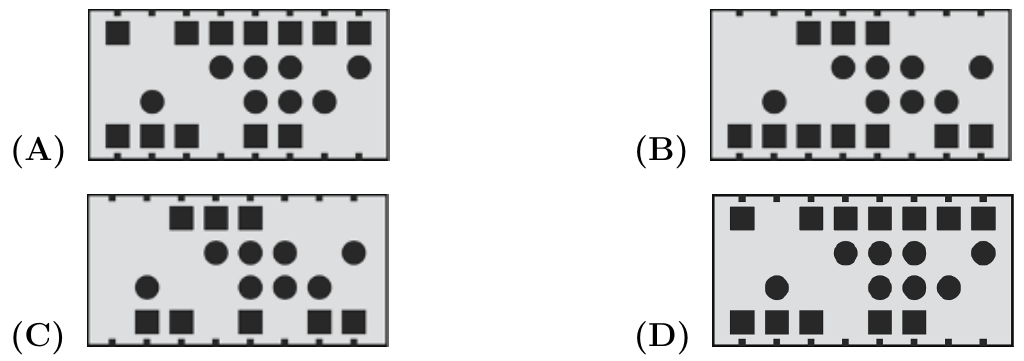
It slides the ruler from right to left. At each column, if at least two of A,B,C show black, it draws a square at Y. If an odd number of A,B,C show black, it draws a square at X. It then moves one column left and repeats. The diagram shows that Y is one column left of the input holes, so a newly drawn Y square can be seen through C at the next step. Here is the completed example sheet.
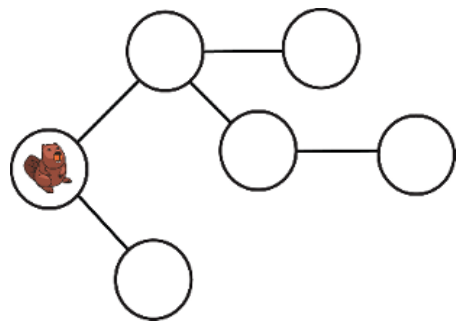
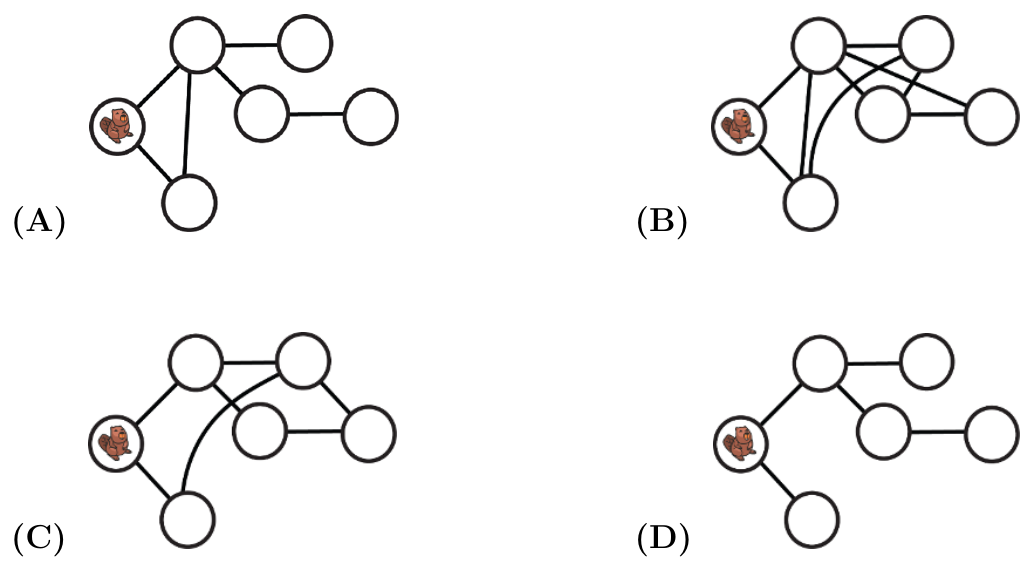
Six houses, including Thomas’s, form a village. Every road takes the same time to traverse. Thomas drew the following diagram showing a shortest route from his house to every other house, but may have omitted some roads.
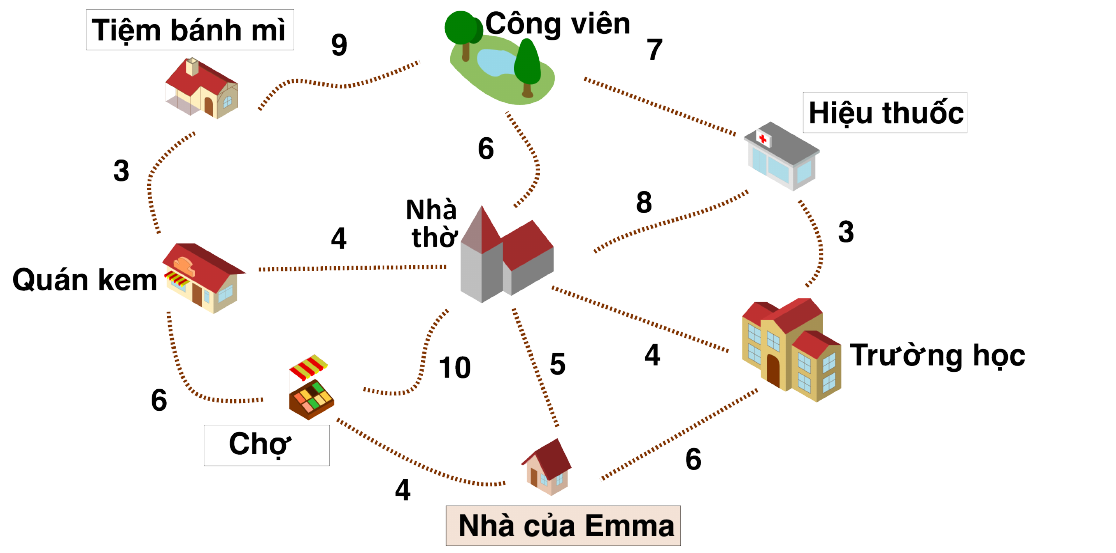
Emma’s village map labels each road with its travel time in minutes.
Labels: Nhà của Emma = Emma’s home; Chợ = market; Tiệm bánh mì = bakery; Hiệu thuốc = pharmacy; Quán kem = ice-cream shop; Nhà thờ = church; Công viên = park; Trường học = school. Emma must buy vegetables at the market, medicine at the pharmacy and a cake at the bakery. She starts and ends at home and may visit the three shops in any order. Each purchase takes one minute. What is the shortest total time, from leaving home until returning?
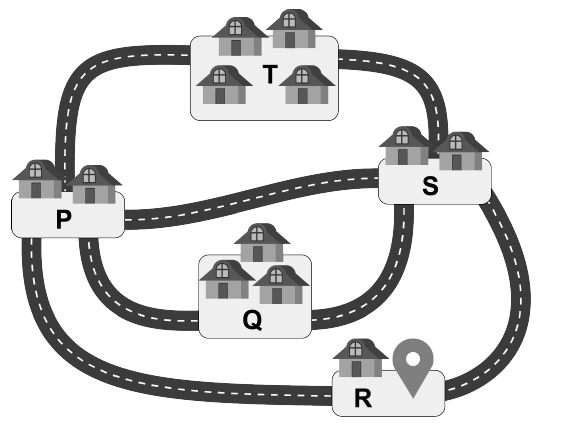
A robot starts at R, traverses every road exactly once and never turns around in the middle of a road. How many different traversal orders can it choose?
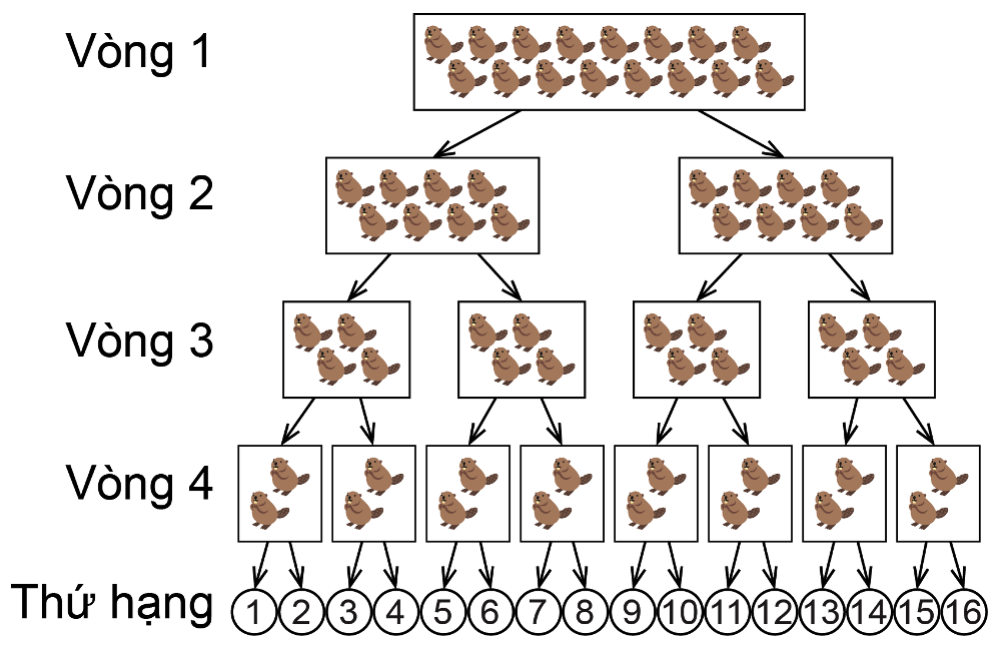
Sixteen beavers play four rounds to determine ranks 1–16. At every round, each group splits into equal winner and loser groups: winners go left and losers right. The process continues as shown.
“Vòng” means round and “Thứ hạng” means rank. A beaver winning rounds 1,2 but losing rounds 3,4 is ranked 4. If Noro loses exactly one round, which ranks could Noro obtain?
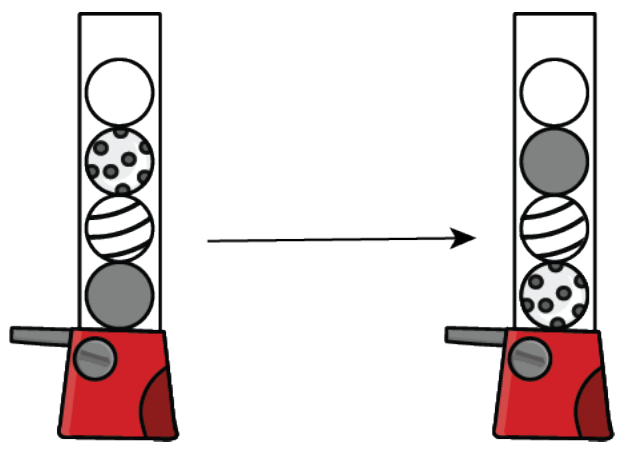
A beaver wants to reorder the four balls as shown. Initially, from bottom to top, they are gray, striped, dotted, white; the target is dotted, striped, gray, white.
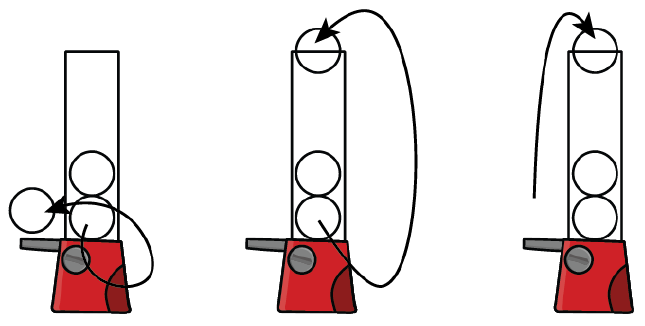
Each move is one of the following:
- Transfer the bottom ball to a waiting tray, which holds at most one ball.
- Move the bottom ball to the top of the main stack.
- Move the waiting-tray ball to the top of the main stack.
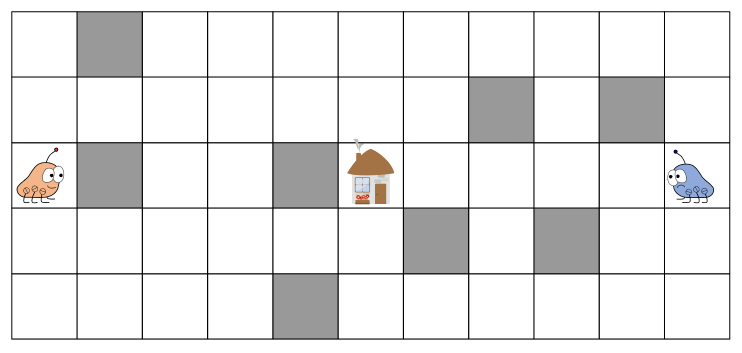
Two robots move on the board with three commands: forward one square, turn left, or turn right.
The orange robot initially faces right and the blue robot faces left. Both receive exactly the same command sequence. They must reach the house without entering a gray obstacle cell.
What is the minimum number of commands in a common instruction sequence?