Skip to content / Đến nội dung
ThichHocToan.com

BEBRAS 2023 Grade 7-8 Round 2 Ext

Question 1

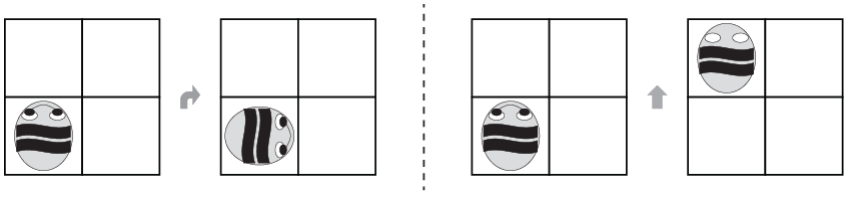
A robot bee executes commands one at a time: the straight arrow moves one square forward in its current direction; the right-turn and left-turn symbols rotate it in place without moving.

Question illustration

The examples illustrate a right turn and a forward move.
Question illustration

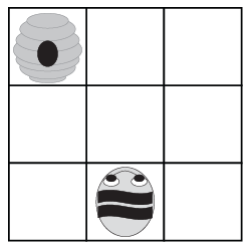
The bee is now in the bottom middle square facing upward, with its hive in the upper left square.
Question illustration

Which command sequence brings it to the hive?

Question illustration
  1. Figure A
  2. Figure B
  3. Figure C
  4. Figure D

Question 2

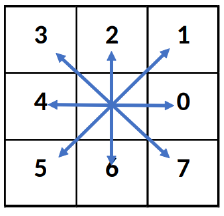
To draw on a square grid, start at the gray square and move in one of eight directions numbered as shown: 0 east, 1 northeast, 2 north, 3 northwest, 4 west, 5 southwest, 6 south, 7 southeast.

Question illustration

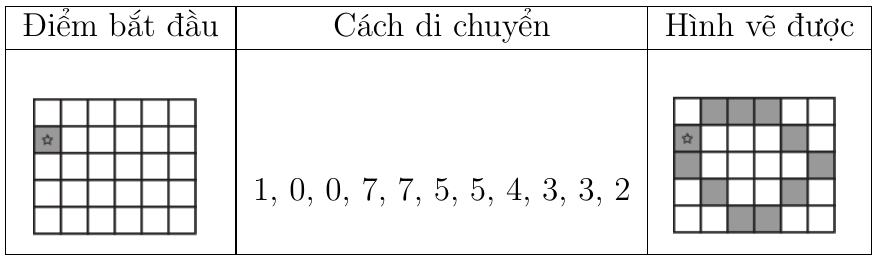
The example shows the start, the sequence 1,0,0,7,7,5,5,4,3,3,2 and the resulting shaded squares.

Question illustration

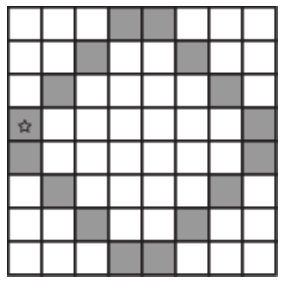
Beaver wants to draw the following shape from its starred square.

Question illustration

Which movement sequences draw it? Select all valid options.
  1. 1,1,1,0,7,7,7,6,5,5,5,4,3,3,3,2
  2. 1,1,0,0,7,7,6,6,5,5,4,4,3,3,2,2
  3. 6,7,7,7,0,1,1,1,2,3,3,3,4,5,5,5
  4. 0,1,1,0,7,7,7,6,5,5,5,4,3,3,3,0

Question 3

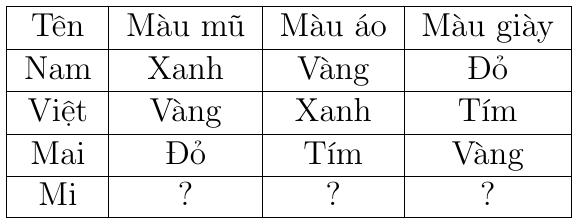
Nam, Việt, Mai and Mi each wear a hat, shirt and shoes in blue, red, purple or yellow. No two children have the same hat color, shirt color or shoe color.

Question illustration

The table columns are Name / Hat / Shirt / Shoes. Nam: blue / yellow / red. Việt: yellow / blue / purple. Mai: red / purple / yellow. Mi: unknown in all three columns. What colors are Mi’s hat, shirt and shoes?
  1. Purple hat, red shirt, blue shoes
  2. Blue hat, purple shirt, red shoes
  3. Yellow hat, red shirt, purple shoes
  4. Purple hat, purple shirt, blue shoes

Question 4

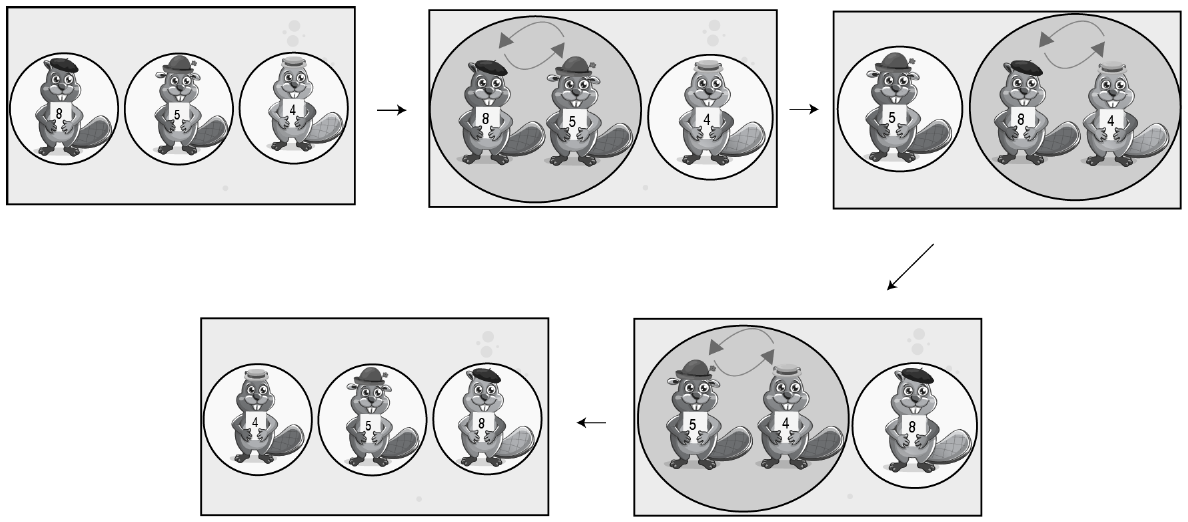
Each beaver holds a number card. They sort themselves into increasing order from left to right. Compare the first two beavers and swap them if the first number is larger. Then compare the second and third, then the third and fourth, and so on. After the rightmost pair, restart from the left. Stop only after a full pass with no swap. The example sorts 8,5,4.

Question illustration

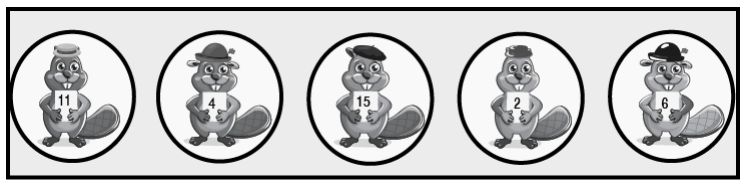
Starting with the five beavers below, how many swaps are needed?

Question illustration
  1. 5
  2. 6
  3. 7
  4. 8

Question 5

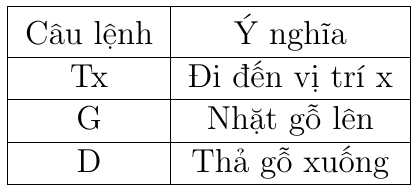
Bob designs a robot beaver that follows these commands.

Question illustration

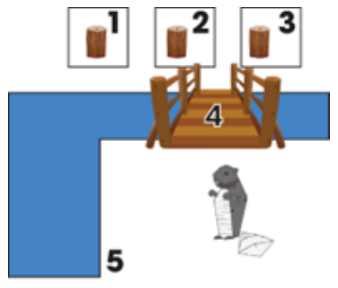
English translation: Tx = go to location x; G = pick up wood; D = put down wood. For example, T4T2GT4D sends the robot to the bridge, then location 2, to pick up wood, back to the bridge, and to put down the wood. The robot works in this forest:

Question illustration

Which program collects the wood at locations 1, 2 and 3 and puts it at location 5? To cross the river, the robot must use the bridge.
  1. T4T1GT4T5DT4T1GT4T5DT4T1GT4T5D
  2. T4T1GT4T5DT4T2DT4T5GT4T3DT4T5G
  3. T4T3GT4T5DT4T2GT4T5DT4T1GT4T5D
  4. T4T1GT4DT4T2GT4DT4T3GT4D

Question 6

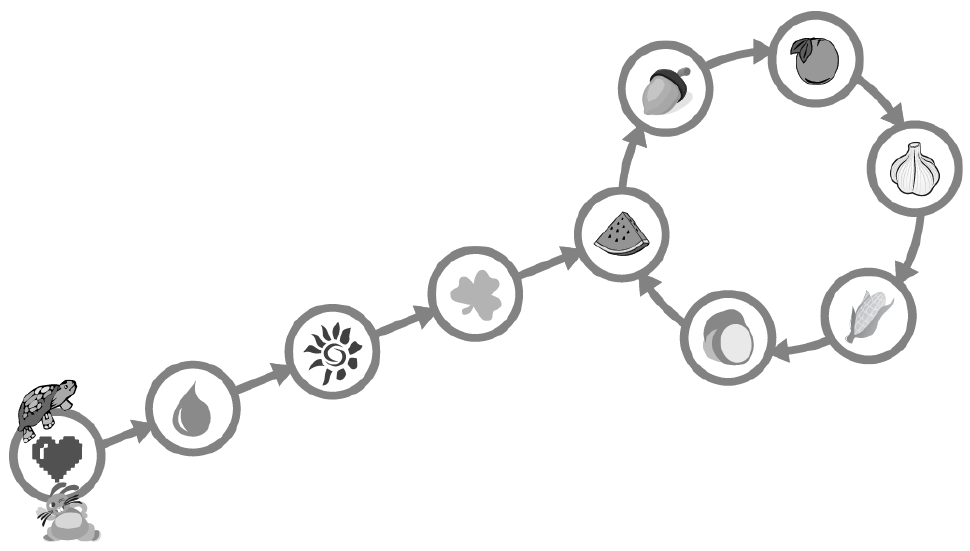
Tortoise and Hare start together at the heart and run along the arrows. Each arrow is one step.

Question illustration

Tortoise moves one step per minute; Hare moves twice as fast, two steps per minute. At which pictured position do they first meet again?

Question illustration
  1. Figure A
  2. Figure B
  3. Figure C
  4. Figure D

Question 7

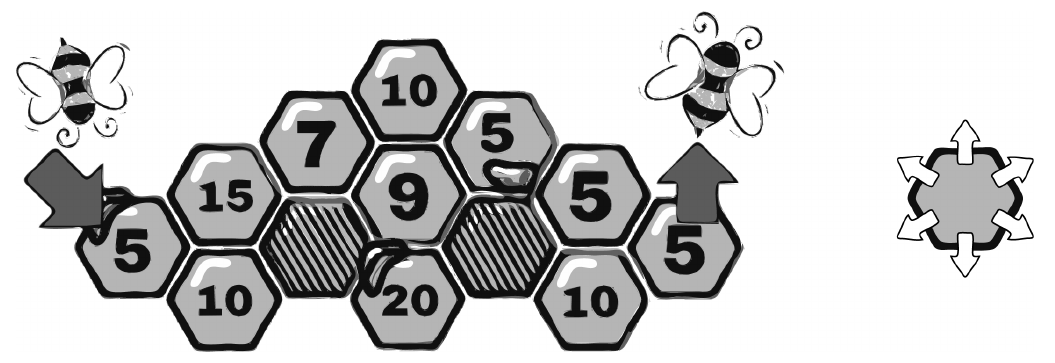
The bee enters at the left arrow and leaves at the right arrow. It visits each hexagonal cell at most once, collecting the amount of honey printed there, then moves to an adjacent cell in one of the six indicated directions.

Question illustration

It cannot enter either striped cell. What is the greatest total honey it can collect?
  1. 76
  2. 81
  3. 92
  4. 101

Question 8

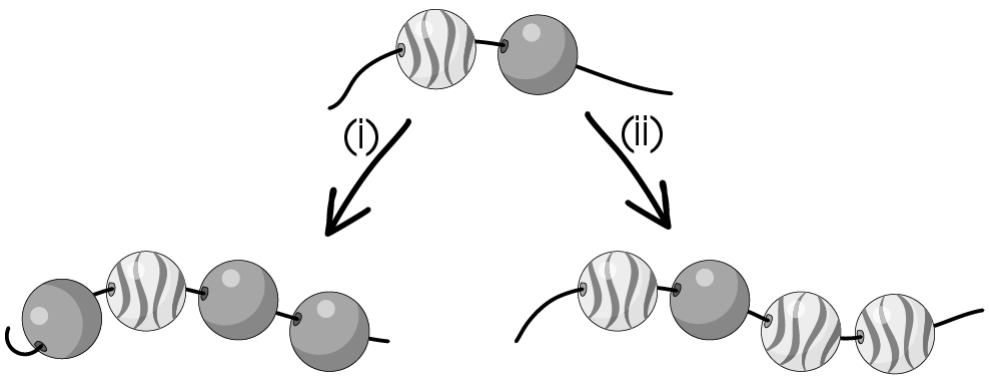
Alex makes strings from striped and plain beads. Start with a striped bead followed by a plain bead.

Question illustration

At each step choose either (i) add one plain bead to each end, or (ii) append two striped beads to the right end. These steps may be repeated.

Question illustration

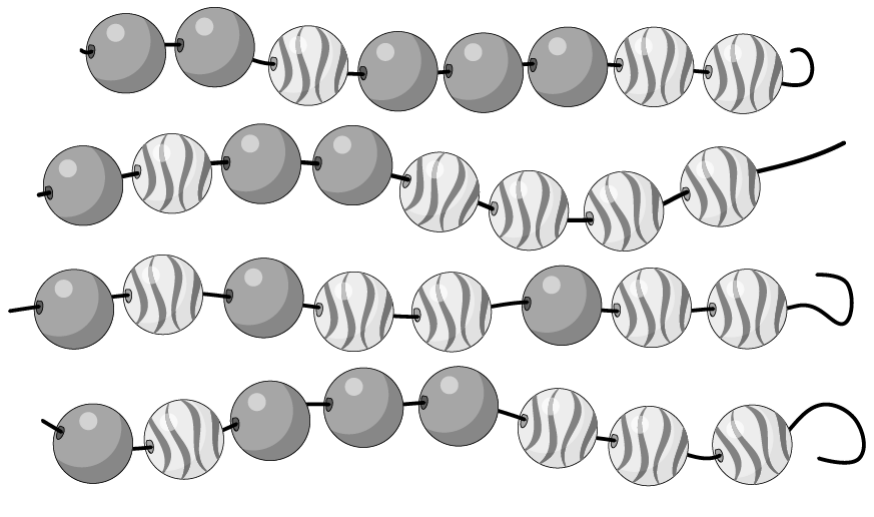
How many of the following four strings can Alex create?

Question illustration
  1. 1
  2. 2
  3. 3
  4. 4

Question 9

Every year, the beavers choose a “lucky queen” as follows:
- Each participant receives a letter card. They stand clockwise in consecutive letter order around a circle.
- Starting with A, they count 1, 2, 3 clockwise. Anyone who says 3 is eliminated; the next remaining beaver restarts at 1. Continue until one remains.
- The last remaining beaver is the lucky queen.
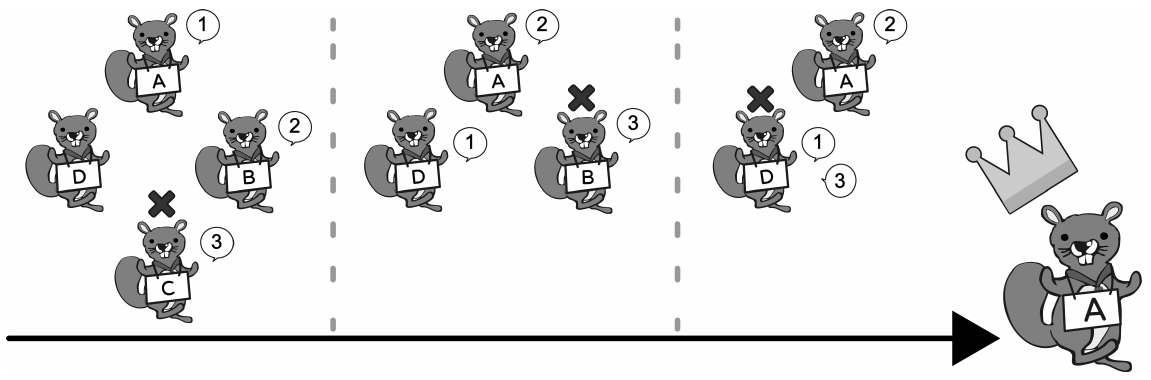
This illustrates the case of four participants:

Question illustration

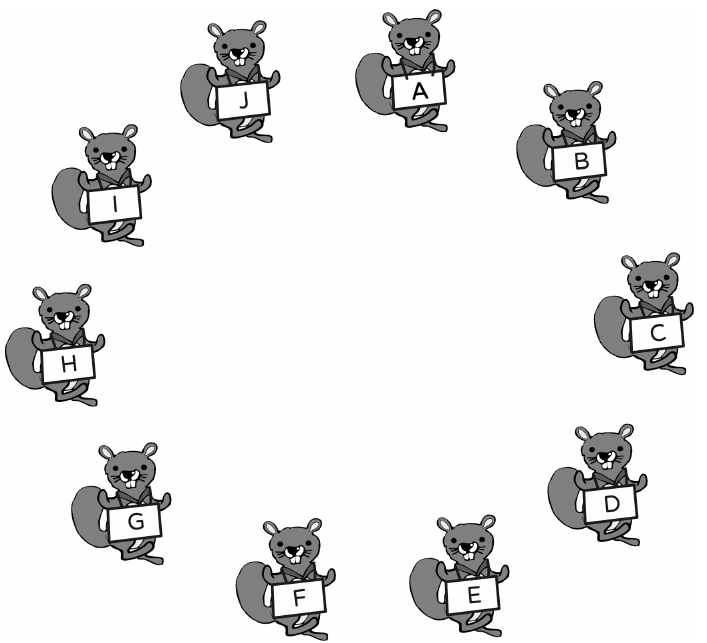
What if there are ten participants holding A, B, C, D, E, F, G, H, I, J?

Question illustration

Who becomes the lucky queen?
  1. The beaver holding A
  2. The beaver holding D
  3. The beaver holding E
  4. The beaver holding J

Question 10

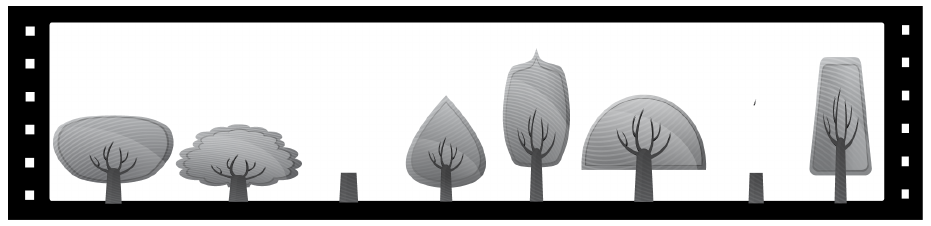
Eight trees are planted in a circle. Last week Alice stood inside it and took a complete 360° panorama as shown.

Question illustration

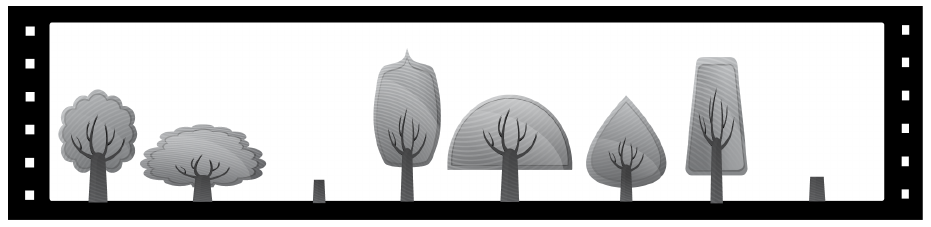
Today she takes another panorama and finds that two trees have been cut down. Which photograph could she take?
Option A:

Question illustration

Option B:

Question illustration

Option C:

Question illustration

Option D:

Question illustration
  1. Figure A
  2. Figure B
  3. Figure C
  4. Figure D

Question 11

Beaver must distribute five items among Fuzzy, Wuzzy and Izzy. Each person values each item differently, as shown.

Question illustration

Columns mean Item 1, Item 2, Item 3, Item 4, Item 5. Fuzzy’s values are 10, 13, 8, 5, 3; Wuzzy’s are 2, 11, 4, 5, 6; Izzy’s are 6, 10, 6, 4, 8. For example, Fuzzy values item 1 at 10 units, while Izzy values it at only 6 units. If Wuzzy has items 4 and 5, Wuzzy has 11 units of value. Beaver A envies Beaver B if A considers B’s items to have greater total value than A’s own items. All five items must be distributed so that no one envies anyone else. What total value could Fuzzy receive? Select all valid options.
  1. 15
  2. 16
  3. 18
  4. 23

Question 12

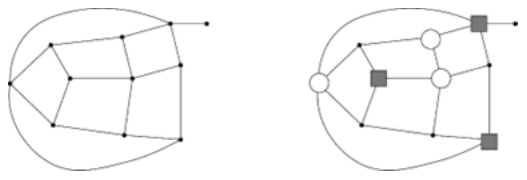
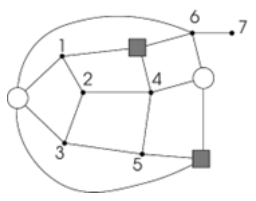
In COL, two players take turns placing their own pieces on empty vertices of the pictured board. One plays white and the other gray. A player loses if two of their own pieces occupy vertices joined by a line. The example shows White losing.

Question illustration

In the following current position, where should White play to guarantee victory?

Question illustration
  1. Position 2
  2. Position 5
  3. Position 7
  4. Position 5 or 7

Question 13

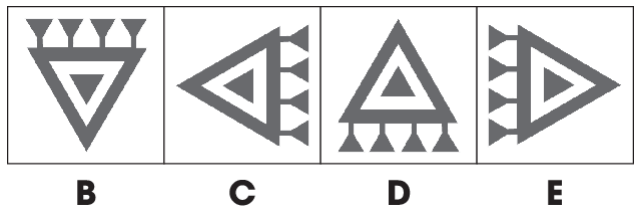
Tom uses the following figures to encode letters.

Question illustration

Each figure and its three successive 90° clockwise rotations correspond, in order, to four consecutive letters of the English alphabet. This example gives the letters encoded by the first figure and its rotations.

Question illustration

Which string could be encoded by the following sequence?

Question illustration
  1. COMPUTER
  2. CUSTOMER
  3. COMMERCE
  4. COLONIST

Question 14

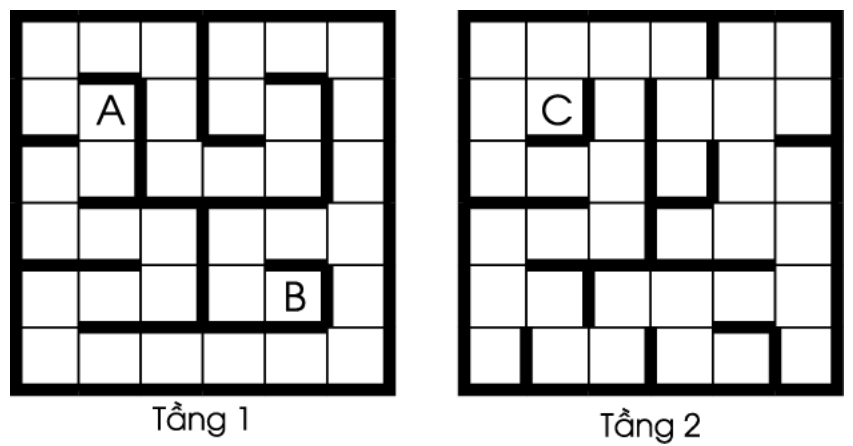
Beaver is in a two-floor maze. On either floor, moving between edge-adjacent cells takes one second if no thick wall blocks the move. Switching magically to the corresponding cell on the other floor takes five seconds.

Question illustration

“Tầng 1” and “Tầng 2” mean Floor 1 and Floor 2. For example, from A it can move down or left in one second, or switch to C on Floor 2 in five seconds. What is the shortest time from A to B?
  1. 16
  2. 17
  3. 18
  4. 20

Question 15

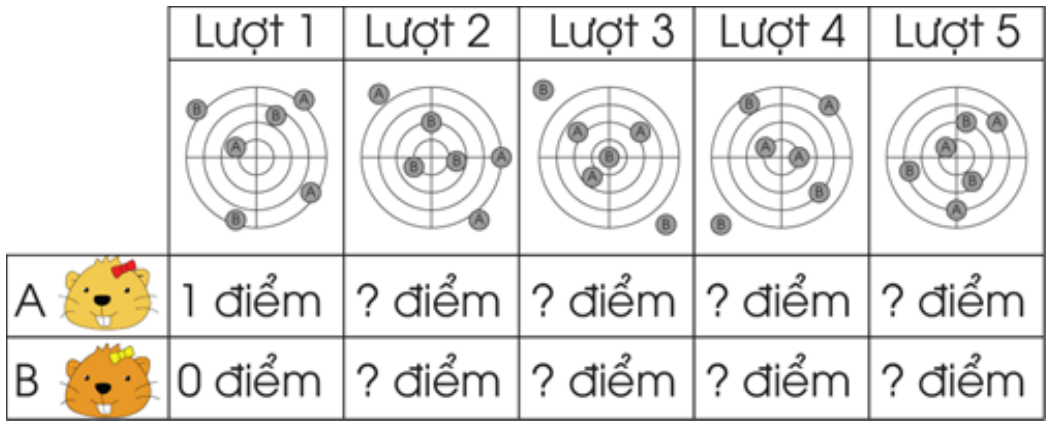
Two beavers play five rounds of darts with these rules:
- Each player throws three darts per round.
- The player with the dart nearest the center wins that round. The winner scores 1, 2 or 3 points according to how many of their darts are closer to the center than the opponent’s nearest dart.
The diagram shows all five rounds and the first-round scores.

Question illustration

“Lượt” means “Round”; “điểm” means “points”; A scores 1 and B scores 0 in round 1. What is the combined total score of the two players after five rounds?
  1. 6
  2. 7
  3. 8
  4. 9