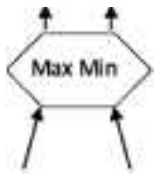
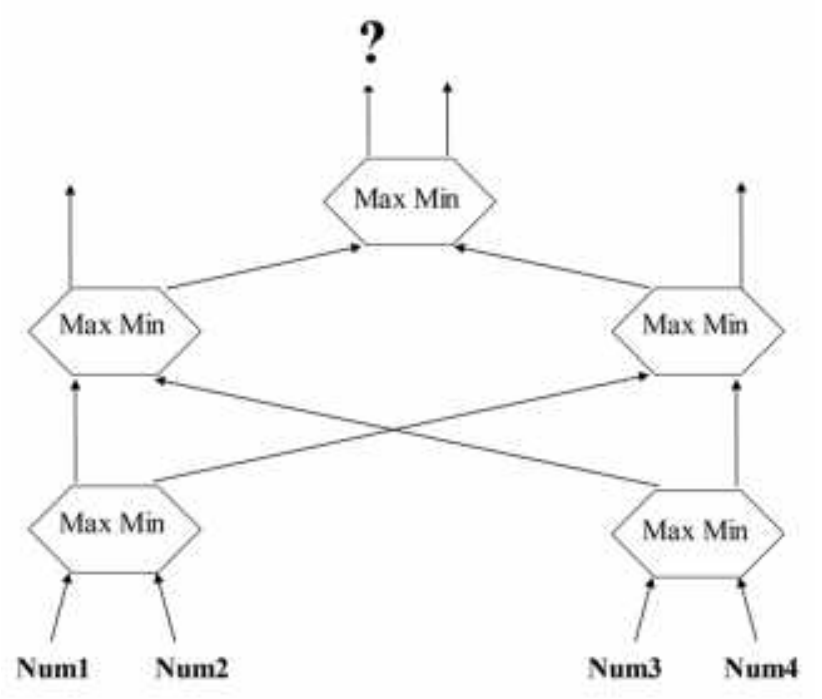
Roberta bought an old calculator that keeps only one digit after the decimal point, discarding all later digits after every operation. For example, 7/5 gives the exact 1.4, but 7/4 gives 1.7 instead of 1.75, an error of 0.05. Computing (7/4)/2 gives first 1.7 and then 0.8, an error of 0.075. If she calculates ((10/3)×(10/3))×9, how far is the displayed result from the exact answer?
Pantellis walks past N piles of logs. The number of logs increases along his walk, and each consecutive increase is either x or y. For example, if a pile contains 5 logs and x=3, y=4, the next pile contains 8 or 9. He wants to determine the possible size of the last pile. There are N=9 piles, x=4 and y=5; the first pile contains no logs. What range contains the possible number in the last pile?
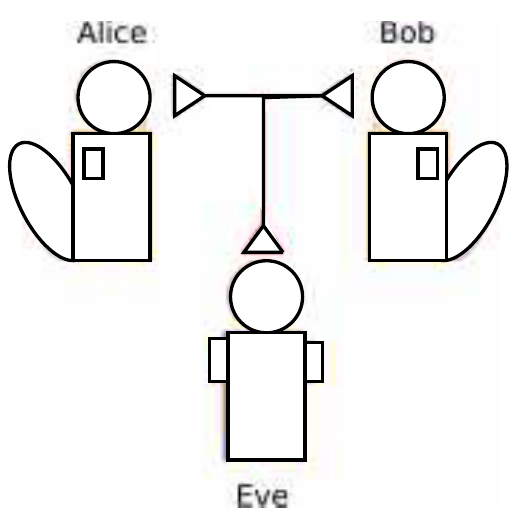
Alice and Bob discover that Eve is trying to read their messages.
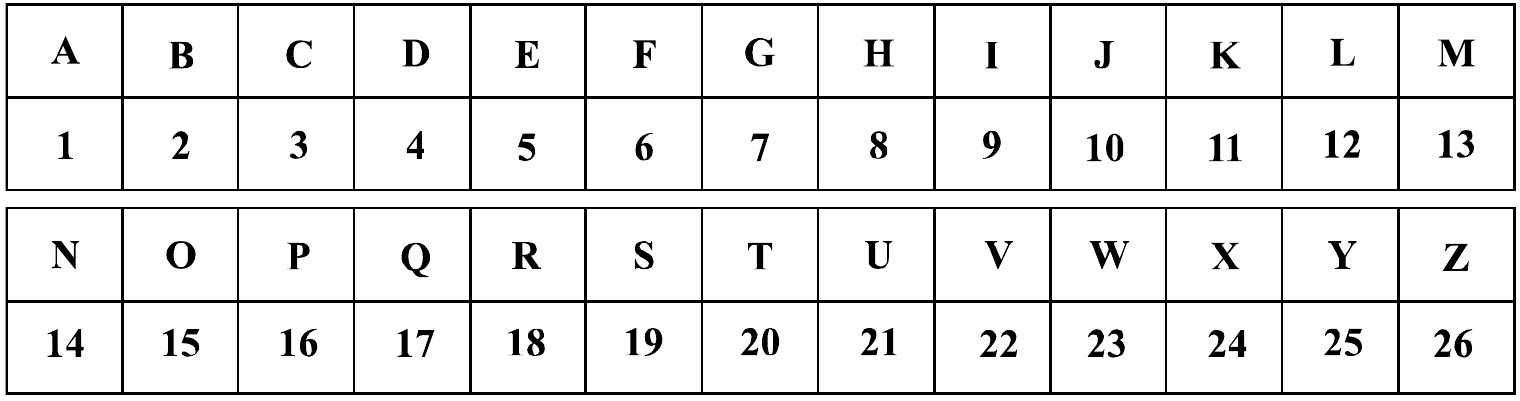
They use letter values A=1, B=2, …, Z=26, shown below.
They send one number and four candidate messages, exactly one genuine and three fake. The number is the sum of the letter values in the genuine message; spaces do not contribute. For example, I WANT TO has sum 9+23+1+14+20+20+15=102.
Which message is intended for Bob if the number is 76?
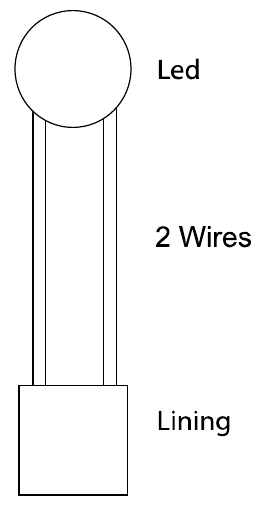
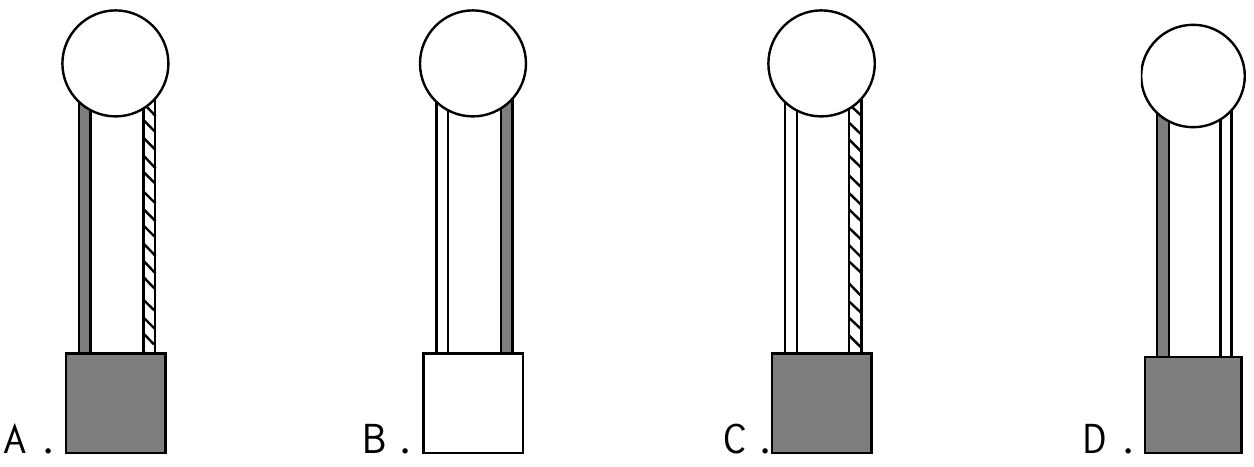
A fictional bomb puzzle has modules, each consisting of an LED that can be on or off, two wires with colors/patterns, and a lining color. The diagram labels “Led”, “2 Wires” and “Lining” identify these components.
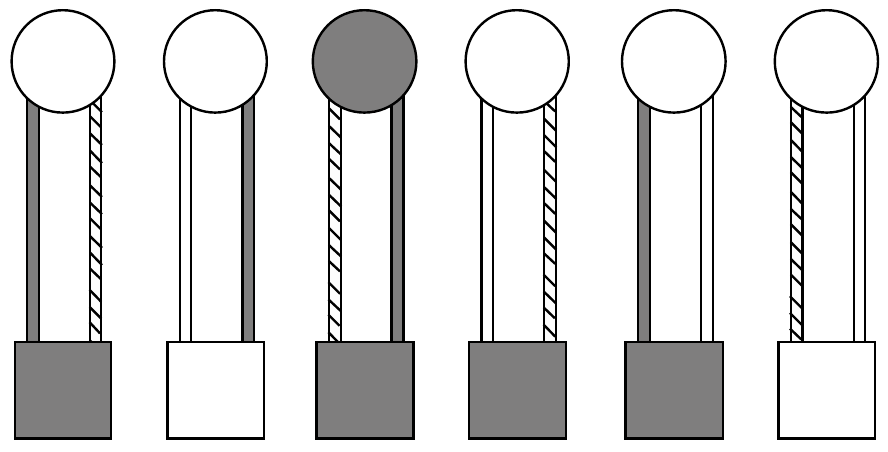
There are six modules, ordered left to right, and both wires of only one module may be cut. The even-position modules have features in common; the odd-position modules also have features in common. Select the module with those common features. Which illustrated module should be selected?
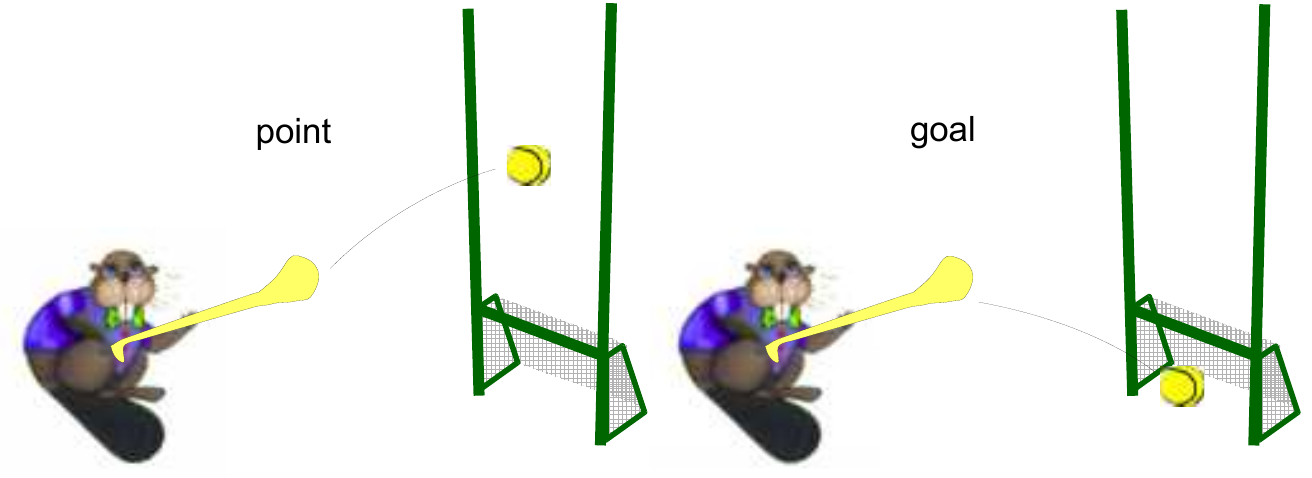
Beavers play a team game with a stick and ball. Hitting above the crossbar scores a “point” worth 1; below it scores a “goal” worth 3.
A score g−p means g goals and p points: 1−2 is 5, 0−2 is 2 and 2−0 is 6. Scores 1−5 and 2−2 both total 8, so that match is a draw. Lyreen River Beavers and Rye River Beavers play four matches:
- Match 1: Lyreen 1−3; Rye 2−1
- Match 2: Lyreen 2−1; Rye 0−4
- Match 3: Lyreen 1−6; Rye 2−4
- Match 4: Lyreen 1−2; Rye 0−5
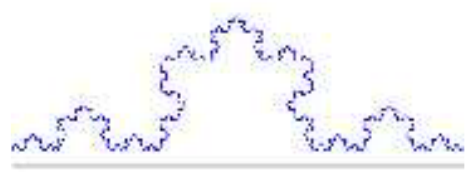
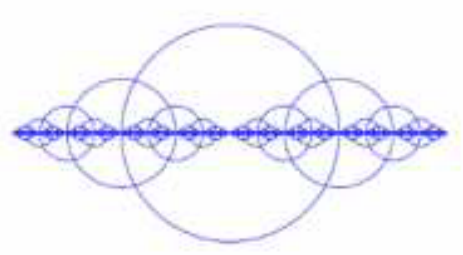
Recursive drawing can create complex patterns from a few instructions, sometimes called algorithmic art. These are examples of a Koch curve and recursive circles.
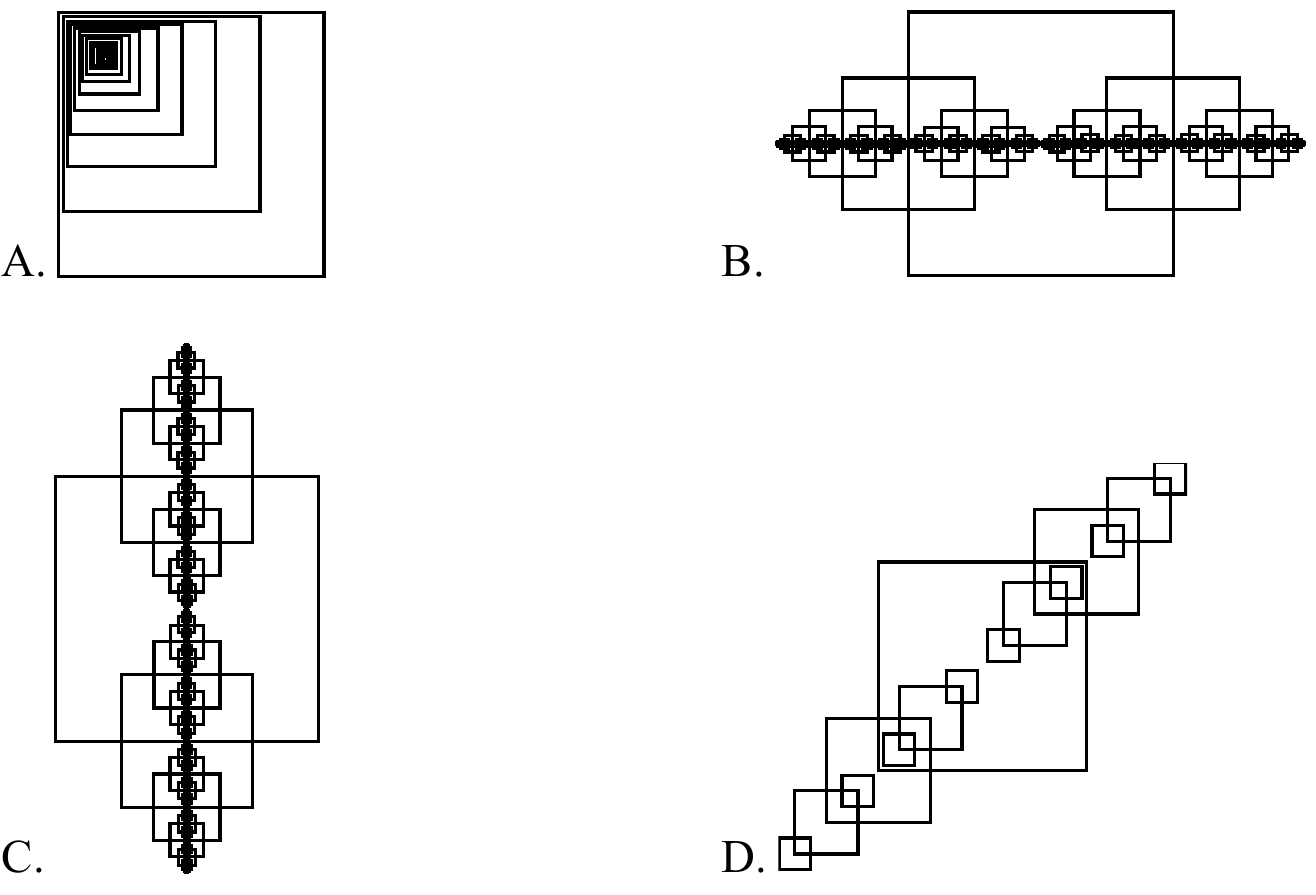
Recursion means that a function calls itself, like repeated reflections between facing mirrors. The source gives this DrawSquare(x,y,s) algorithm:
1. Draw a square of side s centered at (x,y).
2. If the side length is smaller than 2 pixels:
DrawSquare(x+s/2,y,s/2), a smaller square to the right;
DrawSquare(x−s/2,y,s/2), a smaller square to the left.
Which pattern can be produced?
Editorial convention for the conditional answer: preserve the printed “smaller than” rule above, but for a terminating drawing interpret recursion as continuing while s≥2 and stopping after drawing when s<2. The intended correction is not confirmed by the source.
Alonzo's computer uses prefix expressions: (max x₁ … xₙ) returns the greatest input; (min x₁ … xₙ) the least; (+ x₁ … xₙ) their sum; (* x₁ … xₙ) their product. Inputs are real numbers and operations may nest. For example, (+ (* 2 3) (+ 1 2))=9. Evaluate:
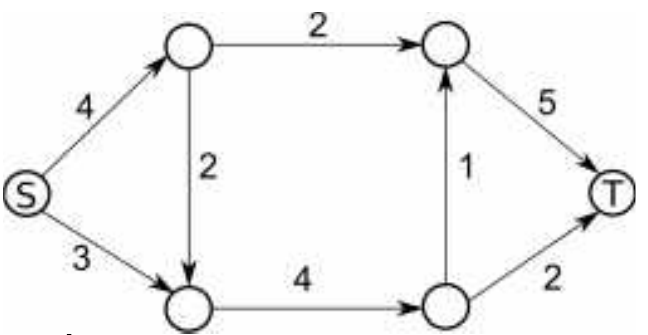
Leslie transports logs through canals from S to T and is paid one beaver dollar per delivered log. All transport must happen in one day. Each directed canal has the daily capacity printed beside its arrow. There are four intermediate stations. Logs must follow the arrows. What is the maximum number delivered in one day?
The power button on your calculator is broken, and you need to calculate 2³⁷. A friend gives two rules:
- For an even exponent, calculate the half power and square it: 2¹⁰=2⁵×2⁵.
- For an odd exponent, subtract one from the exponent and multiply by the base: 2¹¹=2¹⁰×2.
How many multiplications are needed using these rules?
Call a name alphabetically constructible if this procedure can make it: sort all its letters alphabetically; begin with the first letter; then take each remaining letter in order and append it either to the left or to the right of the current string. HENRY is constructible from EHNRY: E→HE→HEN→HENR→HENRY. LUCY is not: sorted CLUY requires C and L to become adjacent, but they are not adjacent in LUCY. Which name below is constructible?
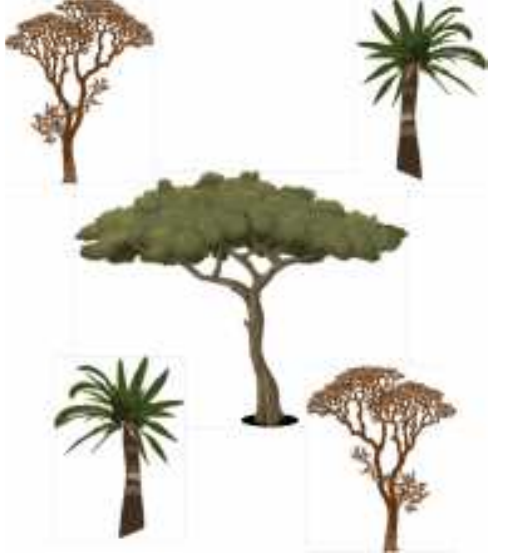
A central leafy tree is surrounded by two bare trees and two palms.
A monkey takes 3 seconds between the central tree and any other tree; 2 seconds between a bare tree and a palm; and 7 seconds between the two bare trees or the two palms. Each tree has a different label P,Q,R,S,T. The monkey visits P,Q,S,R,T,R,P in that order. Which labels can the central tree have if the total travel time is as small as possible?
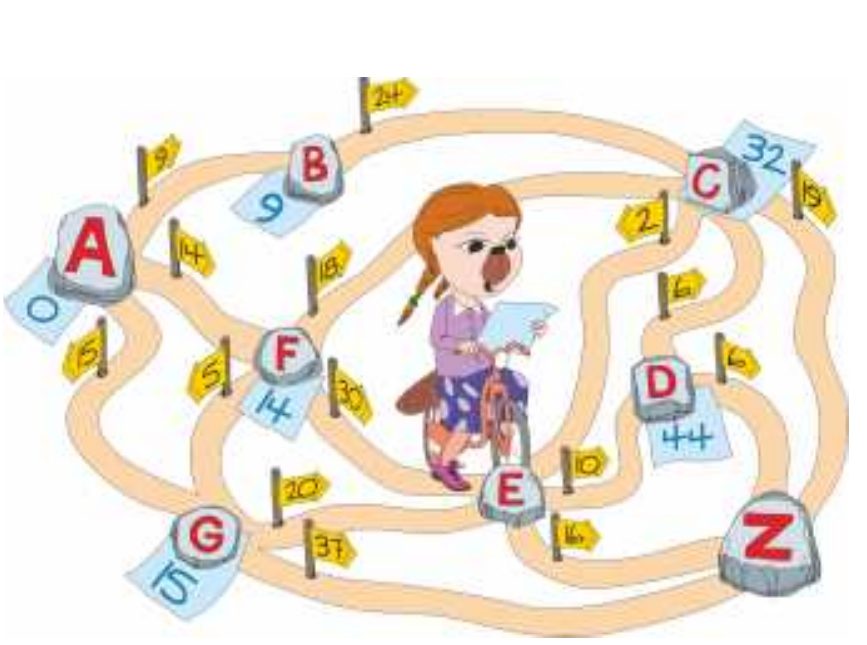
A cyclist seeks the shortest route from A to Z on one-way roads. She uses a shortest-path algorithm and places notes at junctions. Road signs show edge lengths; the blue notes already show A:0, B:9, F:14, G:15, C:32 and D:44. Which number is she writing at E?
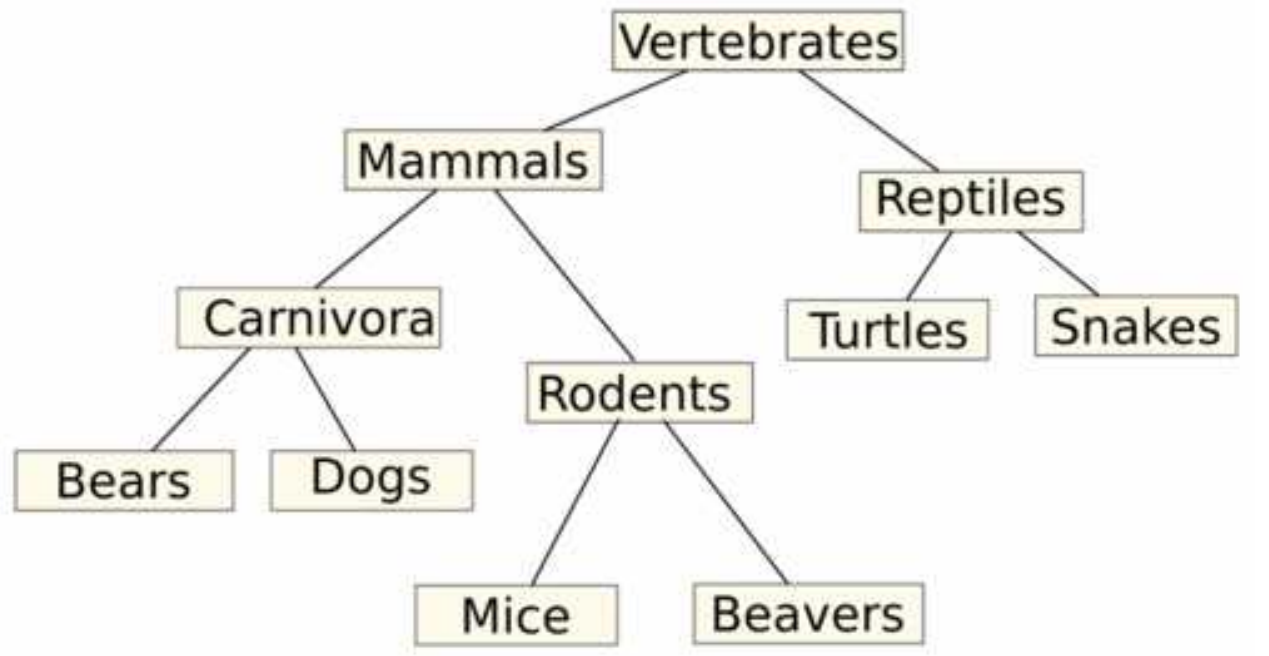
In a classification diagram, a line from a lower group to an upper group means every member of the lower group also belongs to the upper group. For example, all Snakes are Reptiles, and some Mammals are not Mice. The first tree has Vertebrates above Mammals and Reptiles; Mammals above Carnivora and Rodents; Carnivora above Bears and Dogs; Rodents above Mice and Beavers; Reptiles above Turtles and Snakes.
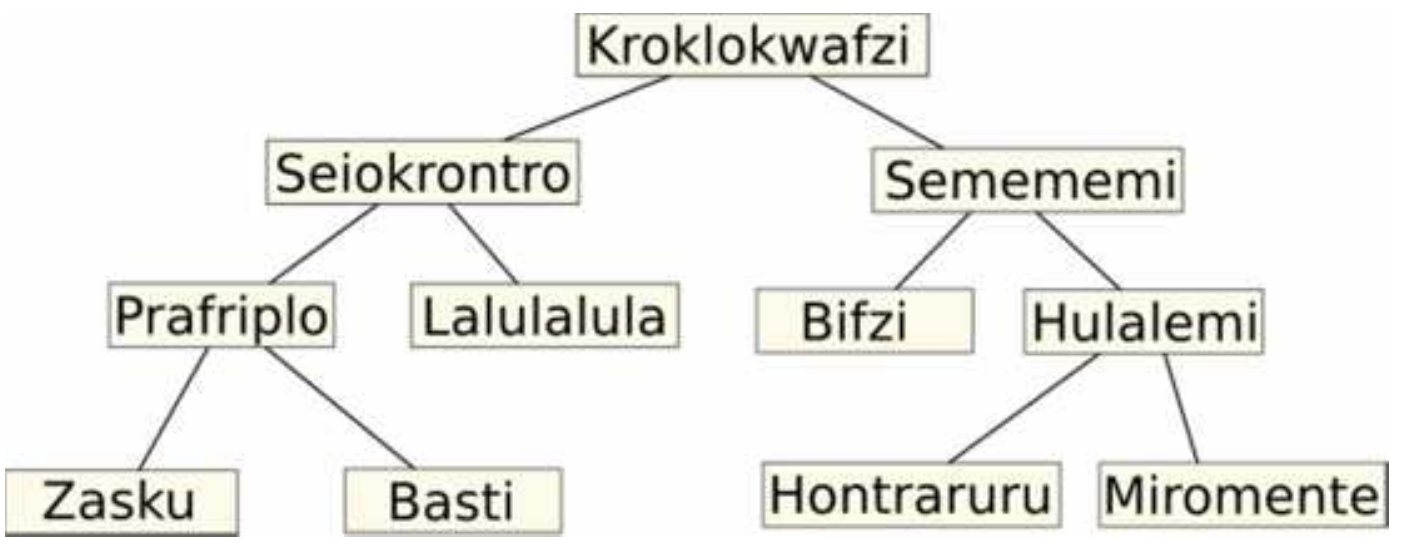
The second diagram shows analogous groups on planet Morgenstern.
Alice: “Every Basti is Seiokronto.” Benjamin: “Some Hontraruru are not Semememi.” What can we say about their statements?
Editorial spelling clarification: Alice's printed “Seiokronto” refers to the node printed “Seiokrontro” in the diagram.
Alonzo's computer uses two operations. R reduces a list with an operation: (R f (x₁ … xₙ)) gives x₁ f x₂ f … f xₙ; for example (R + 1 2 3 4)=10. M maps an operation over a list: (M f (x₁ … xₙ)) gives ((f x₁) … (f xₙ)); for example (M − 1 2 3 4)=(−1 −2 −3 −4). Any operation may be used. If T(x)=3x+2, then (M T 1 2 3)=(5 8 11). Given T(x)=3x+2 and Q(x)=−x, evaluate the printed expression:
(R + (R + (M T 0 2 4) (R + (M Q (M T 3 5)))
Editorial convention: the source's parentheses are unbalanced. For the conditional answer, interpret the intended two sums as (R + (R + (M T 0 2 4)) (R + (M Q (M T 3 5)))). This correction is disclosed rather than claimed to be confirmed source intent.