In Gwen’s classroom, the desks are arranged in a grid. Each row has the same number of desks. Gwen’s desk is third from the front, second from the back and has one desk to the left and four to the right. How many desks are there?
William travels to school in two different ways. Either he walks to school and takes the bus home, or he takes the bus to school and walks home. In each case his total travelling time is 40 minutes. If he were to take the bus both ways, his total travelling time would be 20 minutes. How many minutes would it take if he walked both ways?
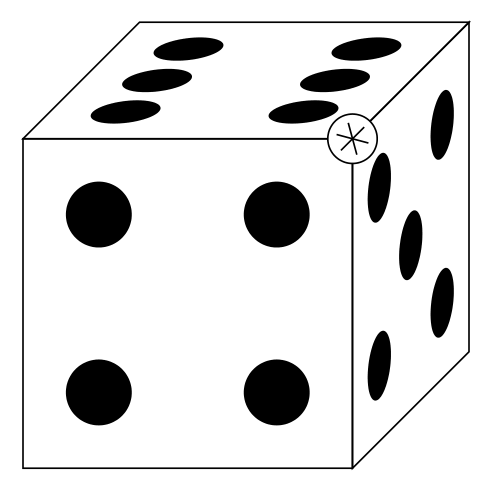
The opposite faces on a standard dice add to give a total of 7. The game of Corners is played by rolling a dice and then choosing a vertex of the dice with your eyes closed. For example, the score for the vertex chosen below would be $4+5+6=15$.
Which of the following scores is NOT possible when playing Corners?
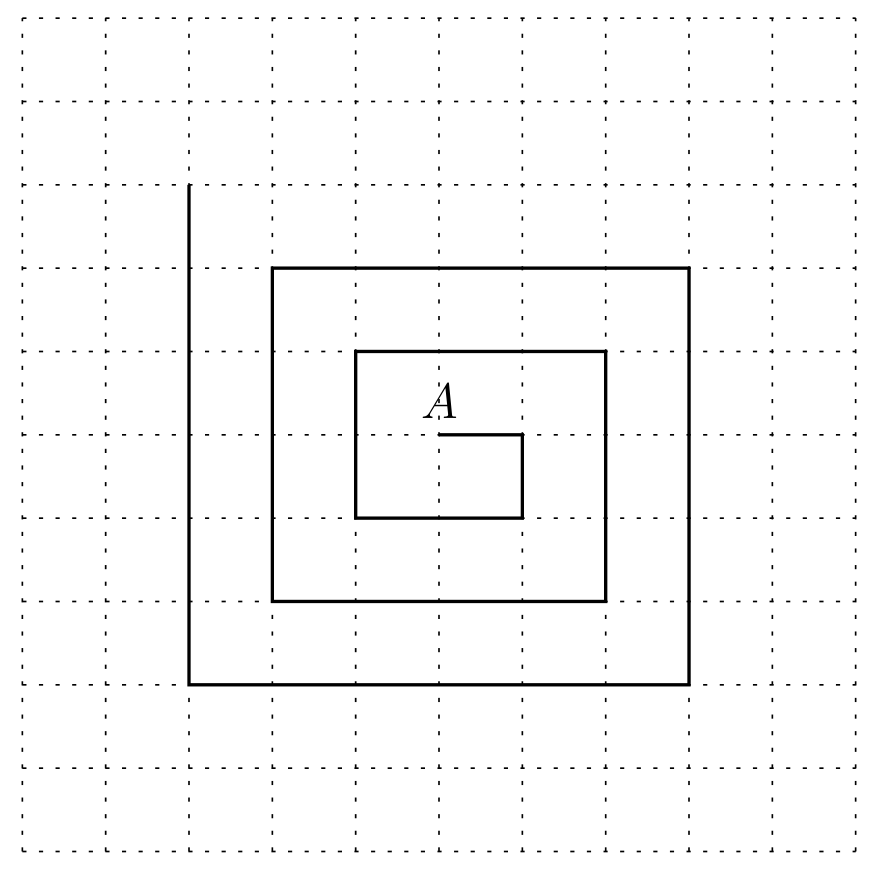
Beginning at the point A, Joel draws the spiral pattern of line segments below on a 1 cm grid. If he continues this pattern, how long, in centimetres, is the 97th segment?
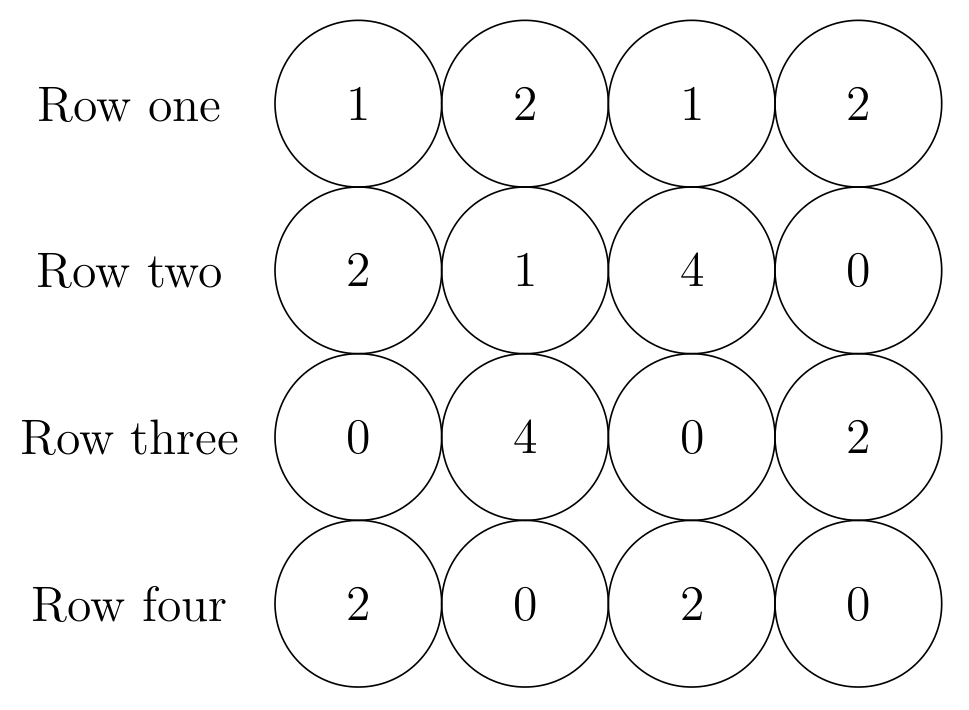
Sixteen discs are arranged in four rows of four. The discs have a number on one side and are either red or green on the other. The number shows how many discs touching that disc have green on the other side.
Which of the following statements is true?
All of the rows have the same number of green discs.
Row one has more green discs than any other row.
Row two has more green discs than any other row.
Row three has fewer green discs than any other row.
Row four has fewer green discs than any other row.
While shopping this week I misread my shopping list and bought 5 loaves of bread and 2 bottles of milk. So I went back to the supermarket, got a full refund, and bought 2 loaves of bread and 5 bottles of milk. This cost me \$4.20 less than my first purchase. How do the prices of bread and milk compare?
A loaf of bread costs \$1.40 more than a bottle of milk.
A loaf of bread costs \$0.60 more than a bottle of milk.
A loaf of bread costs \$0.42 more than a bottle of milk.
A loaf of bread costs \$0.60 less than a bottle of milk.
A loaf of bread costs \$1.40 less than a bottle of milk.
Starting with the number 0 on my calculator, I do a calculation in five steps. At each step, I either add 1 or multiply by 2. What is the smallest number that cannot be the final result?
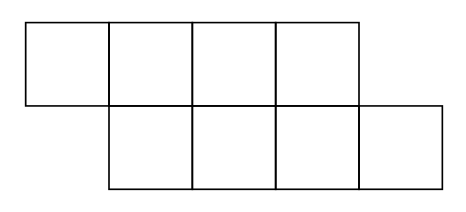
Two more $1\times1$ tiles are added, so that at least one side of each new tile is shared with a side of the original shape. Several different perimeter lengths are now possible. What is the sum of the shortest and longest possible perimeter of the modified shape?