Skip to content / Đến nội dung
ThichHocToan.com

Australian AMC 2009 - Intermediate

Question 1

$(2000+9)+(2000-9)$ equals
  1. 4000
  2. 4009
  3. 200
  4. 2000
  5. 5000

Question 3

The value of $\frac12\times\frac23\times\frac34\times\frac45$ is
  1. $\frac15$
  2. $\frac57$
  3. $\frac16$
  4. $\frac1{15}$
  5. $\frac1{60}$

Question 4

Which of the following has the largest value?
  1. $\frac13$
  2. $\frac13+\frac13$
  3. $\frac13\times\frac13$
  4. $\frac13-\frac13$
  5. $\frac13\div\frac13$

Question 5

Which of the following values can replace the box so that

Question illustration
  1. 500
  2. 50
  3. 5
  4. 0.5
  5. 0.05

Question 6

If $3^k=9^{30}$ then $k$ equals
  1. 15
  2. 30
  3. 40
  4. 60
  5. 90

Question 7

$(x-y)-2(y-z)+3(z-x)$ equals
  1. $-2x-3y+5z$
  2. $-2x-3y-z$
  3. $4x+y-z$
  4. $4x+3y-z$
  5. $2x+3y-5z$

Question 8

The point $(k,17)$ lies on the line joining the points $(1,5)$ and $(4,11)$. The value of $k$ is
  1. 37
  2. 14
  3. 8
  4. 6
  5. 7

Question 9

Paperback books cost \$5 each and hardcover books cost \$7 each. I spend exactly \$86 on books of these two types. What is the maximum number of books that I could have bought?
  1. 10
  2. 14
  3. 16
  4. 18
  5. 20

Question 10

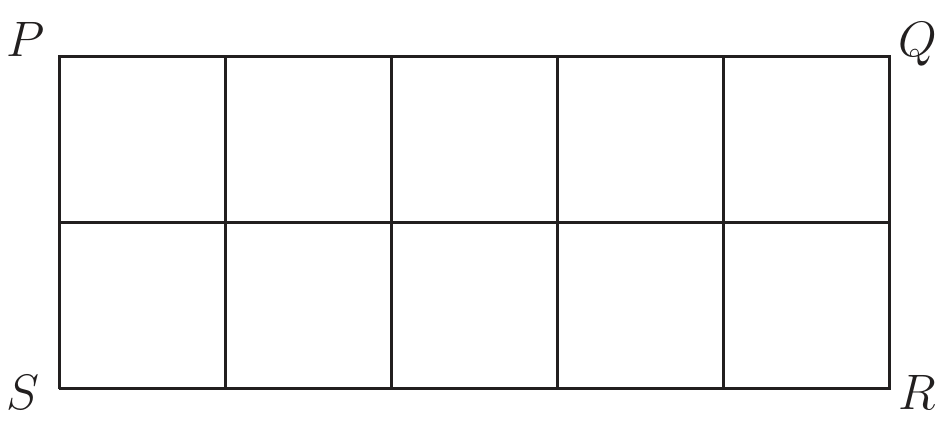
The figure $PQRS$ is a rectangle divided into 10 squares as shown. The perimeter of this rectangle is 21 centimetres. In centimetres, what is the perimeter of each square?

Question illustration
  1. 2.1
  2. 3
  3. 6
  4. 8.4
  5. 12

Question 11

In a school of 1000 students, 570 are girls. One-quarter of the students travel to school by bus and 313 boys do not go by bus. How many girls travel to school by bus?
  1. 7
  2. 63
  3. 153
  4. 180
  5. 133

Question 12

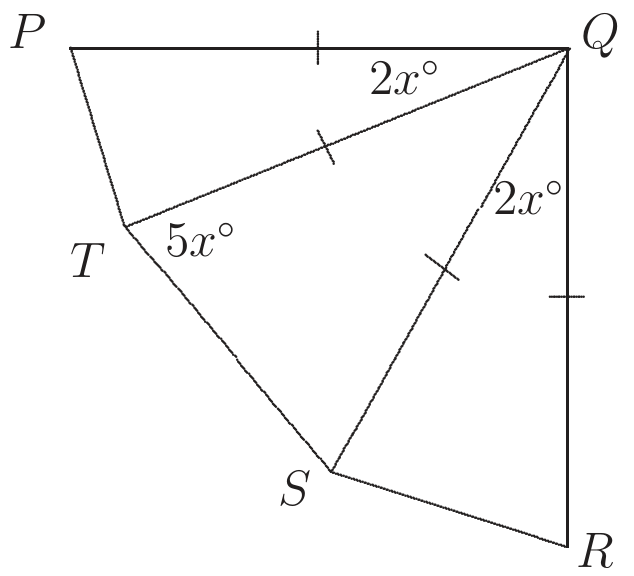
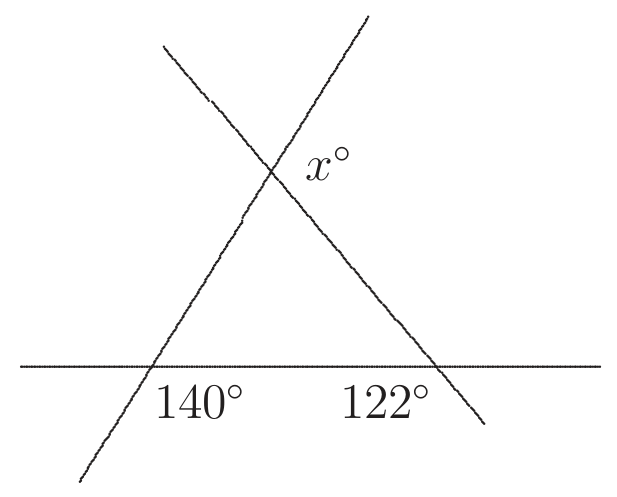
In the diagram, triangles $PQT,QTS$ and $QRS$ are isosceles and $\angle PQR$ is a right angle. Angles $PQT$ and $RQS$ are $2x^\circ$ and angle $QTS$ is $5x^\circ$. The value of $x$ is

Question illustration
  1. 10
  2. 12
  3. 14
  4. 15
  5. 20

Question 13

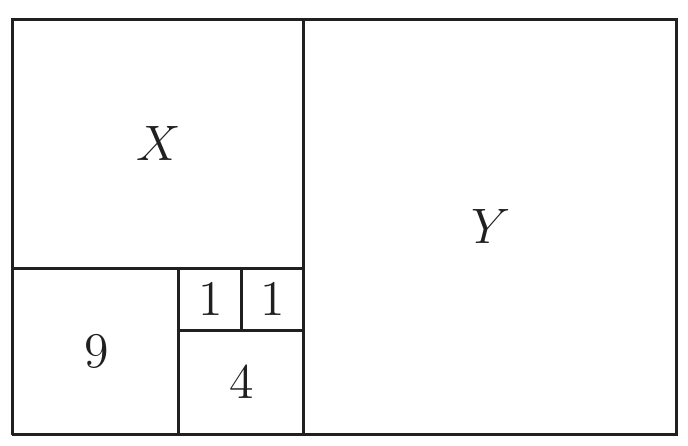
This pattern consists of squares. Areas, in square units, of four of the squares are shown. Given that $X$ and $Y$ are also squares, their areas are respectively

Question illustration
  1. 16, 25
  2. 16, 36
  3. 25, 36
  4. 25, 64
  5. 25, 100

Question 14

Two numbers $P$ and $Q$ are such that $P$ is 40% greater than $Q$. The ratio $P:Q$ is
  1. $40:1$
  2. $5:7$
  3. $5:3$
  4. $5:2$
  5. $7:5$

Question 15

What is the last digit of $6\times8^{2009}$?
  1. 0
  2. 2
  3. 4
  4. 6
  5. 8

Question 16

Two dice are each numbered from 1 to 6, but are biased so that each is twice as likely to land on any of the even numbers as on any of the odd numbers. The two dice are rolled and the numbers multiplied together. What is the probability that the resulting product is odd?
  1. $\frac19$
  2. $\frac29$
  3. $\frac13$
  4. $\frac49$
  5. $\frac23$

Question 17

An eyebrow is an arrangement of the numbers 1, 2, 3, 4 and 5 such that the second and fourth numbers are each bigger than both their immediate neighbours. For example, $(1,3,2,5,4)$ is an eyebrow and $(1,3,4,5,2)$ is not.

The number of eyebrows is
  1. 16
  2. 12
  3. 15
  4. 24
  5. 18

Question 18

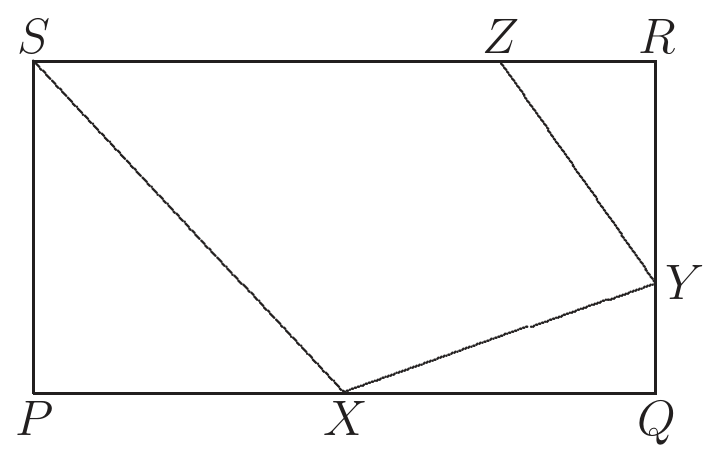
$PQRS$ is a rectangle. $X$ is halfway along $PQ$, $Y$ is a third of the way along $QR$ and $Z$ is a quarter of the way along $RS$. What fraction of the area of $PQRS$ is represented by the quadrilateral $XYZS$?

Question illustration
  1. $\frac12$
  2. $\frac7{12}$
  3. $\frac23$
  4. $\frac34$
  5. $\frac35$

Question 19

The difference between a positive fraction and its reciprocal is $\frac9{20}$. The sum of the fraction and its reciprocal is
  1. $\frac{41}{40}$
  2. $\frac{20}9$
  3. $\frac{25}{16}$
  4. $\frac{41}{20}$
  5. $5$

Question 20

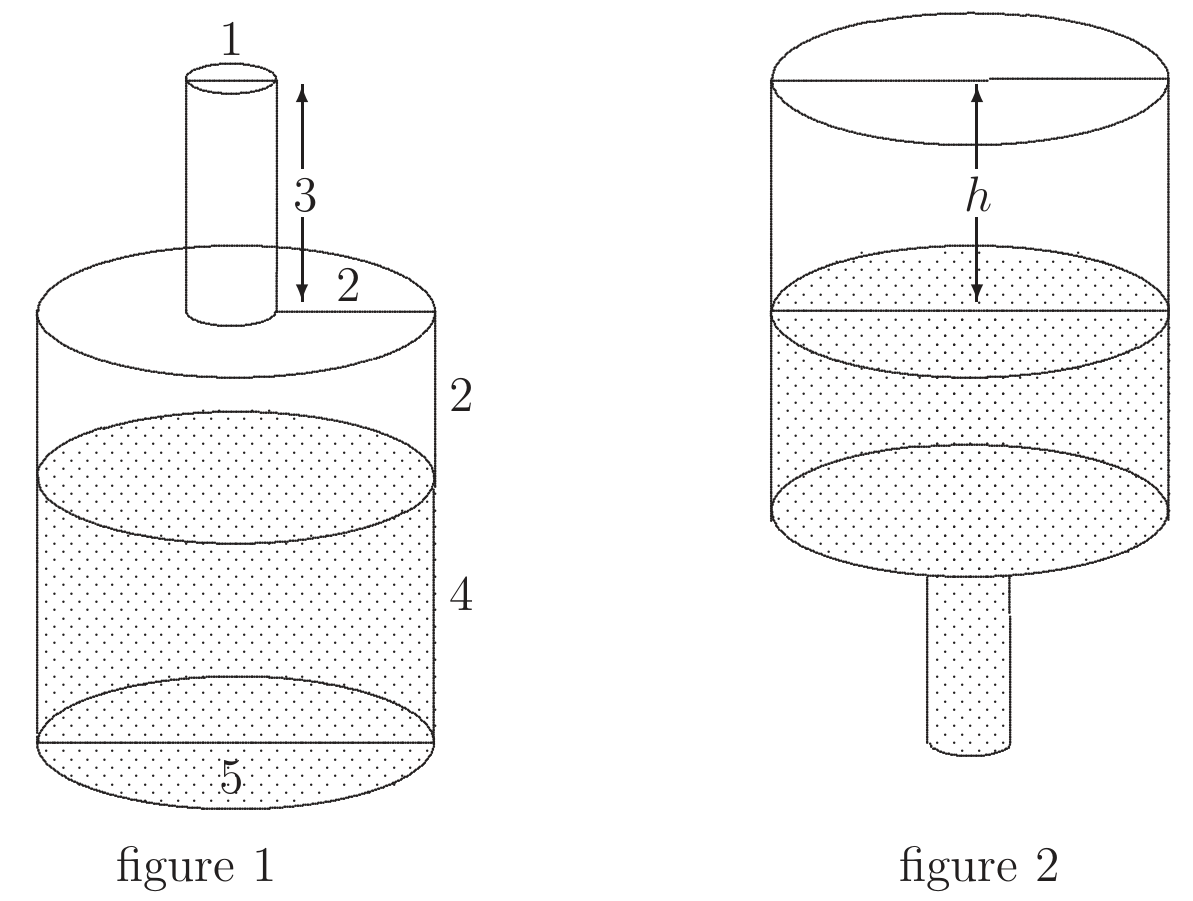
A circular bottle with dimensions, in centimetres, is shown partially filled with water (figure 1).

Question illustration

The bottle is sealed and then turned upside down (figure 2). The height $h$, in centimetres, of the air in the upturned bottle is
  1. $2$
  2. $2\frac13$
  3. $2\frac7{25}$
  4. $2\frac15$
  5. $2\frac3{25}$