Amy and Ben start running on a 200-metre circular track at the same time and starting point in a clockwise direction. The speeds of Amy and Ben are 6 m/s and 4 m/s respectively. How many times did Amy overtake Ben within the first 16 minutes of the run?
There are 10 red, yellow and green balls in a container. The balls are identical in size. The red balls are marked with the number “4” while the yellow and green balls are marked with “5” and “6” respectively. If 8 balls are drawn and the sum of numbers on the balls is 39, how many of these are red balls?
Editorial clarification: the given information allows several answers. Give all possible red-ball counts.
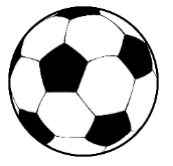
A standard soccer ball is a sphere made up of 32 regular pentagons and hexagons. The diagram below shows a sample of a soccer ball where the hexagons are white and the pentagons are black. How many hexagons are there on the surface of a soccer ball?
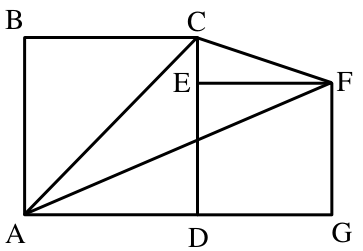
The diagram below shows two squares $ABCD$ and $DEFG$ where $ADG$ is a straight line and the point $E$ lies on $DC$. The length of each side of square $ABCD$ is 8 cm. What is the area of triangle $ACF$?
During a class gathering, Andy bought some bottled drinks under a special offer from a supermarket. For every 5 empty bottles, Andy can exchange 1 free bottled drink from the supermarket. Andy’s class drank a total of 109 bottled drinks, some of which are obtained from the exchange of empty bottles. How many bottled drinks did Andy buy?
In a class of 52 students, there are 30 students who can swim, 35 students who can cycle and 42 students who can play table tennis. At least how many students are there in this class who can swim, cycle and play table tennis?
A transport company has two types of delivery trucks. A larger truck can carry 7 tons of goods and a smaller truck can carry 4 tons of goods. The fuel consumption for a larger truck and a smaller truck is 14 litres per trip and 9 litres per trip respectively. Find the minimum total fuel consumption required for the company to deliver 89 tons of goods.
The sum of the other interior angles of a convex polygon, excluding an interior angle of a vertex, is $2015^\circ$. What is the measure of this excluded interior angle?
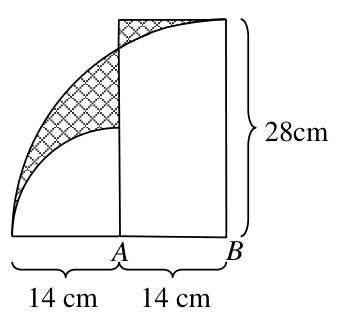
In the diagram below, points $A$ and $B$ are the centres of 2 quadrants with radius 14 cm and 28 cm respectively. What is the difference in area between the two shaded regions? Take $\pi=\frac{22}{7}$.
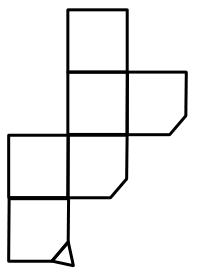
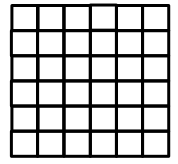
The diagram below shows a $6\times6$ grid. How many shapes of the four displayed orientations of an L-shaped piece made of three unit squares are there altogether in a $6\times6$ grid?
When an integer is divided by another, the quotient is 15 and the remainder is 5. Given that the sum of the dividend, divisor, quotient and remainder is 2169, find the value of the dividend.
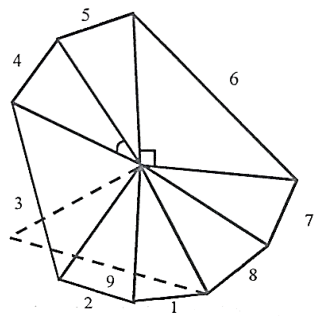
The figure below, not drawn to scale, is formed by combining two types of triangles. Triangle 1 and 2 are isosceles triangles each with a $30^\circ$ angle at one of its vertices. Triangle 3 is a right-angled isosceles triangle. Triangles 4 and 5 are isosceles triangles each with a vertex of $30^\circ$. Triangle 6 is a right-angled isosceles triangle. This pattern continues with subsequent isosceles triangles. Given that the $n$th triangle overlaps with Triangle 1, find the smallest possible value of $n$.
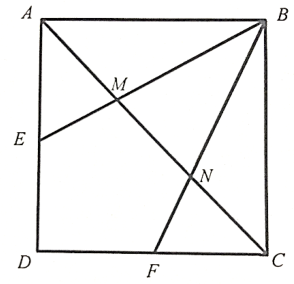
The diagram below shows a square $ABCD$ and the points $E$ and $F$ are mid-points of $AD$ and $CD$ respectively. $BE$ and $BF$ intersect the diagonal $AC$ at points $M$ and $N$ respectively. Given that the area of the square is 48 cm$^2$, find the area of the pentagon $EDFNM$.