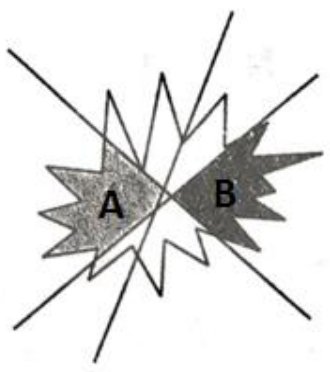
In the figure below, each of the three lines bisected the figure into two regions of equal areas. What is the relationship between shaded area $A$ and shaded area $B$?
(A) $A>B$; (B) $A<B$; (C) $A=B$; (D) Insufficient information to deduce.
Find the number of fractions, among those listed below, which are in their simplest form: $\frac16,\frac27,\frac38,\ldots,\frac{2010}{2015},\frac{2011}{2016}$.
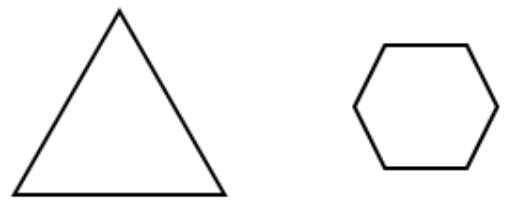
In the diagram below, the equilateral triangle has a length of 3 cm and the hexagon has a length of 1 cm. Given that the ratio of the area of the equilateral triangle to the area of the hexagon is $a:2$, find the value of $a$.
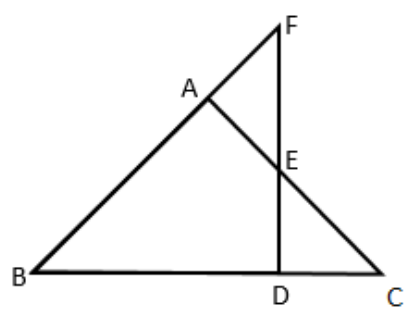
The diagram shows an isosceles triangle $ABC$ in which $\angle BAC=90^\circ$ and $BC=6$ cm. $F$ is a point on $BA$ produced such that $FD$ is perpendicular to $BC$ and it intersects $AC$ at $E$. $D$ lies on $BC$. Find the total length of $DE$ and $DF$.
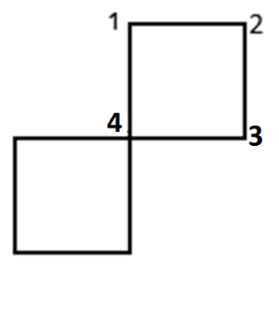
He drives along for 20 m then turns left;
Then drives along for 20 m then turns right;
Then drives along for 20 m then turns right;
Then drives along for 20 m then turns right;
And he repeats the same cycle.
The diagram below shows the path that Daniel drove. From which point (1, 2, 3 or 4) did he begin his journey?
Three cubes have different lengths of 3 cm, 4 cm and 5 cm respectively. All faces of the cubes were painted red. If all three cubes were cut up into smaller 1-cm cubes, find the number of 1-cm cubes that has at least one face painted red.
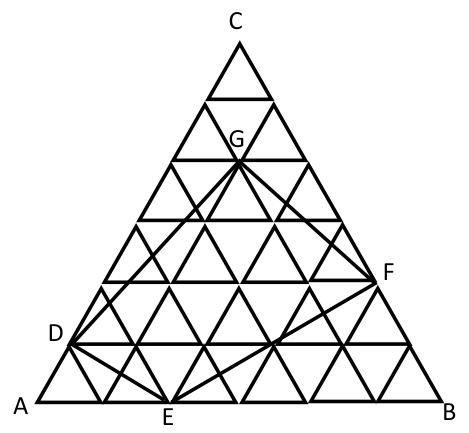
In the diagram below, each side of the equilateral triangle $ABC$ is divided into six equal segments. Given that every small triangle in the diagram has an area of 1 cm$^2$, find the area of the quadrilateral $DEFG$ in cm$^2$.
Two rabbits, Harry and Bunny, leave from points A and B respectively and travel towards each other. Harry’s speed is 1.5 times of Bunny’s speed. If the two rabbits first meet at a point that is 12 m away from the mid-point of AB, find the distance of AB.
It is known that the area of three different sides of a rectangular cuboid is in a ratio of 2 : 3 : 5. The total length of all its edges is 124 cm. Find the volume of the rectangular cuboid.
There is a sequence of the first 300 positive integers 1, 2, 3, ..., 299, 300. If the numbers that are divisible by 5 or 7 are removed from the sequence, find the 123rd number in the remaining sequence.
2016 distinct points are chosen within triangle $ABC$ such that no three points among the 2019 points (inclusive of $A,B,C$) lie on a straight line. Using these 2019 points as vertices, how many smaller triangles can triangle $ABC$ be cut into?
Find the value of $84\times\left(\frac{1}{1\times3}-\frac{2}{3\times5}+\frac{3}{5\times7}-\frac{4}{7\times9}+\cdots+\frac{9}{17\times19}-\frac{10}{19\times21}\right)$.
Given that $a,b,c$ are prime numbers, not necessarily distinct, and their product is the sum of 7 consecutive positive integers. Find the smallest possible value of $a+b+c$.
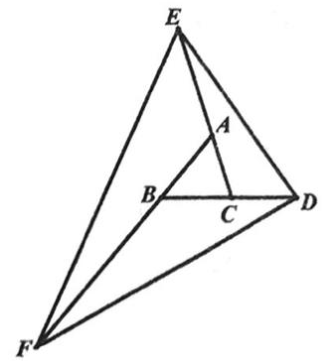
In the figure below, not drawn to scale, the area of triangle $ABC$ is 1 cm$^2$. The points $D,E,F$ are on $BC,CA,AB$ produced such that $BD=2BC$, $CE=3CA$ and $AF=4AB$. Find the area of triangle $DEF$.
Six 10-cent coins have the same height as five 20-cent coins when stacked on top of each other. Four 10-cent coins have the same height as three 50-cent coins when stacked on top of each other. Using 10-cent, 20-cent and 50-cent coins to stack into three stacks of equal height, a total of 124 coins have been used. What is the total value of these coins? Enter the value in dollars.