Skip to content / Đến nội dung
ThichHocToan.com

1994 AMC 8

Question 1

Which of the following is the largest?
  1. $\dfrac{1}{3}$
  2. $\dfrac{1}{4}$
  3. $\dfrac{3}{8}$
  4. $\dfrac{5}{12}$
  5. $\dfrac{7}{24}$

Question 2

What is the value of the following expression?

$$
\begin{aligned} &\frac{1}{10} + \frac{2}{10} + \frac{3}{10} + \frac{4}{10} \\ &\quad {}+ \frac{5}{10} + \frac{6}{10} + \frac{7}{10} + \frac{8}{10} \\ &\quad {}+ \frac{9}{10} + \frac{55}{10} \end{aligned}
$$
  1. $4\dfrac{1}{2}$
  2. $6.4$
  3. $9$
  4. $10$
  5. $11$

Question 3

Each day Maria must work $8$ hours. This does not include the $45$ minutes she takes for lunch. If she begins working at $7{:}25$ A.M. and takes her lunch break at noon, then her working day will end at
  1. $3{:}40$ P.M.
  2. $3{:}55$ P.M.
  3. $4{:}10$ P.M.
  4. $4{:}25$ P.M.
  5. $4{:}40$ P.M.

Question 4

Which of the following represents the result when the figure shown at the right is rotated clockwise $120°$ about its center?

Question illustration

**(A)** Question illustration

**(B)** Question illustration

**(C)** Question illustration

**(D)** Question illustration

**(E)** Question illustration
  1. Choice A shown above
  2. Choice B shown above
  3. Choice C shown above
  4. Choice D shown above
  5. Choice E shown above

Question 5

Given that $1$ mile $= 8$ furlongs and $1$ furlong $= 40$ rods, the number of rods in one mile is
  1. $5$
  2. $320$
  3. $660$
  4. $1760$
  5. $5280$

Question 6

The unit’s digit (one’s digit) of the product of any six consecutive positive whole numbers is
  1. $0$
  2. $2$
  3. $4$
  4. $6$
  5. $8$

Question 7

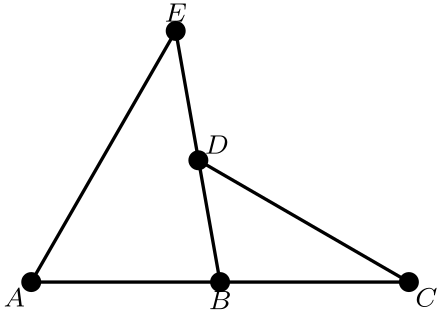
If $\angle A = 60°,$ $\angle E = 40°,$ and $\angle C = 30°,$ then $\angle BDC =$

Question illustration
  1. $40°$
  2. $50°$
  3. $60°$
  4. $70°$
  5. $80°$

Question 8

For how many three-digit whole numbers does the sum of the digits equal $25?$
  1. $2$
  2. $4$
  3. $6$
  4. $8$
  5. $10$

Question 9

A shopper buys a $\$100$ coat on sale for $20\%$ off. An additional $\$5$ is taken off the sale price by using a discount coupon. A sales tax of $8\%$ is paid on the final selling price. The total amount the shopper pays for the coat is
  1. $\$81.00$
  2. $\$81.40$
  3. $\$82.00$
  4. $\$82.08$
  5. $\$82.40$

Question 10

For how many positive integer values of $N$ $(N \gt 0)$ is the expression

$$
\frac{36}{N+2}
$$

an integer?
  1. $7$
  2. $8$
  3. $9$
  4. $10$
  5. $12$

Question 11

Last summer $100$ students attended basketball camp. Of those attending, $52$ were boys and $48$ were girls. Also, $40$ students were from Jones Middle School and $60$ were from Clay Middle School. Twenty of the girls were from Jones Middle School. How many of the boys were from Clay Middle School?
  1. $20$
  2. $32$
  3. $40$
  4. $48$
  5. $52$

Question 12

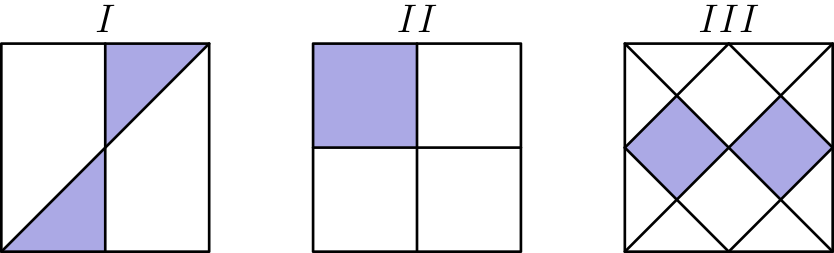
Each of the three large squares shown is the same size. Segments that intersect the sides of the squares intersect at the midpoints of the sides. How do the shaded areas of these squares compare?

Question illustration
  1. The shaded areas in all three are equal.
  2. Only the shaded areas of $I$ and $II$ are equal.
  3. Only the shaded areas of $I$ and $III$ are equal.
  4. Only the shaded areas of $II$ and $III$ are equal.
  5. The shaded areas of $I,$ $II,$ and $III$ are all
    different.

Question 13

The number halfway between $\dfrac{1}{6}$ and $\dfrac{1}{4}$ is
  1. $\dfrac{1}{10}$
  2. $\dfrac{1}{5}$
  3. $\dfrac{5}{24}$
  4. $\dfrac{7}{24}$
  5. $\dfrac{5}{12}$

Question 14

Two children at a time can play pairball. For $90$ minutes, with only two children playing at one time, five children take turns so that each one plays the same amount of time. The number of minutes each child plays is
  1. $9$
  2. $10$
  3. $18$
  4. $20$
  5. $36$

Question 15

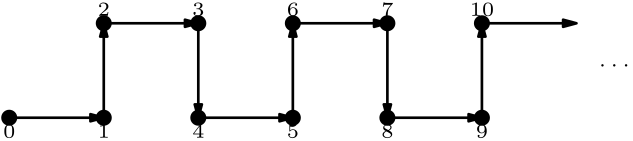
If this path is to continue in the same pattern, then which sequence of arrows goes from point $425$ to point $427?$

Question illustration

**(A)** Question illustration

**(B)** Question illustration

**(C)** Question illustration

**(D)** Question illustration

**(E)** Question illustration
  1. Choice A shown above
  2. Choice B shown above
  3. Choice C shown above
  4. Choice D shown above
  5. Choice E shown above

Question 16

The perimeter of one square is $3$ times the perimeter of another square. The area of the larger square is how many times the area of the smaller square?
  1. $2$
  2. $3$
  3. $4$
  4. $6$
  5. $9$

Question 17

Pauline Bunyan can shovel snow at the rate of $20$ cubic yards for the first hour, $19$ cubic yards for the second, $18$ for the third, etc., always shoveling one cubic yard less per hour than the previous hour. If her driveway is $4$ yards wide, $10$ yards long, and covered with snow $3$ yards deep, then the number of hours it will take her to shovel it clean is closest to
  1. $4$
  2. $5$
  3. $6$
  4. $7$
  5. $12$

Question 18

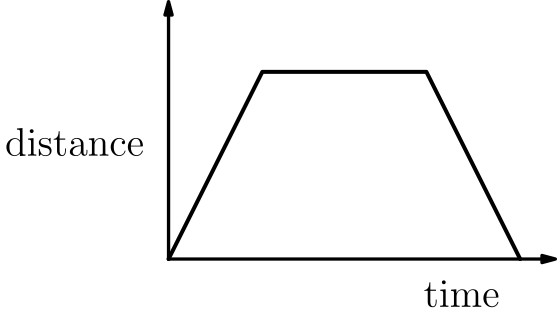
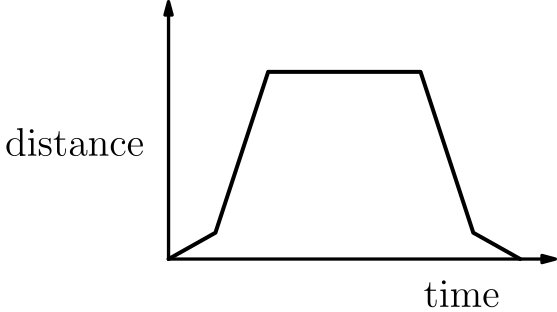
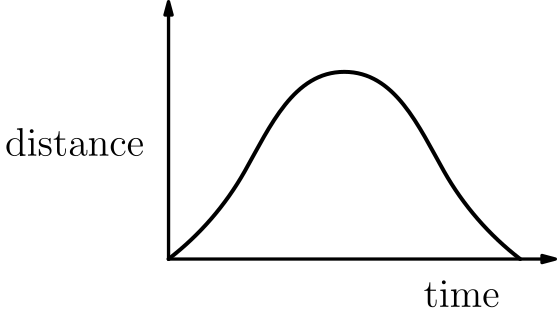
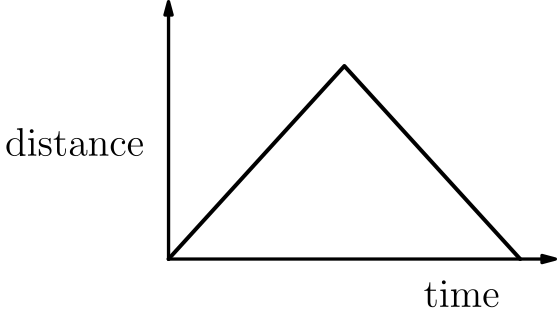
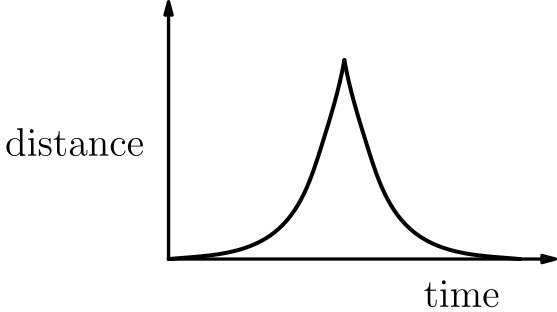
Mike leaves home and drives slowly east through city traffic. When he reaches the highway he drives east more rapidly until he reaches the shopping mall where he stops. He shops at the mall for an hour. Mike returns home by the same route as he came, driving west rapidly along the highway and then slowly through city traffic. Each graph shows the distance from home on the vertical axis versus the time elapsed since leaving home on the horizontal axis. Which graph is the best representation of Mike’s trip?

**(A)** Question illustration

**(B)** Question illustration

**(C)** Question illustration

**(D)** Question illustration

**(E)** Question illustration
  1. Choice A shown above
  2. Choice B shown above
  3. Choice C shown above
  4. Choice D shown above
  5. Choice E shown above

Question 19

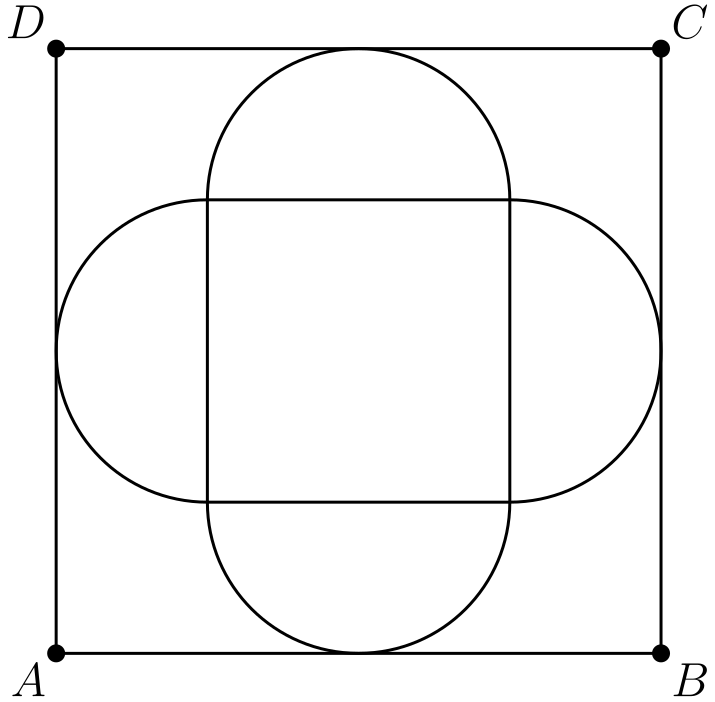
Around the outside of a $4$ by $4$ square, construct four semicircles with the four sides of the square as their diameters. Another square, $ABCD,$ has its sides parallel to the corresponding sides of the original square, and each side of $ABCD$ is tangent to one of the semicircles. The area of the square $ABCD$ is

Question illustration
  1. $16$
  2. $32$
  3. $36$
  4. $48$
  5. $64$

Question 20

Let $W,$ $X,$ $Y,$ and $Z$ be four different digits selected from the set

$$
\{1, 2, 3, 4, 5, 6, 7, 8, 9\}.
$$

If the sum $\dfrac{W}{X} + \dfrac{Y}{Z}$ is to be as small as possible, then $\dfrac{W}{X} + \dfrac{Y}{Z}$ must equal
  1. $\dfrac{2}{17}$
  2. $\dfrac{3}{17}$
  3. $\dfrac{17}{72}$
  4. $\dfrac{25}{72}$
  5. $\dfrac{13}{36}$