Let each of the letters $L,U,C,K,N,W,I,M$ represent a distinct digit from 1 to 9, and let $O$ represent the digit 0. Find the number of solutions to
$$\begin{array}{rrrrr}&L&U&C&K\\+&&N&O&W\\\hline&I&I&M&C\end{array}$$
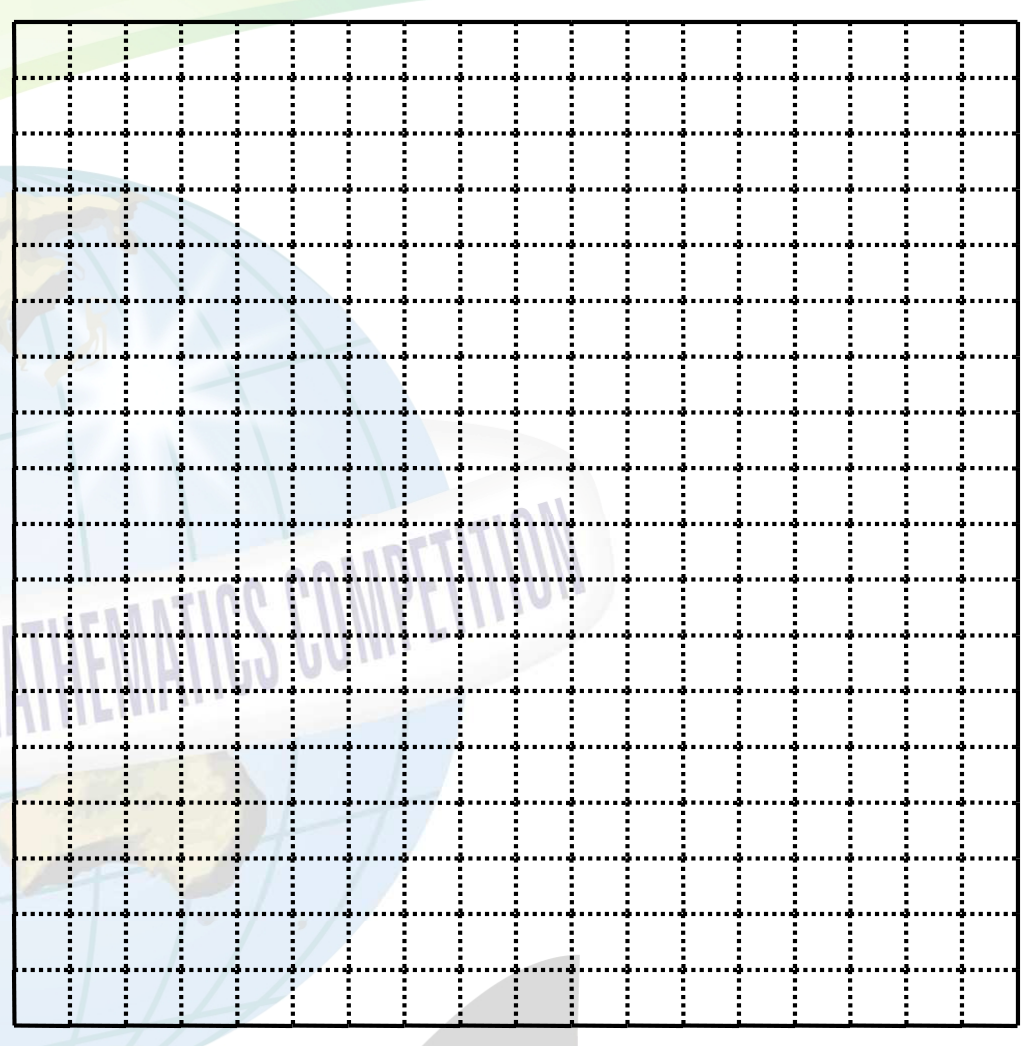
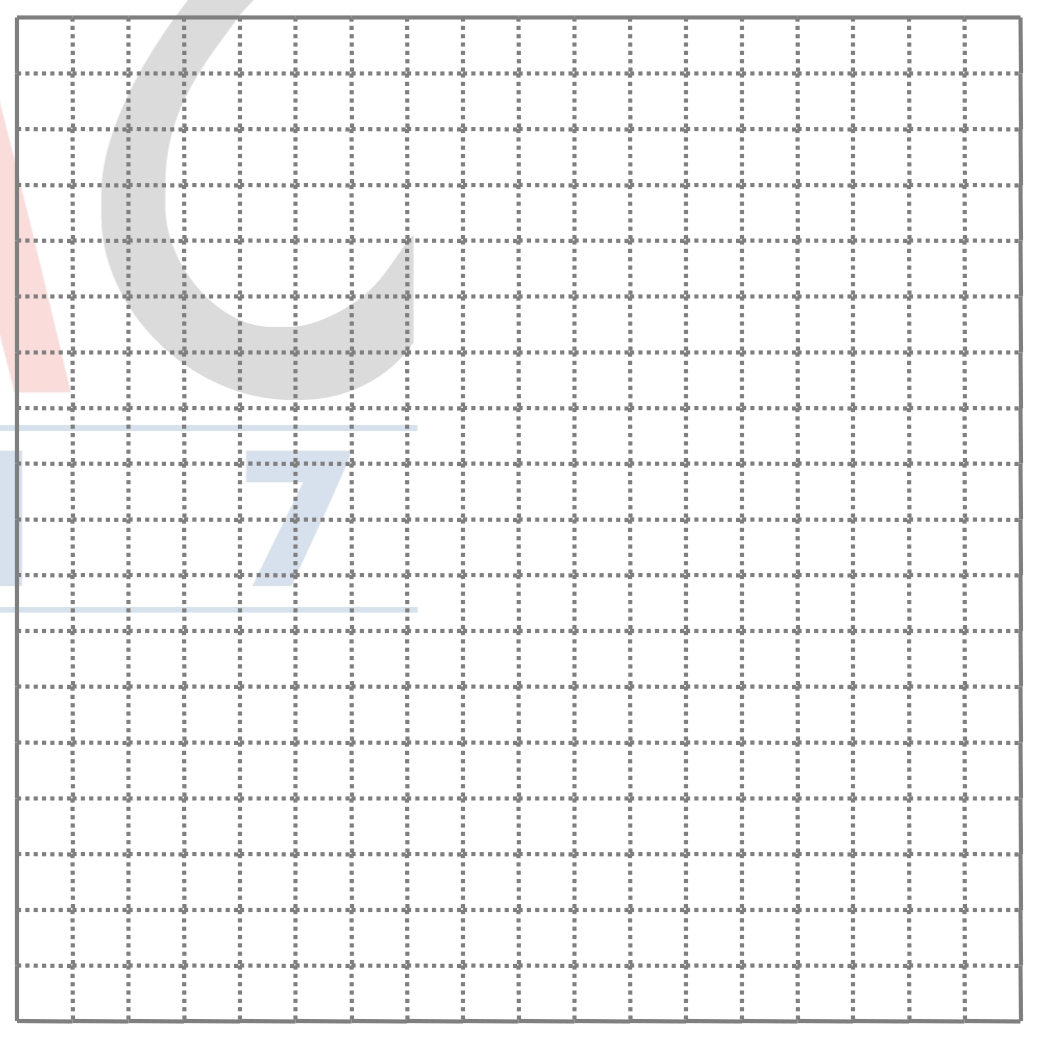
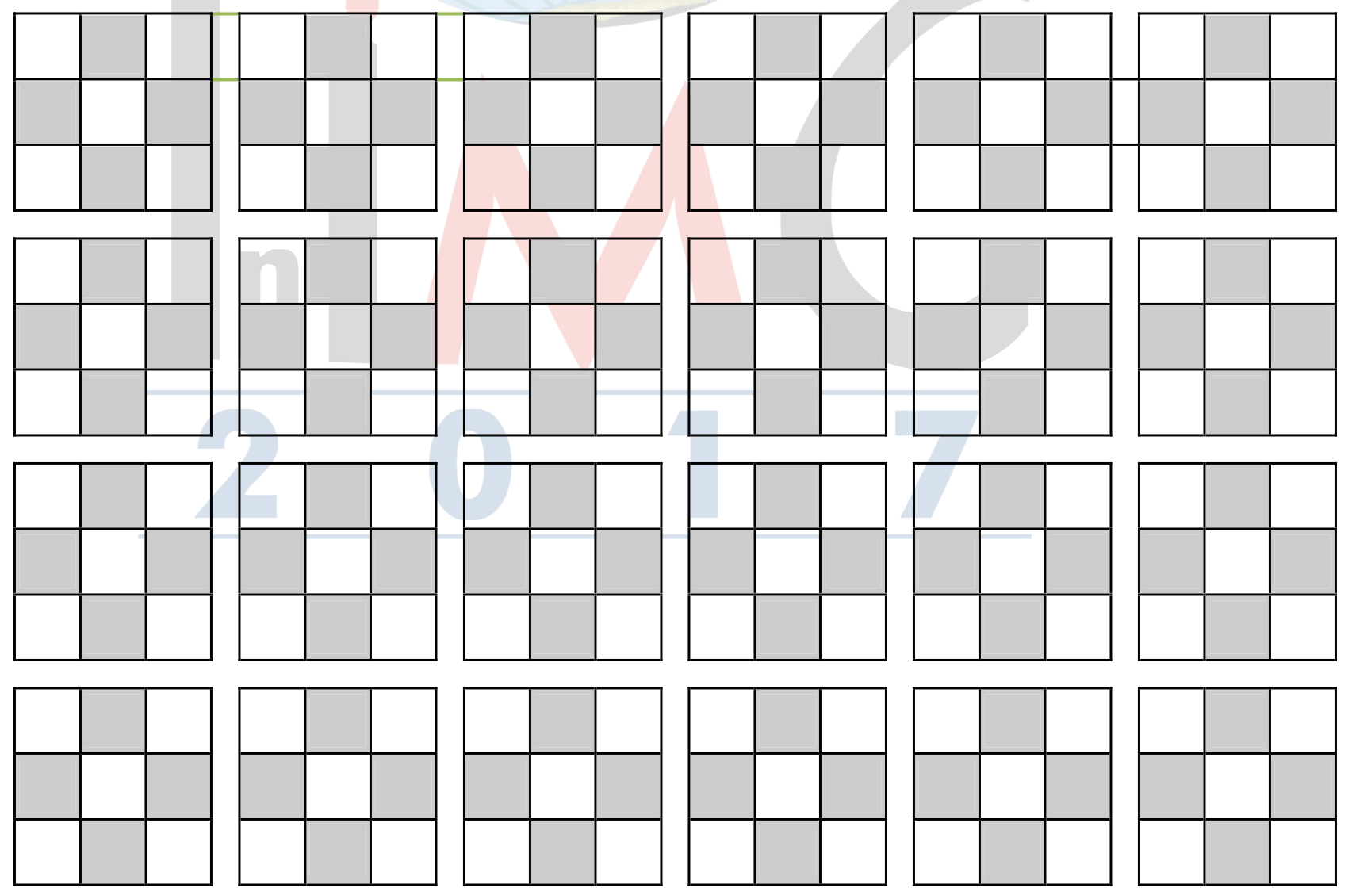
On the $18\times18$ grid, diagonals are drawn all in the same direction on some of the unit squares. If no two diagonals share a common point, what is the largest number of diagonals that can be drawn? Show a sample pattern where this can be achieved
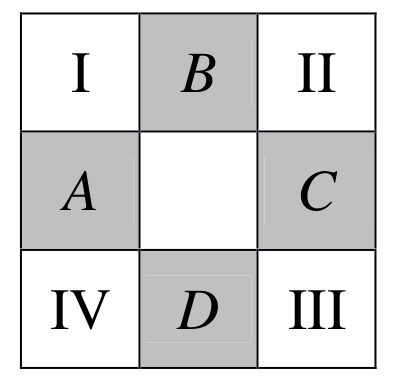
In the diagram, eight of the numbers from 1 to 10 are used to fill the squares $A,B,C,D,\mathrm{I},\mathrm{II},\mathrm{III},\mathrm{IV}$. The numbers in $\mathrm{I},\mathrm{II},\mathrm{III},\mathrm{IV}$ are the sums of their two neighbors. List down all the possible solutions. (Rotations and reflections are allowed).
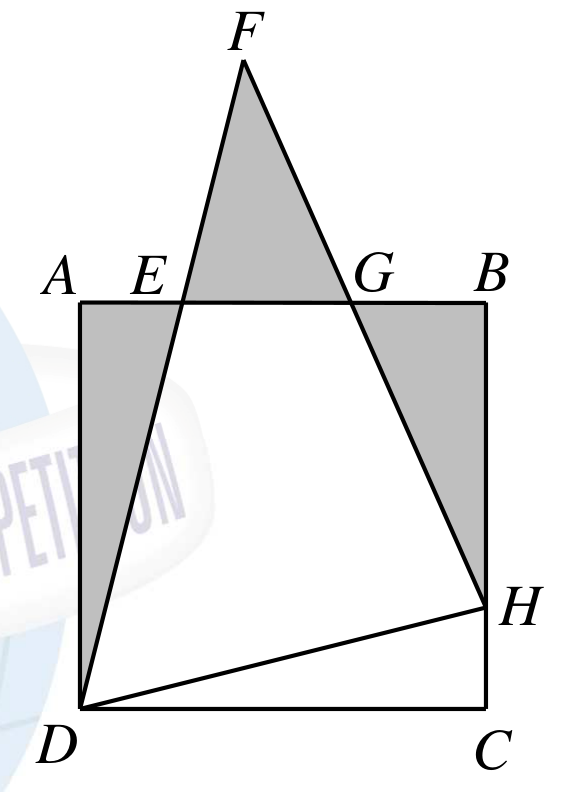
$H$ is a point on the side $BC$ of a square $ABCD$. $F$ is a point outside $ABCD$ such that the side $AB$ intersects $FD$ at $E$ and $FH$ at $G$, where $DE:EF=5:3$ and $GH:FG=5:4$. If the areas of triangles $ADE$, $EFG$ and $BGH$ are the same, find the ratio of the area of $DEGH$ to the area of $CDH$.
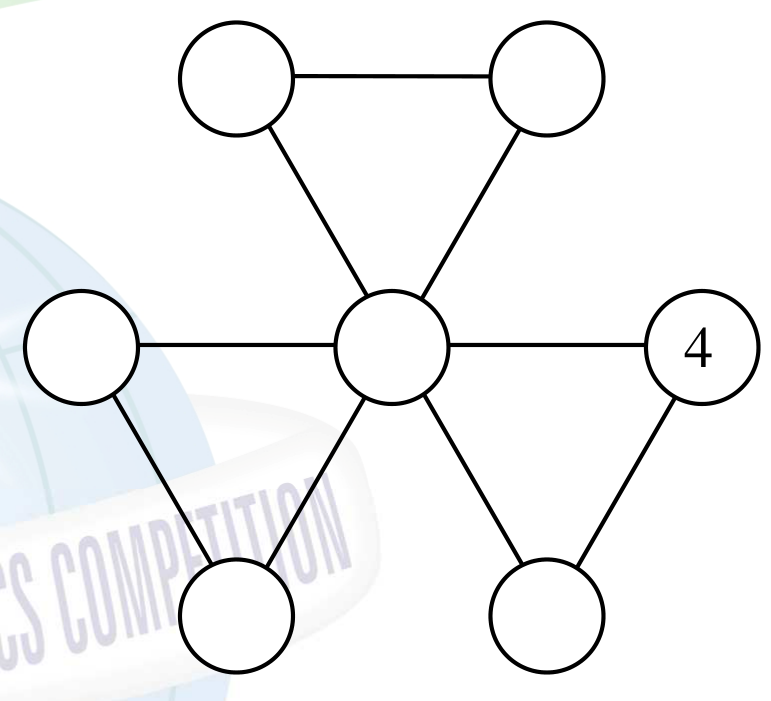
The integers from 1 to 7 are to be placed in the seven circles in the diagram. In each of the three triangles drawn, the sum of the three numbers is the same. One of the numbers, namely 4, is given. Find the number of different ways of placing the other six numbers?
When a positive integer is inputted into a machine, the machine returns a number which is half the original number if it is even, and 1 less than the original number if it is odd. Find the smallest positive integer such that if we input it into the machine, and continue to input the number that we receive in return continuously for 17 times, we obtain the result of 1. (17 operations performed in total.)
Find the largest four-digit number $\overline{abcd}$ such that at least one of its digits is 1 and $\overline{abcd}=2\times a\times b\times c\times d+2017$.