Choose nine different ones of 1, 2, 3, 4, 5, 6, 7, 8, 9 and 10. Use each of them exactly once to form three equations, using each of addition, subtraction, multiplication and division at most once. What is the smallest number that we can leave out?
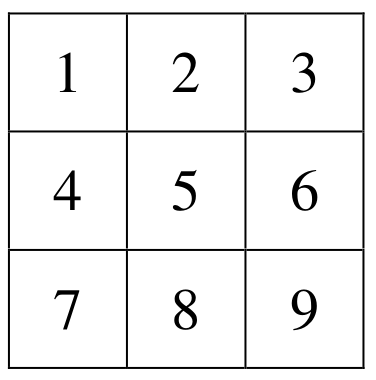
The squares of a 3 by 3 table are labelled $1,2,\ldots,9$ as shown. In how many ways can we shade five of the squares so that no row or column is completely shaded?
Submission guidance: Give a full solution, as required for this even-numbered problem by the examination cover.
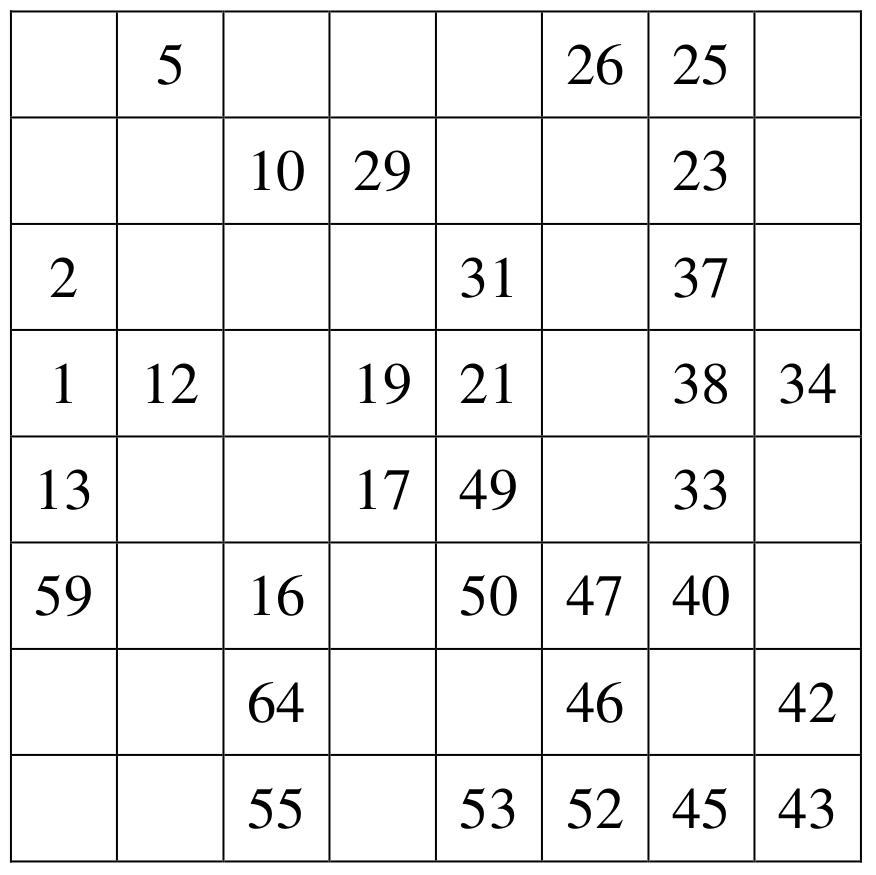
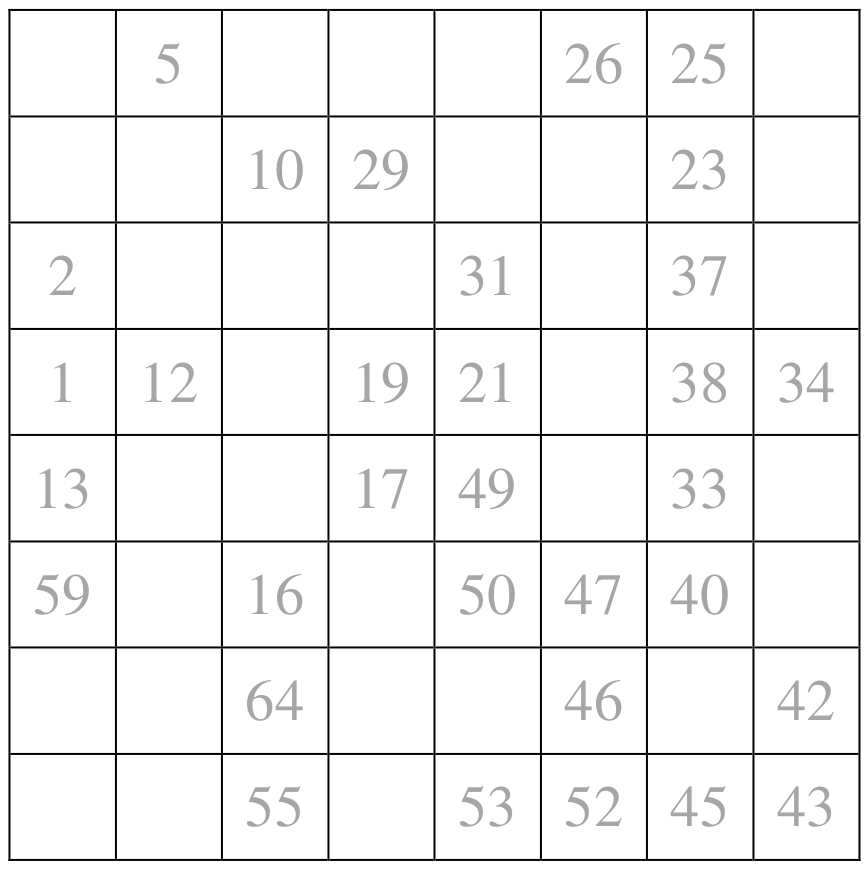
The diagram shows an 8 by 8 board. An ant visits each of the 64 squares once and only once. It crawls from one to another of two squares sharing at least one corner. The order in which the squares are visited is marked with numbers, starting from 1 and ending at 64. Some of the marked numbers have been erased. Restore these erased numbers.
Original answer template:
Submission guidance: Supply the completed grid only; the source does not require a written proof for this odd-numbered problem. It is represented as a manually graded grid response, with all-or-nothing credit.
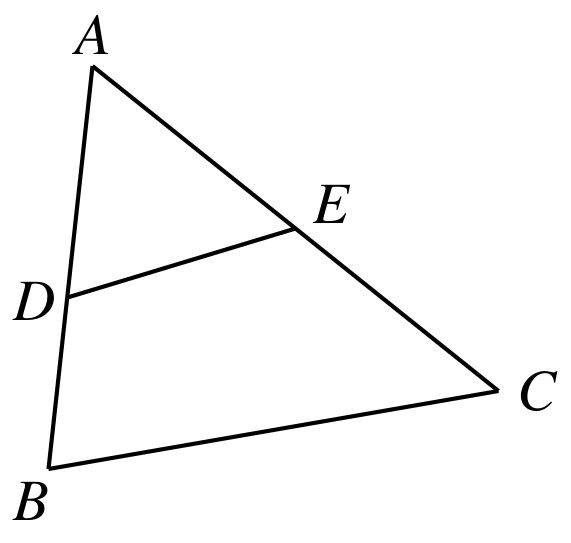
In triangle $ABC$, $AB=7$ cm and $AC=9$ cm. $D$ is a point on $AB$ such that $BD=3$ cm. $E$ is a point on $AC$ such that the area of the quadrilateral $BCED$ is $\frac57$ of the area of triangle $ABC$. Find the length, in cm, of $CE$.
Submission guidance: Give a full solution, as required by the examination cover.
How many positive integers less than 100 are there such that the product of all positive divisors of such a number is equal to the square of the number?
A hat is put on the head of each of 33 children. Each hat is red, white or blue. Each can see the hats of all other children except his or her own. Willem sees three times as many red hats as blue hats. Maxima sees twice as many white hats as blue hats. What is the colour of Maxima’s hat?
Submission guidance: Give a full solution, as required by the examination cover.
Mary has a three-digit number. The first two digits are the same but different from the third digit. Myra has a one-digit number. It is the same as the last digit of Mary’s number. How many different four-digit numbers can be the product of Mary’s and Myra’s numbers?
A 4 m by 4 m window on a wall is to be boarded up with eight identical 1 m by 2 m or 2 m by 1 m wooden planks. In how many different ways can this be done? Two ways resulting in the same final diagram are not considered different.
Submission guidance: Give a full solution, as required by the examination cover.
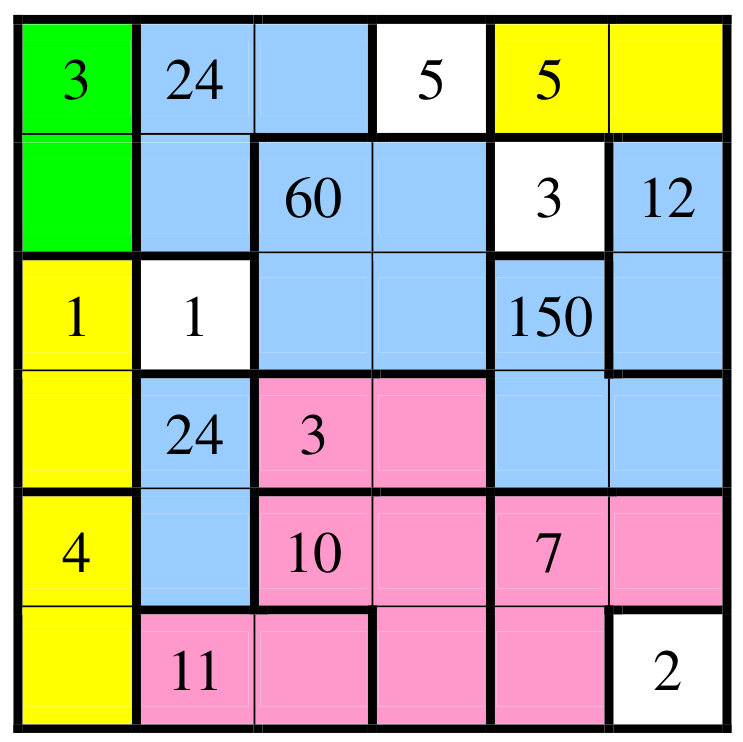
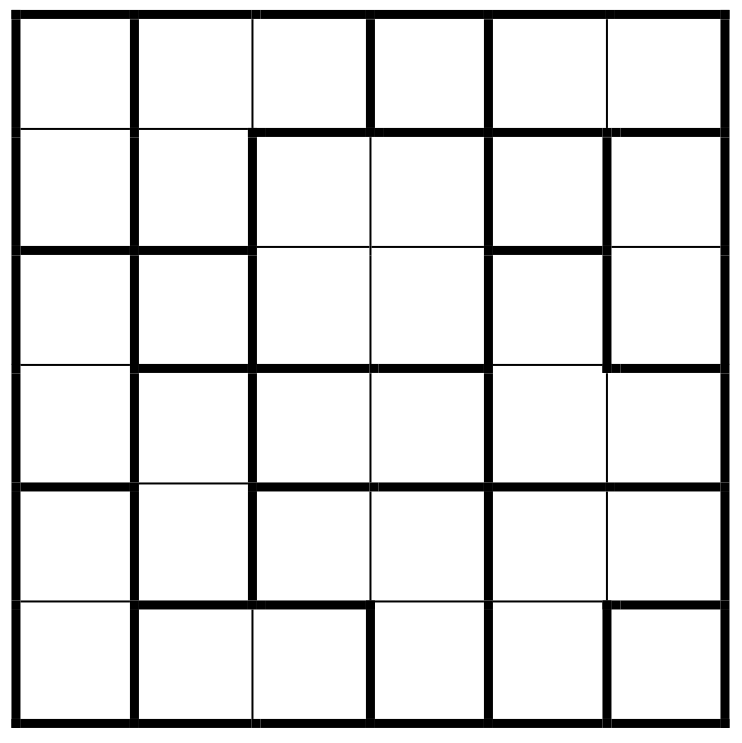
The 6 by 6 table in the diagram below is divided into 17 regions, each containing a number. Each of the 36 squares contains one of the numbers 1, 2, 3, 4, 5 and 6. All six numbers appear in every row and every column. The number in a white region is the number in the only square of the region. The number in a yellow region is the difference when the number in one of the squares is subtracted from the number in the other square. The number in a green region is the quotient when the number in one of the squares is divided by the number in the other square. The number in a red region is the sum of the numbers in all the squares of the region. The number in a blue region is the product of the numbers in all the squares of the region. Fill in the 36 numbers.
Original answer template:
Submission guidance: Supply the completed grid only; the source does not require a written proof for this odd-numbered problem. It is represented as a manually graded grid response, with all-or-nothing credit.
A polygon is said to be convex if each of its interior angles is less than $180^\circ$. What is the maximum number of sides of a convex polygon which can be dissected into squares and equilateral triangles of equal side lengths? Justify your answer.