Skip to content / Đến nội dung
ThichHocToan.com

1991 AMC 8

Question 1

What is the value of $$
\begin{aligned} &1{,}000{,}000{,}000{,}000 \\ &\quad {}- 777{,}777{,}777{,}777? \end{aligned}
$$
  1. $222{,}222{,}222{,}222$
  2. $222{,}222{,}222{,}223$
  3. $233{,}333{,}333{,}333$
  4. $322{,}222{,}222{,}223$
  5. $333{,}333{,}333{,}333$

Question 2

What is the value of $$
\frac{16+8}{4-2}?
$$
  1. $4$
  2. $8$
  3. $12$
  4. $16$
  5. $20$

Question 3

Two hundred thousand times two hundred thousand equals
  1. four hundred thousand
  2. four million
  3. forty thousand
  4. four hundred million
  5. forty billion

Question 4

If $991 + 993 + 995$ $+ 997 + 999$ $= 5000 - N,$ then $N = $
  1. $5$
  2. $10$
  3. $15$
  4. $20$
  5. $25$

Question 5

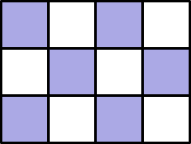
A “domino” is made up of two small squares:

Question illustration

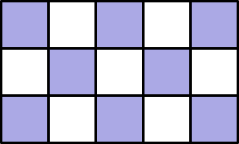
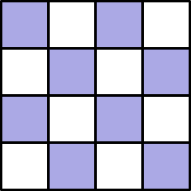
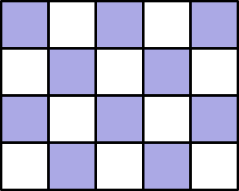
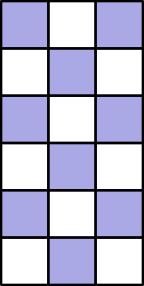
. Which of the “checkerboards” illustrated below CANNOT be covered exactly and completely by a whole number of non-overlapping dominoes?

**(A)** $3 \times 4$ Question illustration

**(B)** $3 \times 5$ Question illustration

**(C)** $4 \times 4$ Question illustration

**(D)** $4 \times 5$ Question illustration

**(E)** $6 \times 3$ Question illustration
  1. Choice A shown above
  2. Choice B shown above
  3. Choice C shown above
  4. Choice D shown above
  5. Choice E shown above

Question 6

Which number in the array below is both the largest in its column and the smallest in its row? (Columns go up and down, rows go right and left.)

$$
\begin{array}{ccccc} 10 & 6 & 4 & 3 & 2 \\ 11 & 7 & 14 & 10 & 8 \\ 8 & 3 & 4 & 5 & 9 \\ 13 & 4 & 15 & 12 & 1 \\ 8 & 2 & 5 & 9 & 3 \end{array}
$$
  1. $1$
  2. $6$
  3. $7$
  4. $12$
  5. $15$

Question 7

The value of $$
\tiny\frac{(487{,}000)(12{,}027{,}300) + (9{,}621{,}001)(487{,}000)}{(19{,}367)(0.05)}
$$ is closest to
  1. $10{,}000{,}000$
  2. $100{,}000{,}000$
  3. $1{,}000{,}000{,}000$
  4. $10{,}000{,}000{,}000$
  5. $100{,}000{,}000{,}000$

Question 8

What is the largest quotient that can be formed using two numbers chosen from the set $\{-24, -3, -2, 1, 2, 8\}?$
  1. $-24$
  2. $-3$
  3. $8$
  4. $12$
  5. $24$

Question 9

How many whole numbers from $1$ through $46$ are divisible by either $3$ or $5$ or both?
  1. $18$
  2. $21$
  3. $24$
  4. $25$
  5. $27$

Question 10

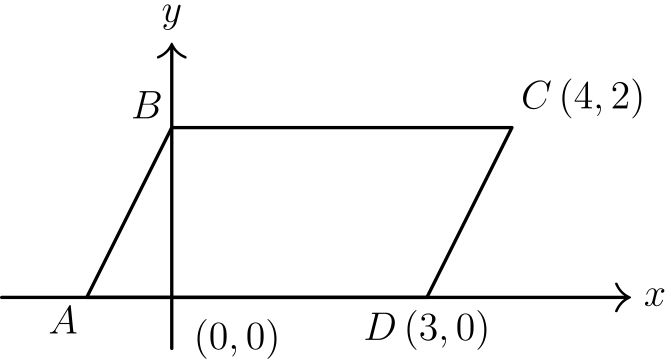
The area in square units of the region enclosed by parallelogram $ABCD$ is

Question illustration
  1. $6$
  2. $8$
  3. $12$
  4. $15$
  5. $18$

Question 11

There are several sets of three different numbers whose sum is $15$ which can be chosen from $\{1, 2, 3, 4, 5, 6, 7, 8, 9\}.$ How many of these sets contain a $5?$
  1. $3$
  2. $4$
  3. $5$
  4. $6$
  5. $7$

Question 12

If $$
\begin{aligned} &\frac{2+3+4}{3} \\ &= \frac{1990+1991+1992}{N}, \end{aligned}
$$ then $N = $
  1. $3$
  2. $6$
  3. $1990$
  4. $1991$
  5. $1992$

Question 13

How many zeros are at the end of the product $$
\begin{aligned} &25 \times 25 \times 25 \times 25 \\ &\quad {}\times 25 \times 25 \times 25 \\ &\quad {}\times 8 \times 8 \times 8? \end{aligned}
$$
  1. $3$
  2. $6$
  3. $9$
  4. $10$
  5. $12$

Question 14

Several students are competing in a series of three races. A student earns $5$ points for winning a race, $3$ points for finishing second, and $1$ point for finishing third. There are no ties. What is the smallest number of points that a student must earn in the three races to be guaranteed of earning more points than any other student?
  1. $9$
  2. $10$
  3. $11$
  4. $13$
  5. $15$

Question 15

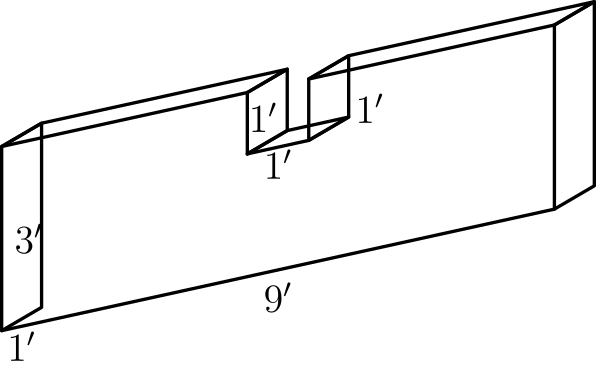
All six sides of a rectangular solid were rectangles. A one-foot cube was cut out of the rectangular solid as shown. The total number of square feet in the surface of the new solid is how many more or less than that of the original solid?

Question illustration
  1. $2$ less
  2. $1$ less
  3. the same
  4. $1$ more
  5. $2$ more

Question 16

The $16$ squares on a piece of paper are numbered as shown in the diagram. While lying on a table, the paper is folded in half four times in the following sequence:

$(1)$ fold the top half over the bottom half;

$(2)$ fold the bottom half over the top half;

$(3)$ fold the right half over the left half;

$(4)$ fold the left half over the right half.

Which numbered square is on top after step $4?$

$$
\begin{array}{|c|c|c|c|} \hline 1 & 2 & 3 & 4 \\ \hline 5 & 6 & 7 & 8 \\ \hline 9 & 10 & 11 & 12 \\ \hline 13 & 14 & 15 & 16 \\ \hline \end{array}
$$
  1. $1$
  2. $9$
  3. $10$
  4. $14$
  5. $16$

Question 17

An auditorium with $20$ rows of seats has $10$ seats in the first row. Each successive row has one more seat than the previous row. If students taking an exam are permitted to sit in any row, but not next to another student in that row, then the maximum number of students that can be seated for an exam is
  1. $150$
  2. $180$
  3. $200$
  4. $400$
  5. $460$

Question 18

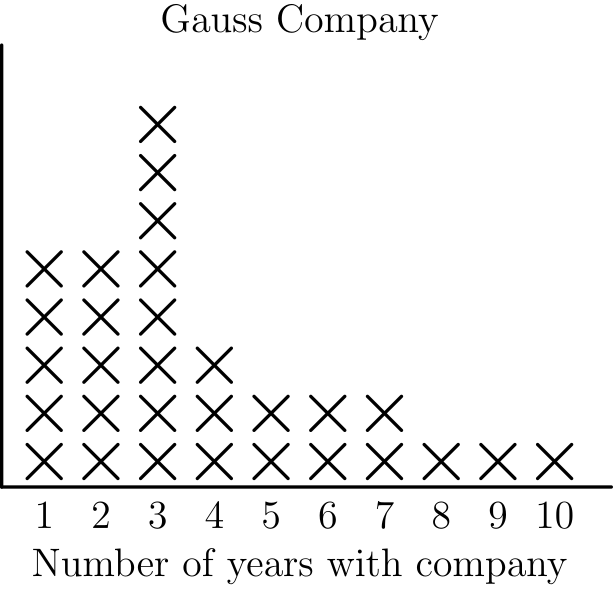
The vertical axis indicates the number of employees, but the scale was accidentally omitted from this graph. What percent of the employees at the Gauss Company have worked there for $5$ years or more?

Question illustration
  1. $9\%$
  2. $23\dfrac13\%$
  3. $30\%$
  4. $42\dfrac67\%$
  5. $50\%$

Question 19

The average (arithmetic mean) of $10$ different positive whole numbers is $10.$ The largest possible value of any of these numbers is
  1. $10$
  2. $50$
  3. $55$
  4. $90$
  5. $91$

Question 20

In the addition problem shown, each digit has been replaced by a letter. If different letters represent different digits, then $C = $

$$
\begin{array}{cccc} & A & B & C \\ & & A & B \\ + & & & A \\ \hline & 3 & 0 & 0 \end{array}
$$
  1. $1$
  2. $3$
  3. $5$
  4. $7$
  5. $9$