Todd and Steven start at $A$ on a $950$ m track $AB$, running back and forth for $90$ minutes. Their speeds are $40$ and $150$ m/min. Count meetings when they run towards one another. At which such meeting are they closest to $B$?
Group $A$: $\frac16,\frac1{12},\frac1{20},\frac1{30},\frac1{42}$. Group $B$: $\frac18,\frac1{24},\frac1{48},\frac1{80}$. Group $C$: $2.82,2.76,2.18,2.24$. Choose one number from each and multiply. Find the sum of all $80$ products.
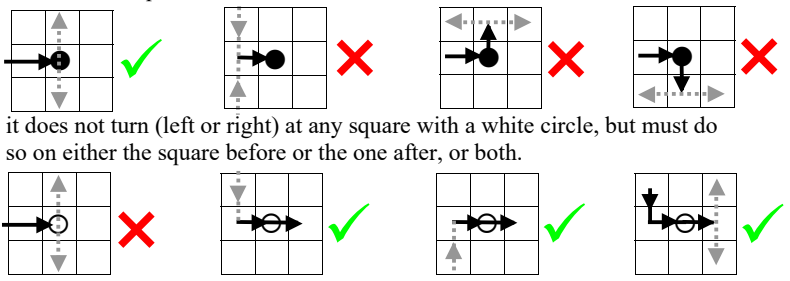
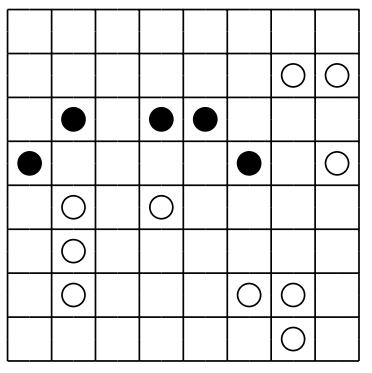
On the $8\times8$ board, draw a single closed non-self-intersecting path through every marked circle, moving between cells sharing a side. At a black circle turn, but go straight in both adjacent path cells. At a white circle go straight, but turn in at least one adjacent path cell.
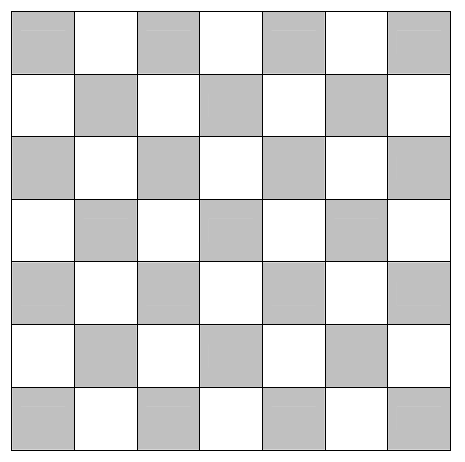
A $7\times7$ checkerboard has black corner squares. How many ways can six checkers occupy squares of the same colour, with no two in the same row or column?
What is the maximum number of different positive integers not exceeding $2008$ that can be selected so the sum of any two is not divisible by their difference?
Cut a $7\times7\times7$ cube into cubes of sizes $4\times4\times4$, $3\times3\times3$, $2\times2\times2$, or $1\times1\times1$. Find the minimum number of smaller cubes.
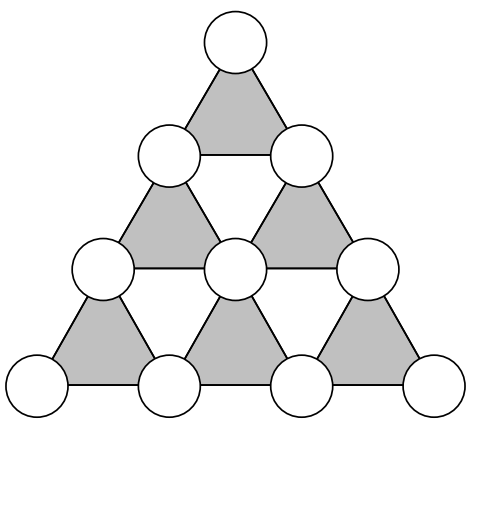
Place digits $0$ through $9$ once each in the ten circles shown so the sums at the three vertices of all six upward-pointing shaded triangles are equal.
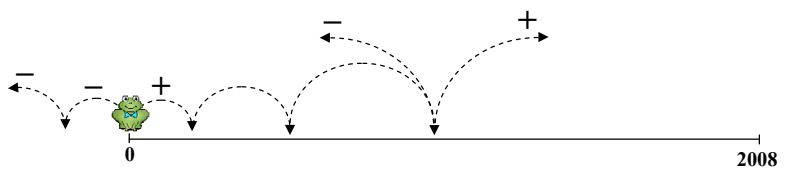
A frog starts at $0$ on a line and must reach $2008$ in exactly $19$ jumps of lengths $1^2,2^2,\ldots,19^2$ in order, choosing positive or negative direction each time. What is the earliest possible last negative jump?