Skip to content / Đến nội dung
ThichHocToan.com

1989 AMC 8

Question 1

What is the value of

$$
\begin{aligned} &(1 + 11 + 21 + 31 + 41) \\ &\quad {}+ (9 + 19 + 29 + 39 + 49)? \end{aligned}
$$
  1. $150$
  2. $199$
  3. $200$
  4. $249$
  5. $250$

Question 2

What is the value of

$$
\frac{2}{10} + \frac{4}{100} + \frac{6}{1000}?
$$
  1. $0.012$
  2. $0.0246$
  3. $0.12$
  4. $0.246$
  5. $246$

Question 3

Which of the following numbers is the largest?
  1. $0.99$
  2. $0.9099$
  3. $0.9$
  4. $0.909$
  5. $0.9009$

Question 4

Estimate to determine which of the following is closest to

$$
\frac{401}{0.205}.
$$
  1. $0.2$
  2. $2$
  3. $20$
  4. $200$
  5. $2000$

Question 5

What is the value of

$$
-15 + 9 \times (6 \div 3)?
$$
  1. $-48$
  2. $-12$
  3. $-3$
  4. $3$
  5. $12$

Question 6

If the markings on the number line shown are equally spaced, what is the number $y?$

Question illustration
  1. $3$
  2. $10$
  3. $12$
  4. $15$
  5. $16$

Question 7

The value of $20$ quarters and $10$ dimes equals the value of $10$ quarters and $n$ dimes. What is $n?$
  1. $10$
  2. $20$
  3. $30$
  4. $35$
  5. $45$

Question 8

What is the value of

$$
(2 \times 3 \times 4)\left(\frac{1}{2} + \frac{1}{3} + \frac{1}{4}\right)?
$$
  1. $1$
  2. $3$
  3. $9$
  4. $24$
  5. $26$

Question 9

There are $2$ boys for every $3$ girls in Ms. Johnson’s math class. If there are $30$ students in her class, what percent of them are boys?
  1. $12\%$
  2. $20\%$
  3. $40\%$
  4. $60\%$
  5. $66\dfrac{2}{3}\%$

Question 10

How many degrees are in the smaller angle between the hour hand and the minute hand of a clock that reads seven o’clock?
  1. $50^\circ$
  2. $120^\circ$
  3. $135^\circ$
  4. $150^\circ$
  5. $165^\circ$

Question 11

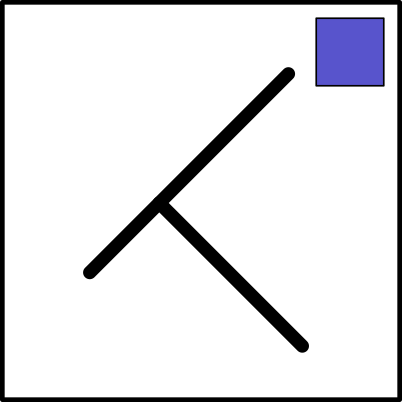
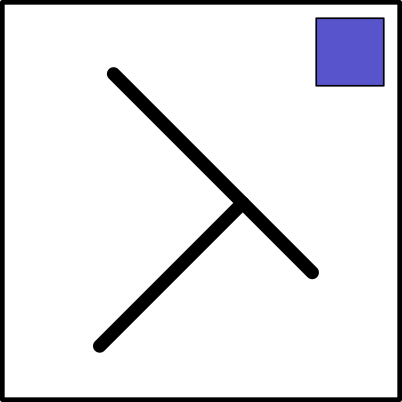
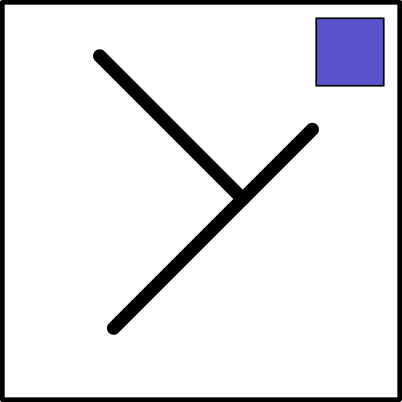
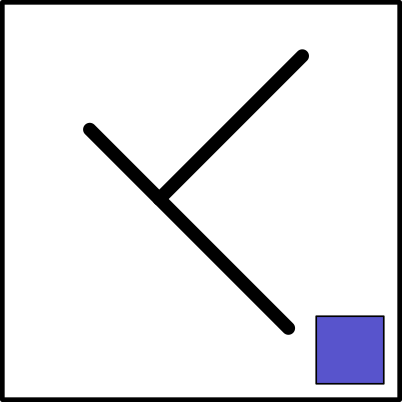
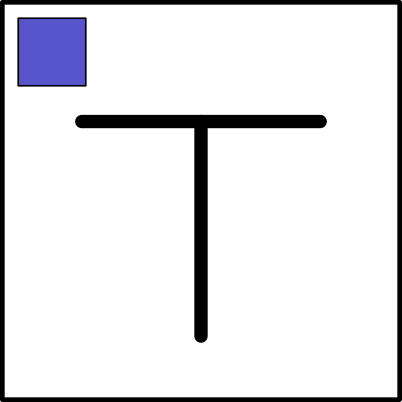
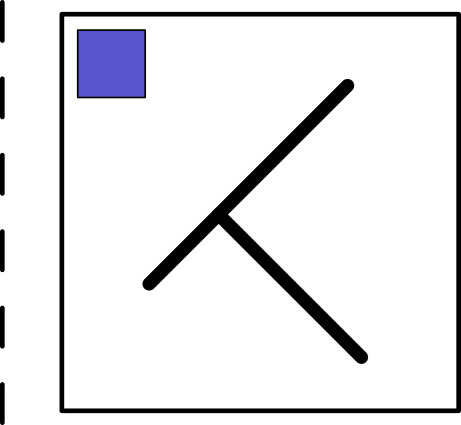
Which of the five “T-like shapes” would be symmetric to the one shown with respect to the dashed line?

Question illustration

**(A)** Question illustration

**(B)** Question illustration

**(C)** Question illustration

**(D)** Question illustration

**(E)** Question illustration
  1. Choice A shown above
  2. Choice B shown above
  3. Choice C shown above
  4. Choice D shown above
  5. Choice E shown above

Question 12

What is the value of

$$
\frac{1 - \frac{1}{3}}{1 - \frac{1}{2}}?
$$
  1. $\dfrac{1}{3}$
  2. $\dfrac{2}{3}$
  3. $\dfrac{3}{4}$
  4. $\dfrac{3}{2}$
  5. $\dfrac{4}{3}$

Question 13

Which of the following is equal to

$$
\frac{9}{7 \times 53}?
$$
  1. $\dfrac{0.9}{0.7 \times 53}$
  2. $\dfrac{0.9}{0.7 \times 0.53}$
  3. $\dfrac{0.9}{0.7 \times 5.3}$
  4. $\dfrac{0.9}{7 \times 0.53}$
  5. $\dfrac{0.09}{0.07 \times 0.53}$

Question 14

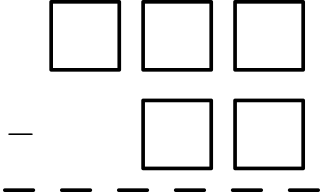
When placing each of the digits $2,$ $4,$ $5,$ $6,$ $9$ in exactly one of the boxes of this subtraction problem, what is the smallest difference that is possible?

Question illustration
  1. $58$
  2. $123$
  3. $149$
  4. $171$
  5. $176$

Question 15

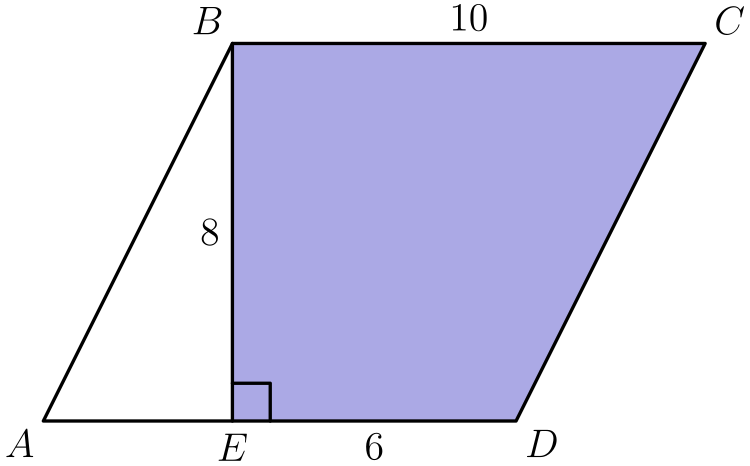
In parallelogram $ABCD$ shown, what is the area of the shaded region $BEDC?$

Question illustration
  1. $24$
  2. $48$
  3. $60$
  4. $64$
  5. $80$

Question 16

In how many ways can $47$ be written as the sum of two primes?
  1. $0$
  2. $1$
  3. $2$
  4. $3$
  5. more than $3$

Question 17

The number $N$ is between $9$ and $17.$ Which of the following could be the average of $6,$ $10,$ and $N?$
  1. $8$
  2. $10$
  3. $12$
  4. $14$
  5. $16$

Question 18

A calculator has a reciprocal key that replaces the number currently displayed with its reciprocal. For example, if the display shows $4$ and the key is pressed, the display becomes $0.25.$ If $32$ is currently displayed, what is the fewest number of times the reciprocal key must be pressed so that the display again reads $32?$
  1. $1$
  2. $2$
  3. $3$
  4. $4$
  5. $5$

Question 19

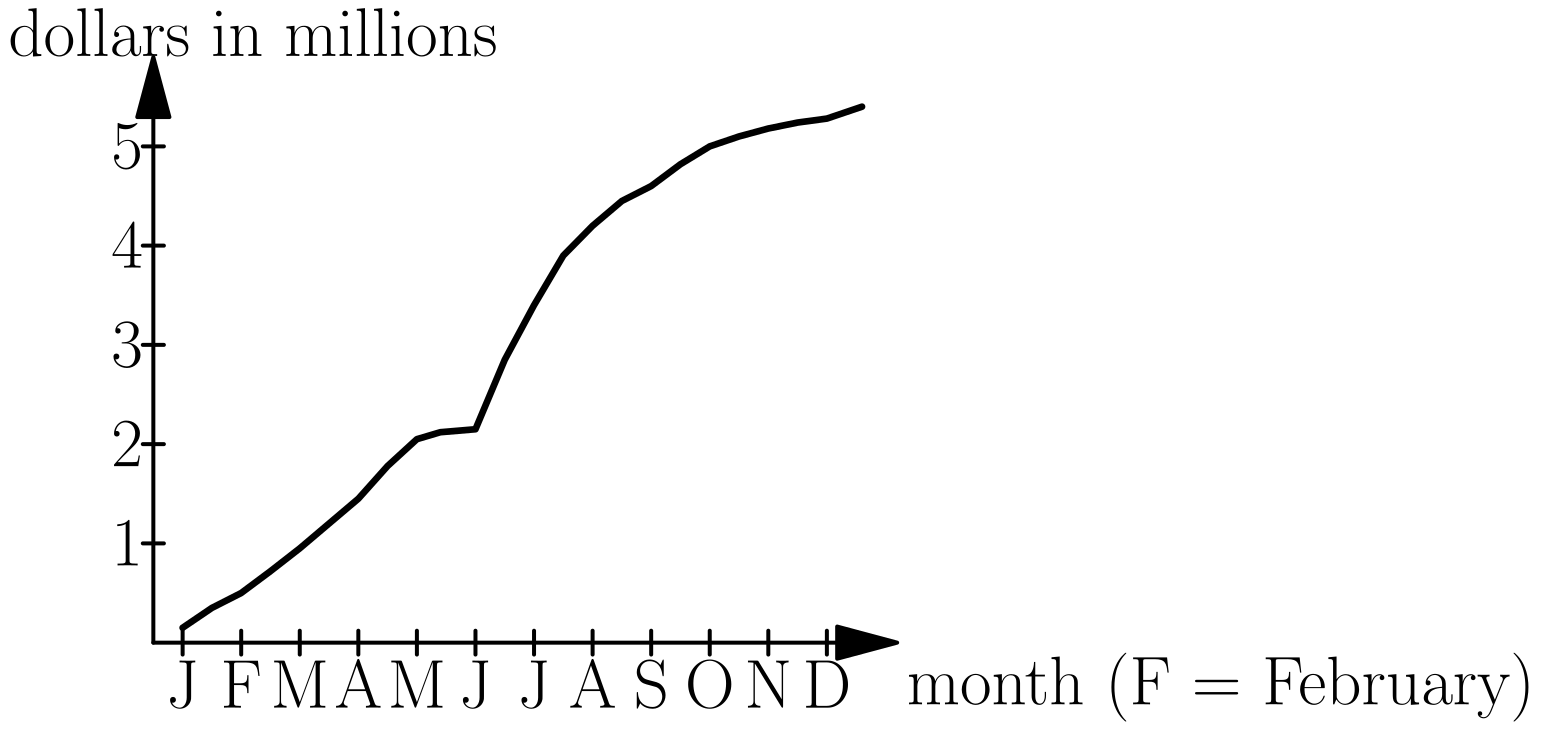
The graph below shows the total accumulated dollars (in millions) spent by the Surf City government during $1988.$ For example, about $0.5$ million had been spent by the beginning of February and approximately $2$ million by the end of April. Approximately how many millions of dollars were spent during the summer months of June, July, and August?

Question illustration
  1. $1.5$
  2. $2.5$
  3. $3.5$
  4. $4.5$
  5. $5.5$

Question 20

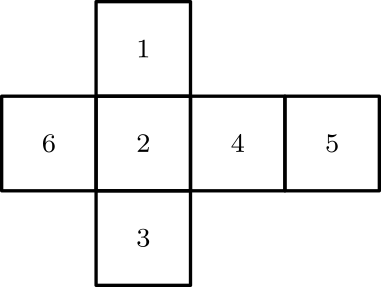
The figure shown may be folded along the lines to form a number cube. Three faces come together at each corner of the cube. What is the largest sum of three numbers whose faces come together at a corner?

Question illustration
  1. $11$
  2. $12$
  3. $13$
  4. $14$
  5. $15$