Question 52
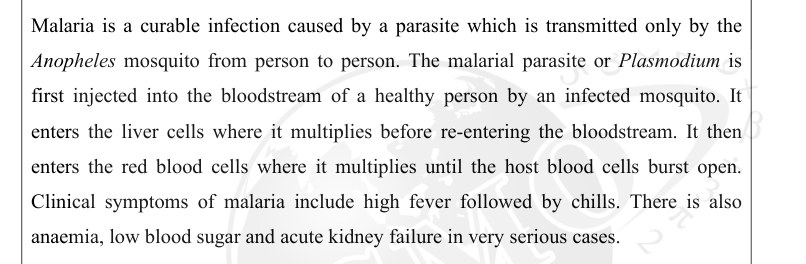
Malaria is a curable infection caused by a parasite which is transmitted only by the
Anopheles mosquito from person to person. The malarial parasite or Plasmodium is
first injected into the bloodstream of a healthy person by an infected mosquito. It
enters the liver cells where it multiplies before re-entering the bloodstream. It then
enters the red blood cells where it multiplies until the host blood cells burst open.
Clinical symptoms of malaria include high fever followed by chills. There is also
anaemia, low blood sugar and acute kidney failure in very serious cases.
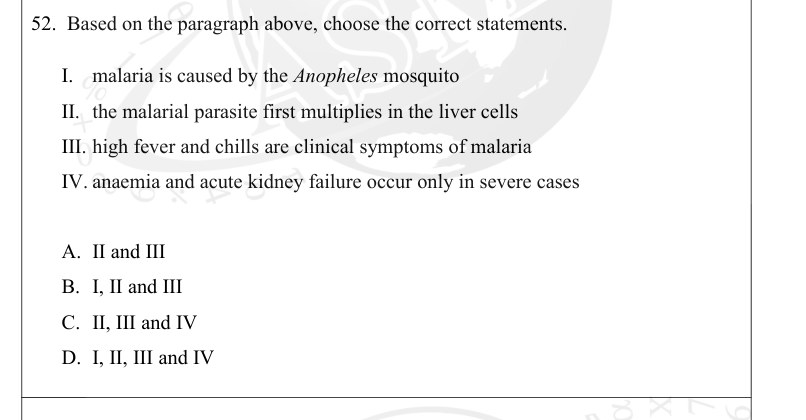
Based on the paragraph above, choose the correct statements. I. malaria is caused by the Anopheles mosquito II. the malarial parasite first multiplies in the liver cells III. high fever and chills are clinical symptoms of malaria IV. anaemia and acute kidney failure occur only in severe cases
Anopheles mosquito from person to person. The malarial parasite or Plasmodium is
first injected into the bloodstream of a healthy person by an infected mosquito. It
enters the liver cells where it multiplies before re-entering the bloodstream. It then
enters the red blood cells where it multiplies until the host blood cells burst open.
Clinical symptoms of malaria include high fever followed by chills. There is also
anaemia, low blood sugar and acute kidney failure in very serious cases.
Based on the paragraph above, choose the correct statements. I. malaria is caused by the Anopheles mosquito II. the malarial parasite first multiplies in the liver cells III. high fever and chills are clinical symptoms of malaria IV. anaemia and acute kidney failure occur only in severe cases