Question 15
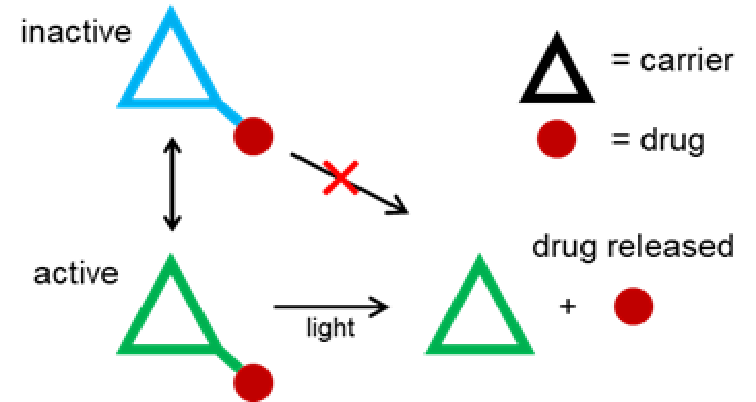
Smart materials respond to stimuli such as heat or light by changing their properties. For example, new drug carriers are being developed by researchers worldwide for the controlled release of drugs. To illustrate, an active drug (red circle) may be attached to a smart carrier (green triangle). Once the carrier reaches the target organ, light is applied to the organ to locally release the drug. This is especially important for diseases like cancer, where terrible side effects can occur if the drug affects the other parts of the body. In some cases, the carrier is in equilibrium between an active and inactive state (blue triangle), but only the former is sensitive to light while the latter is not: In a system consisting of a large number of carriers, one of these two is more stable than the other. In a trial drug being developed for cancer, the active state is less stable by 1.15 kJ/mol. Given a million pieces of drug carrier, what is the ratio of the number of carriers in the inactive state relative to the inactive state at 25 C?
Editorial correction: the second “inactive state” in the requested ratio is read as “active state”. Interpret the stated stability difference as a molar free-energy difference at the stated temperature.
Editorial correction: the second “inactive state” in the requested ratio is read as “active state”. Interpret the stated stability difference as a molar free-energy difference at the stated temperature.