Question 29
Answer-format rule: round a non-integer answer to the nearest integer. If the calculated answer has more than five digits, give its last five digits.
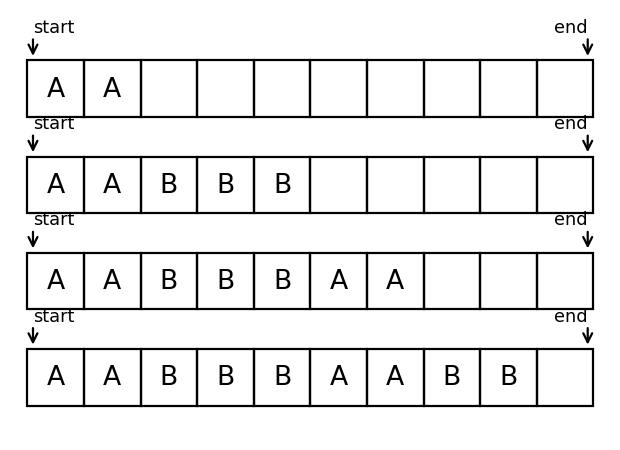
Two players alternately place 1 to 5 marbles in consecutive empty squares, starting from the left. The player who places the last marble loses. In the ten-square example, A starts and places 2, B places 3, A places 2, B places 2, and A must fill the last square and loses. The four intermediate rows are shown. With a row of 50 squares, how many marbles should the first player place on the first turn to guarantee a win?
Two players alternately place 1 to 5 marbles in consecutive empty squares, starting from the left. The player who places the last marble loses. In the ten-square example, A starts and places 2, B places 3, A places 2, B places 2, and A must fill the last square and loses. The four intermediate rows are shown. With a row of 50 squares, how many marbles should the first player place on the first turn to guarantee a win?